Skip to content
Temporary Frames Arts Society
  • Projects / Archive
  • About
  • Support Material / TEAM

Temporary Frames Arts Society provides physical and administrative containers for emergent ideas. We cross-breed contemplative performance, relational aesthetics, and psychoacoustic environments.

Featured projects & practices

  • TF-002Imaginal Airlines2025–An immersive experience staged as a collective flight.immersive experience
  • TF-001The Gong Library2023–A collection of gongs and resonating instruments alongside an 18-voice just intonation soundscape.installation / community practice
  • PRACTICEDeep ListeningongoingSound, sustained attention, sensory autonomy, acoustic space, and collective listening.sound / listening / spatial practice

Programs & Partnerships

  • SPACEHypha Artist AssociationongoingTemporary Frames’ studio and offices are based at Hypha Arts, where the two organizations also co-produce public events.workspace / partnership
  • ONGOINGPresentations / Co-ProductionsongoingOne-off readings, launches, performances, concerts, and collaborative events hosted or co-produced by Temporary Frames.programming
  • PRACTICEClown Working Group2024–presentSeasonal clown pedagogy research, shared practice, and public process showings.clown pedagogy / practice-research
  • TF-007Temporary Frames Artist Residency2018–presentA relational residency offering artists self-directed time and space without required public outcomes.residency / program

Archive

  • TF-000Wheel of Time Gallery2018–2021An experimental art space and Temporary Autonomous Zone that became a foundational incubator for Temporary Frames.gallery / concluded
  • ARC-001Interactive Community ArtsarchivedParticipatory projects developed through shared making, play, symbolism, material exploration, shadow, and sound.collection
  • ARC-003CLOUD Studio2019–concludedAn independent movement studio and grassroots incubator for physical theatre, somatic research, and clown practice.studio / research

All Projects / Archive

  • INDEXAll Projects / Archive2017–Browse active work, practice areas, partnerships, archived projects, and earlier community art records.complete index

Projects / Archive

A single, complete index of Temporary Frames projects, practice areas, and archived work.

All projects & archive

  • TF-002Imaginal Airlines2025–An immersive experience staged as a collective flight.immersive experience
  • TF-001The Gong Library2023–A collection of gongs and resonating instruments alongside an 18-voice just intonation soundscape.installation / community practice
  • TF-006International Drone DayepisodicA durational gathering centred on sustained sound, acoustic attention, and collective listening.music / listening
  • TF-007Temporary Frames Artist Residency2018–presentA relational residency offering artists self-directed time and space without required public outcomes.residency / program
  • PRACTICEDeep ListeningongoingSound, sustained attention, sensory autonomy, acoustic space, and collective listening.sound / listening / spatial practice
  • PRACTICEClown Working Group2024–presentSeasonal clown pedagogy research, shared practice, and public process showings.clown pedagogy / practice-research
  • SPACEHypha ArtsongoingThe home of Temporary Frames’ studio and offices, and a partner in shared cultural programming.workspace / partnership
  • PROGRAMPresentations & Co-ProductionsongoingReadings, launches, performances, concerts, and collaborative events hosted or co-produced by Temporary Frames.programming
  • TF-000Wheel of Time Gallery2018–2021An experimental art space and Temporary Autonomous Zone that became a foundational incubator for Temporary Frames.gallery / concluded
  • ARC-001Interactive Community ArtsarchivedParticipatory projects developed through shared making, play, symbolism, material exploration, shadow, and sound.collection
  • ARC-002Quiet Night Series2017–2020A multidisciplinary performance series centred on accessibility, acoustic intimacy, and deep listening.series
  • ARC-003CLOUD Studio2019–concludedAn independent movement studio and grassroots incubator for physical theatre, somatic research, and clown practice.studio / research
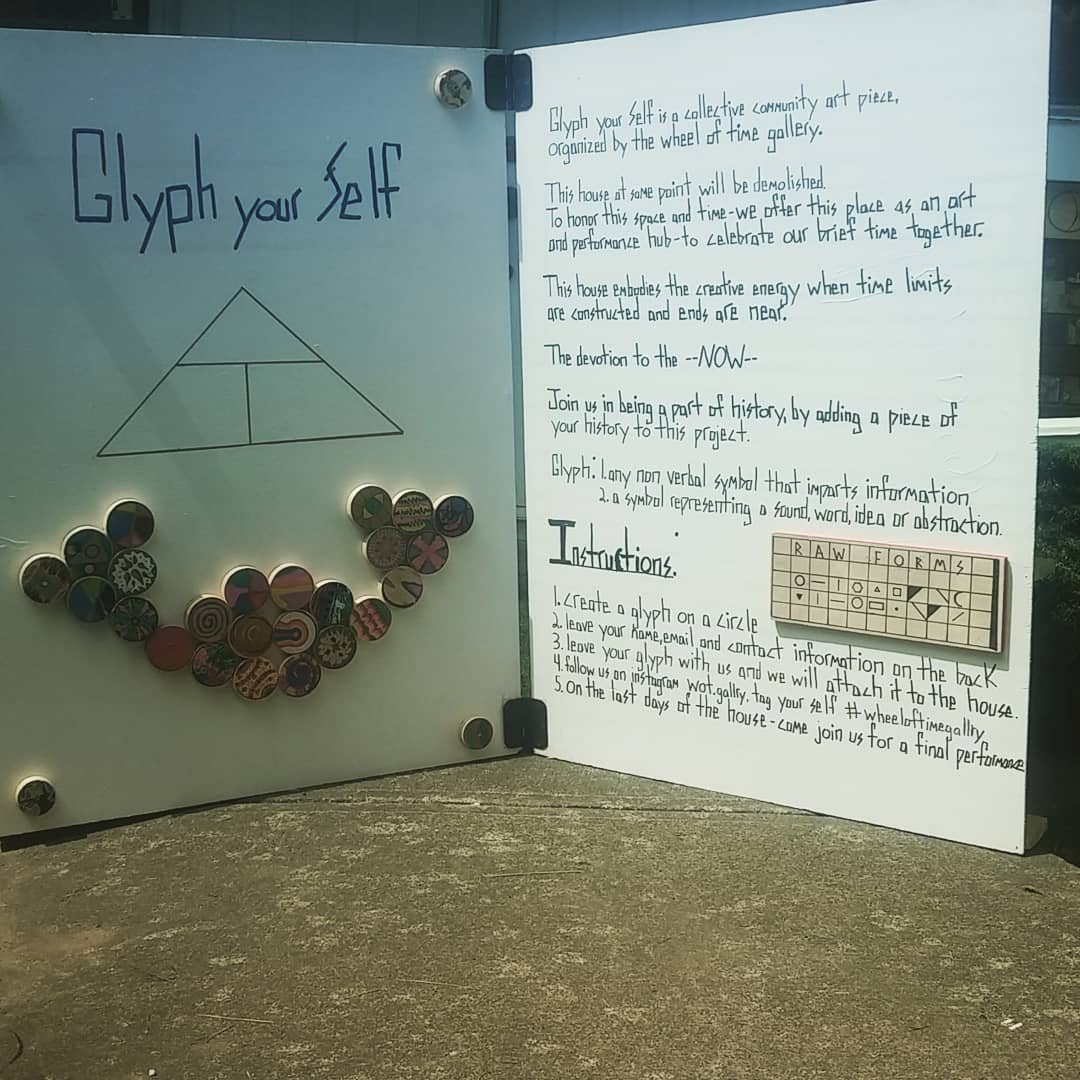
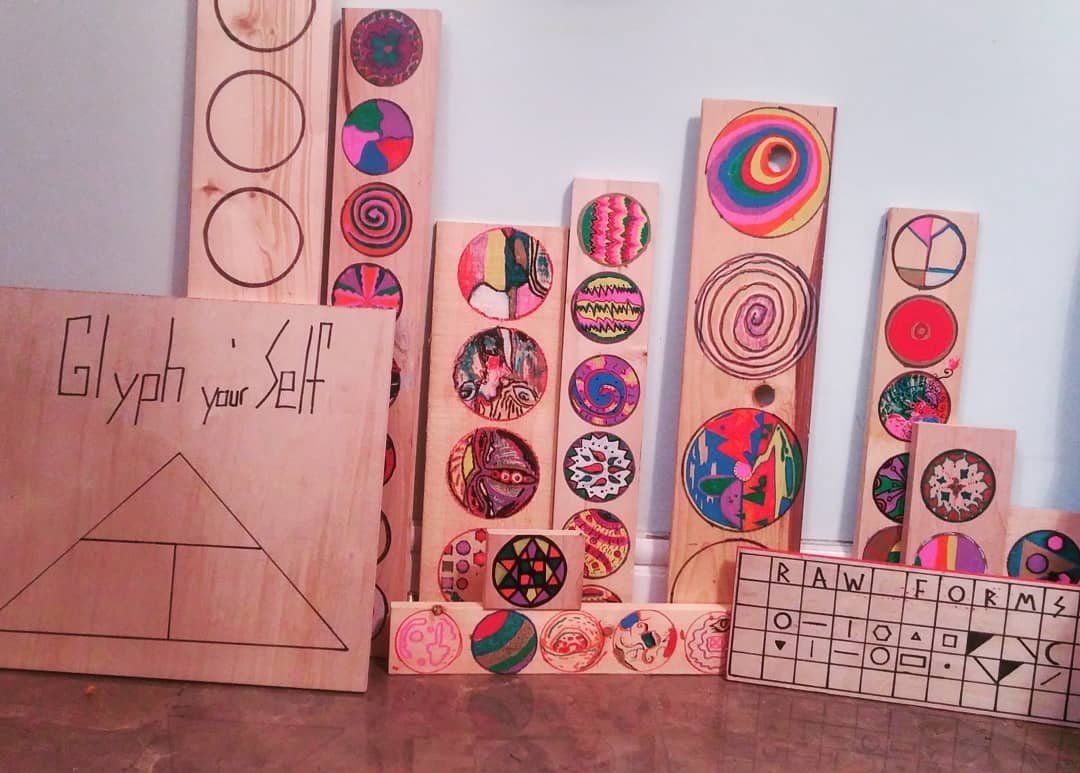
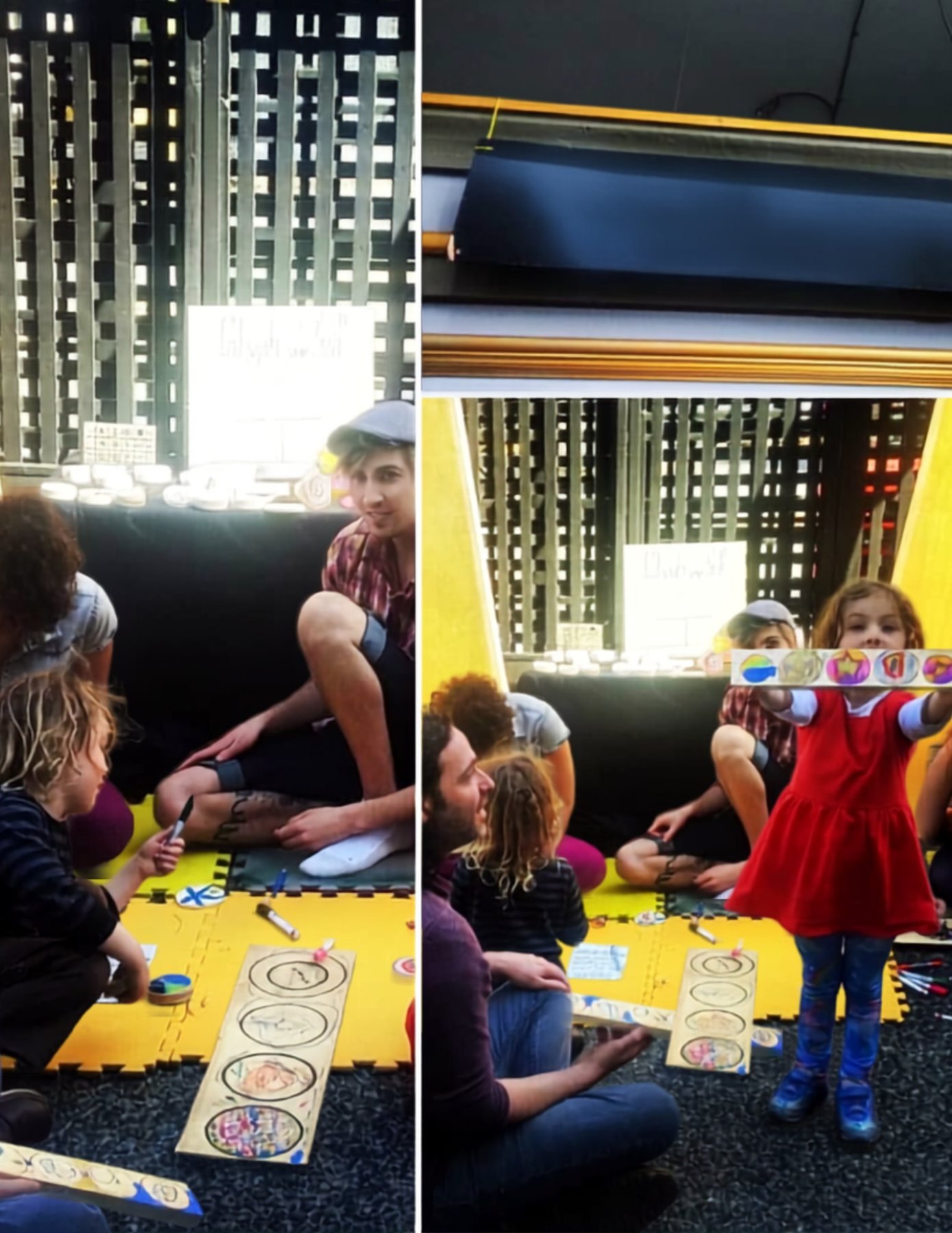
  • ARC-001.1GLYPH YO’ SELF2018–2021A participatory installation built through personal symbols, shared making, and the evolving architecture of Kids Castle.installation / participatory art
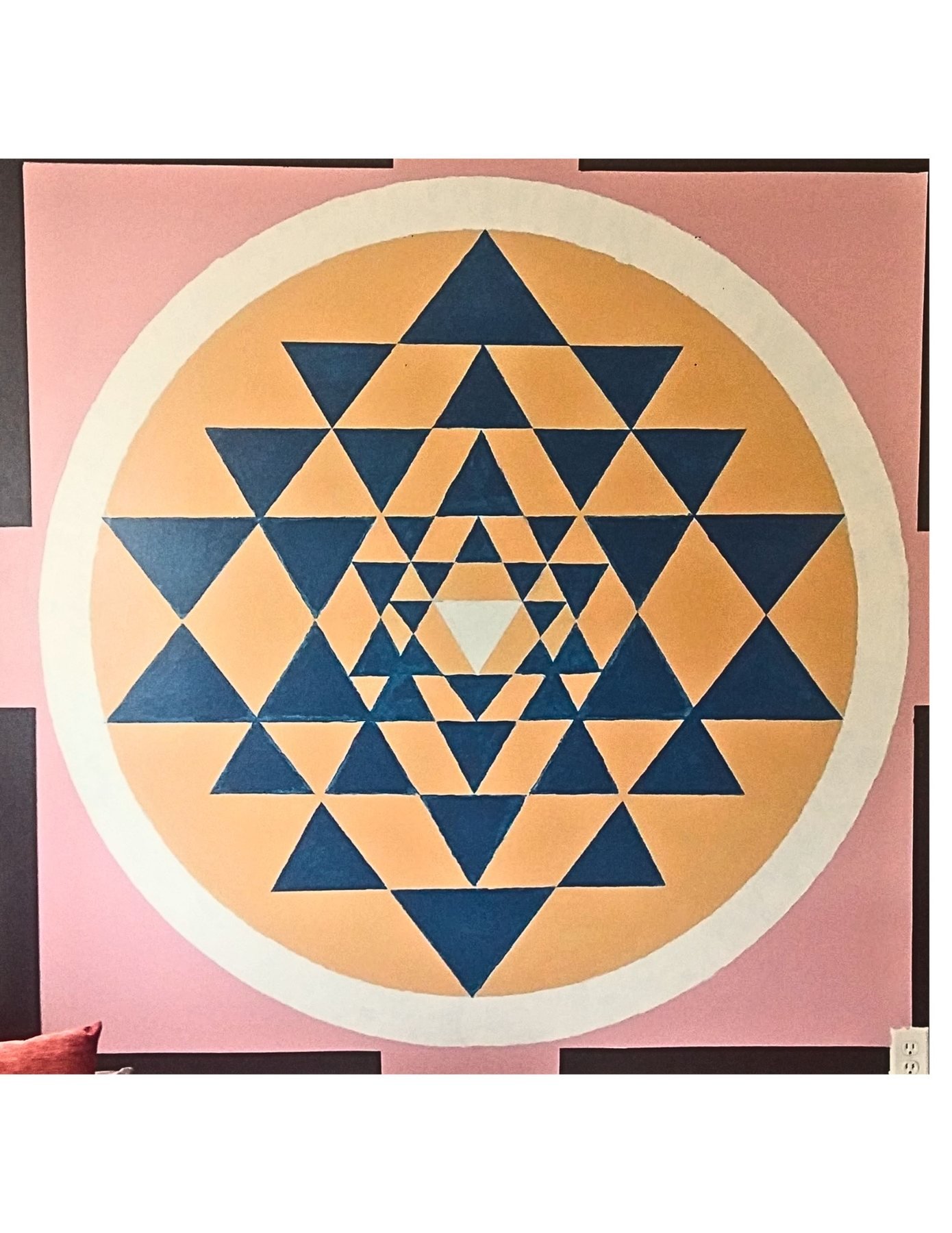
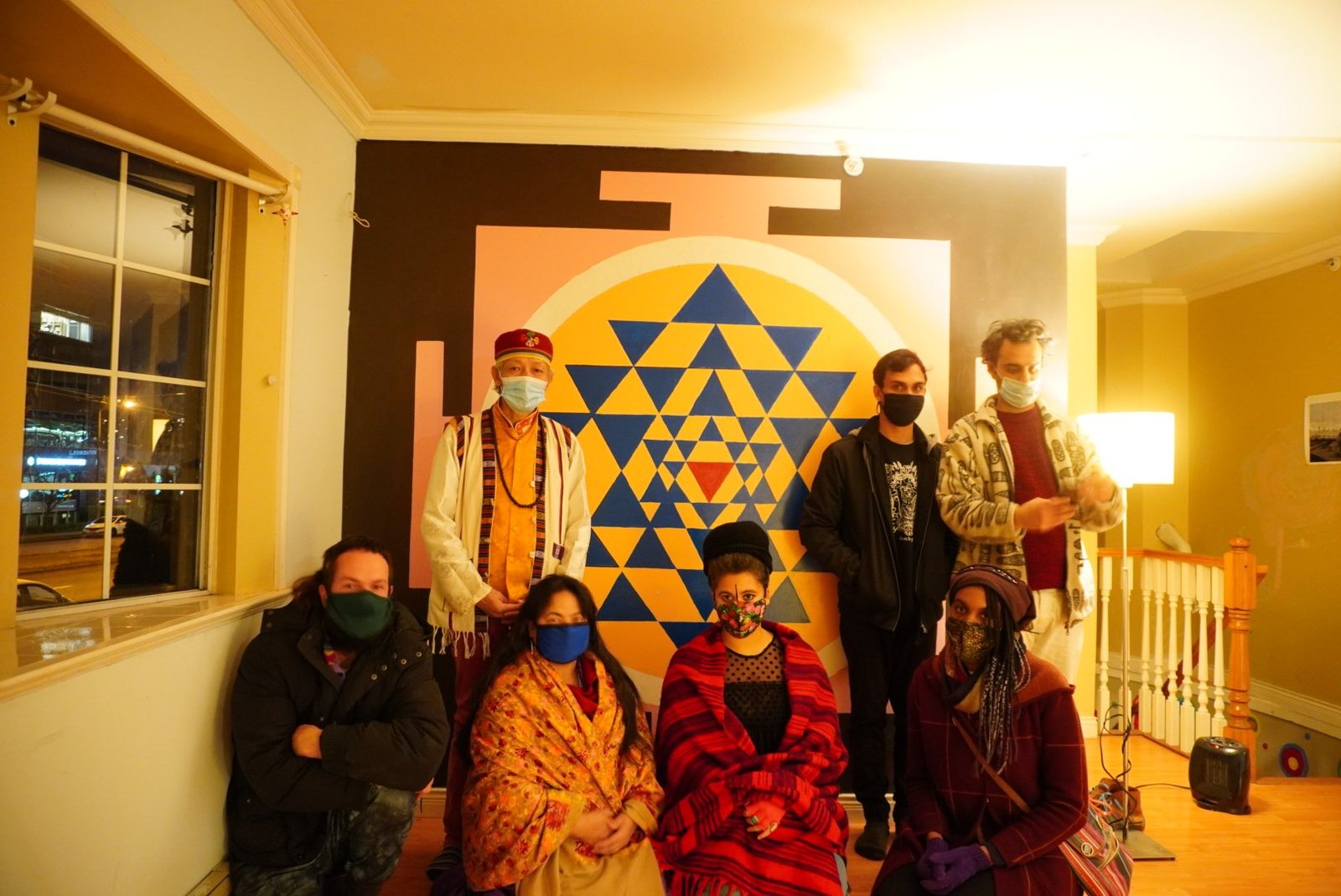
  • ARC-001.2SRI YANTRA // KIDS CASTLE MANDALAarchivedA collective mandala-making project connecting geometric form, contemplation, and community participation.workshop / installation
  • ARC-001.3CARDBOARD DAYarchivedA material-play gathering using cardboard as an accessible medium for collaborative invention.participatory event
  • ARC-001.4SHADOWJAM WITH MIND OF A SNAIL2018A collective shadow-theatre environment built through craft, projection, sound, and improvised play.performance / participatory art
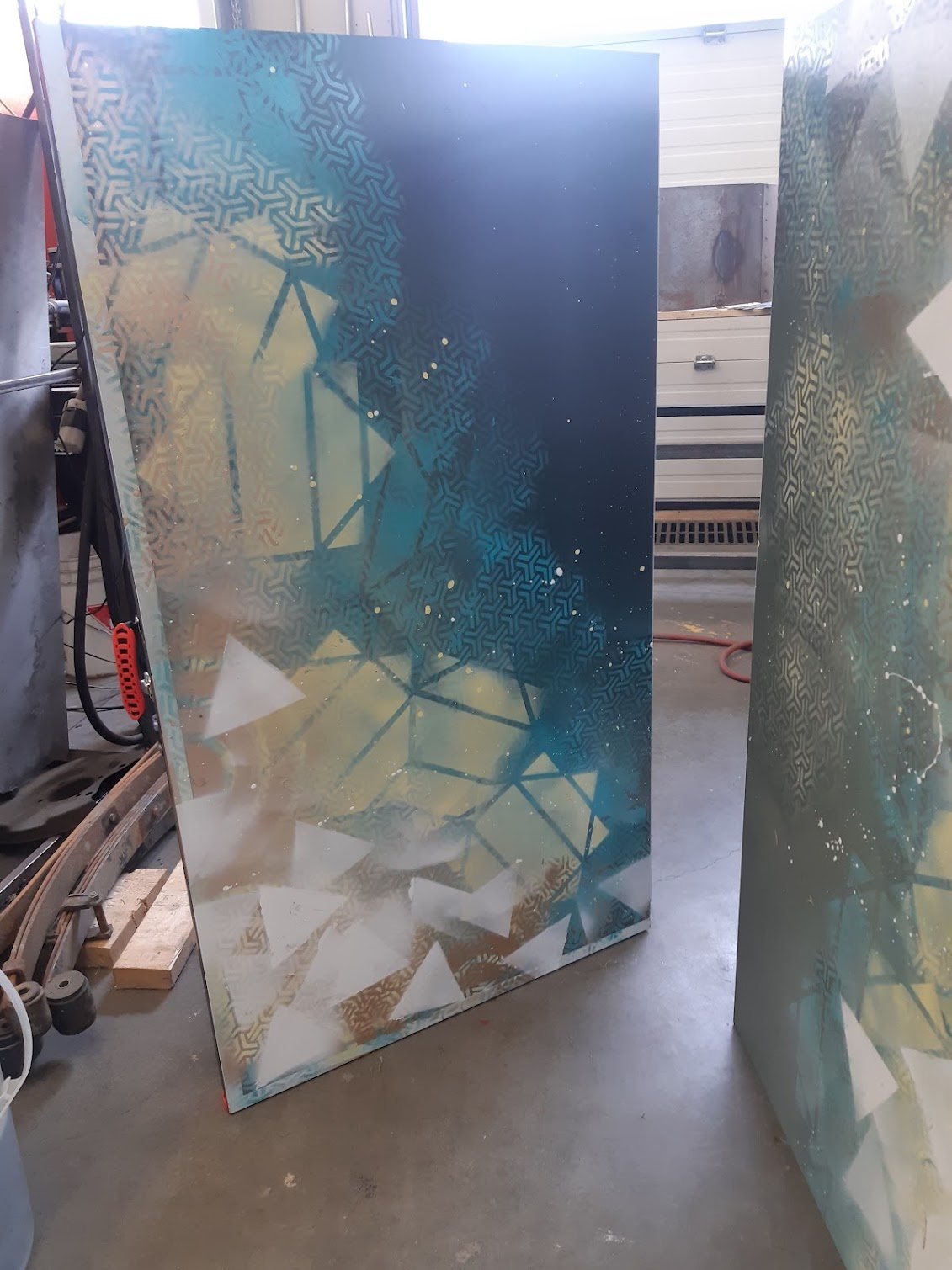
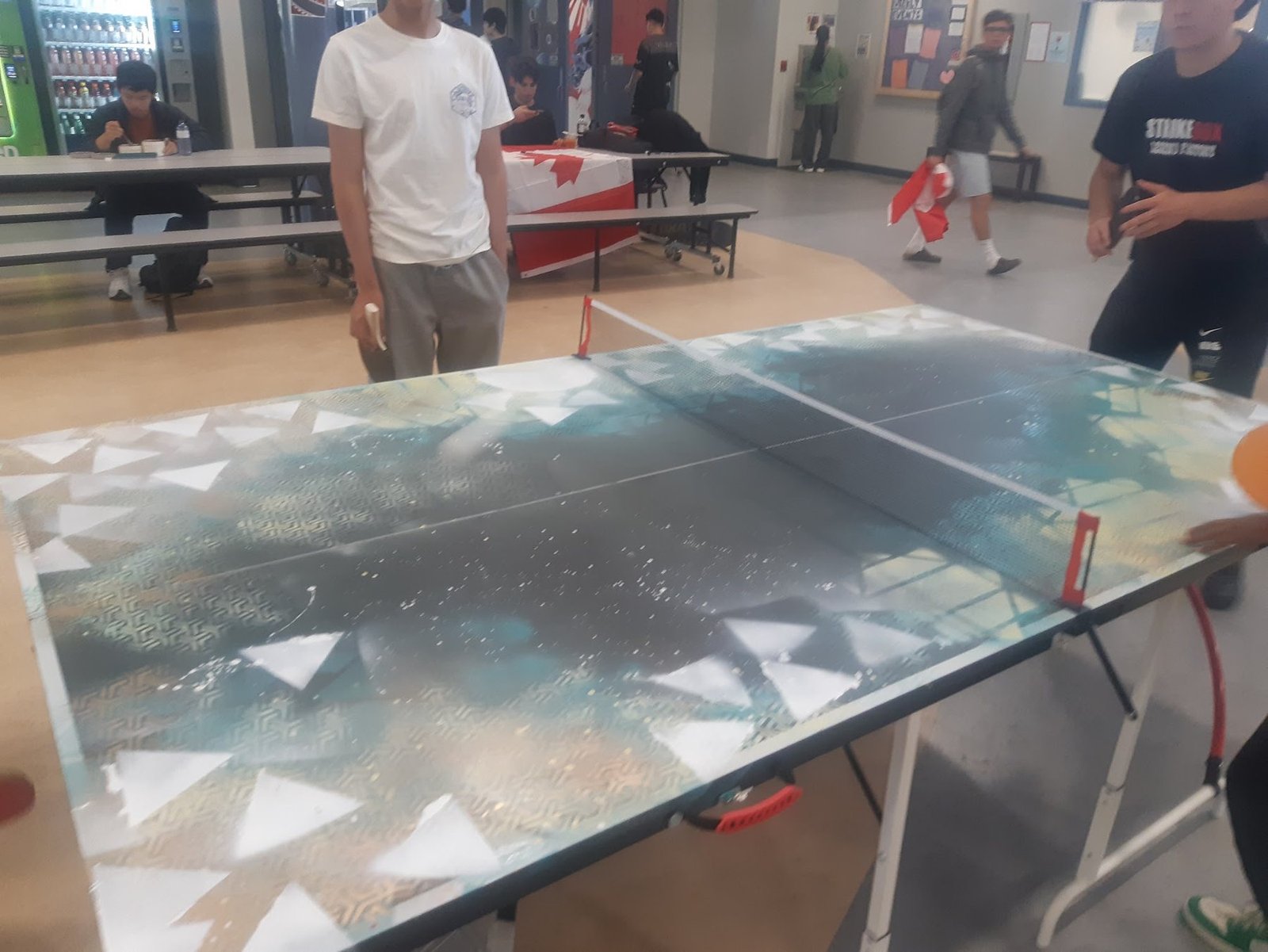
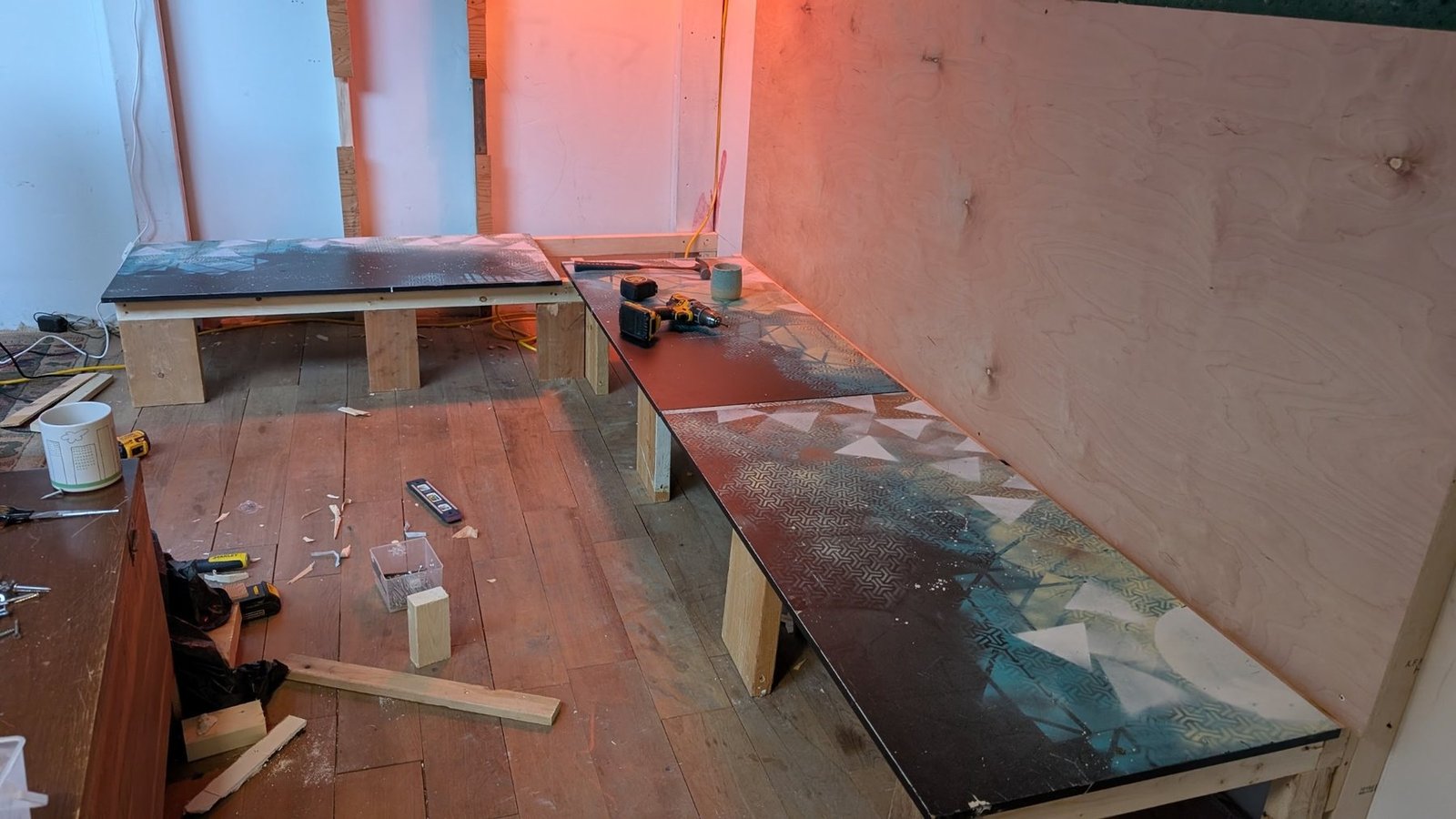
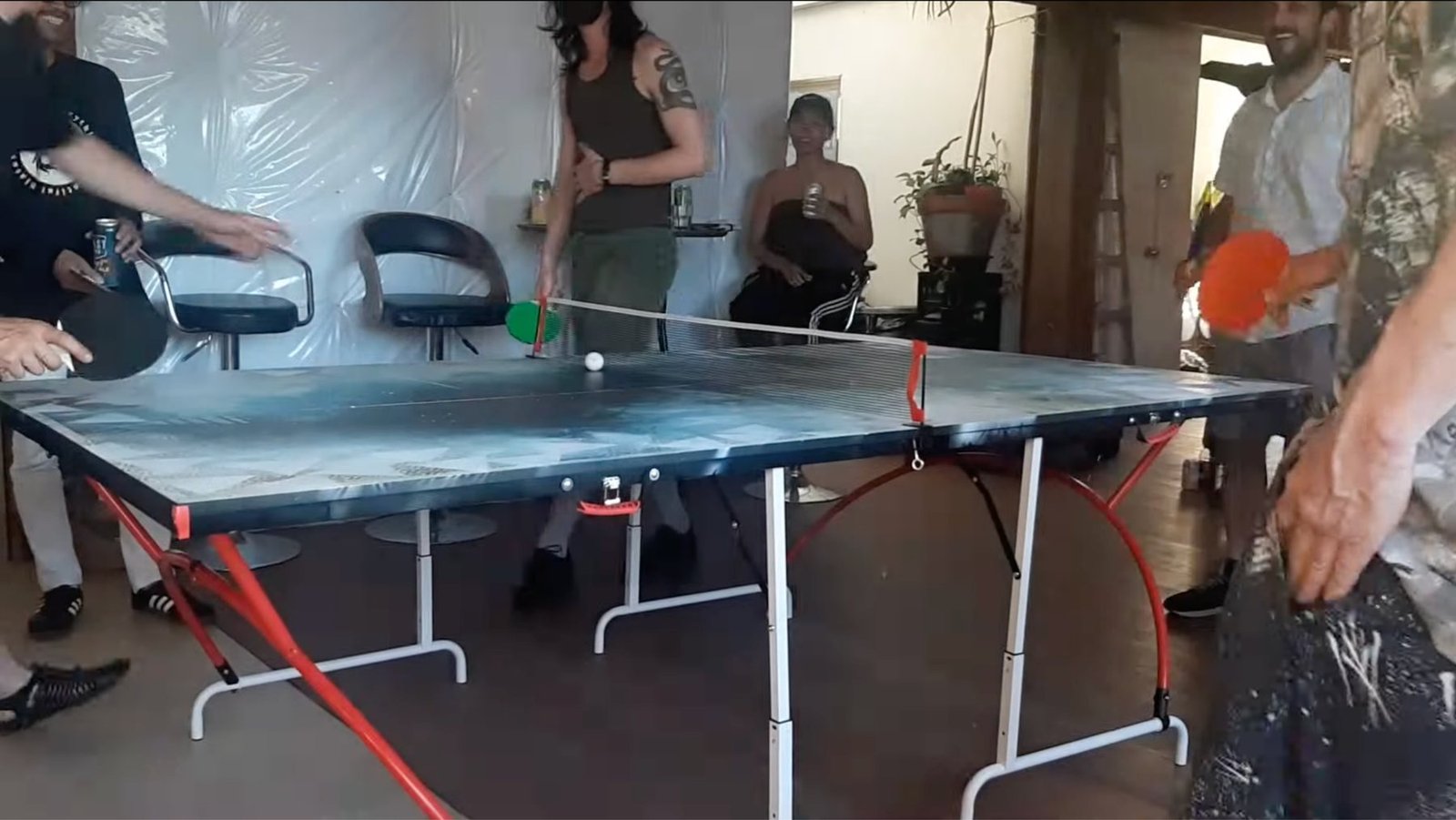
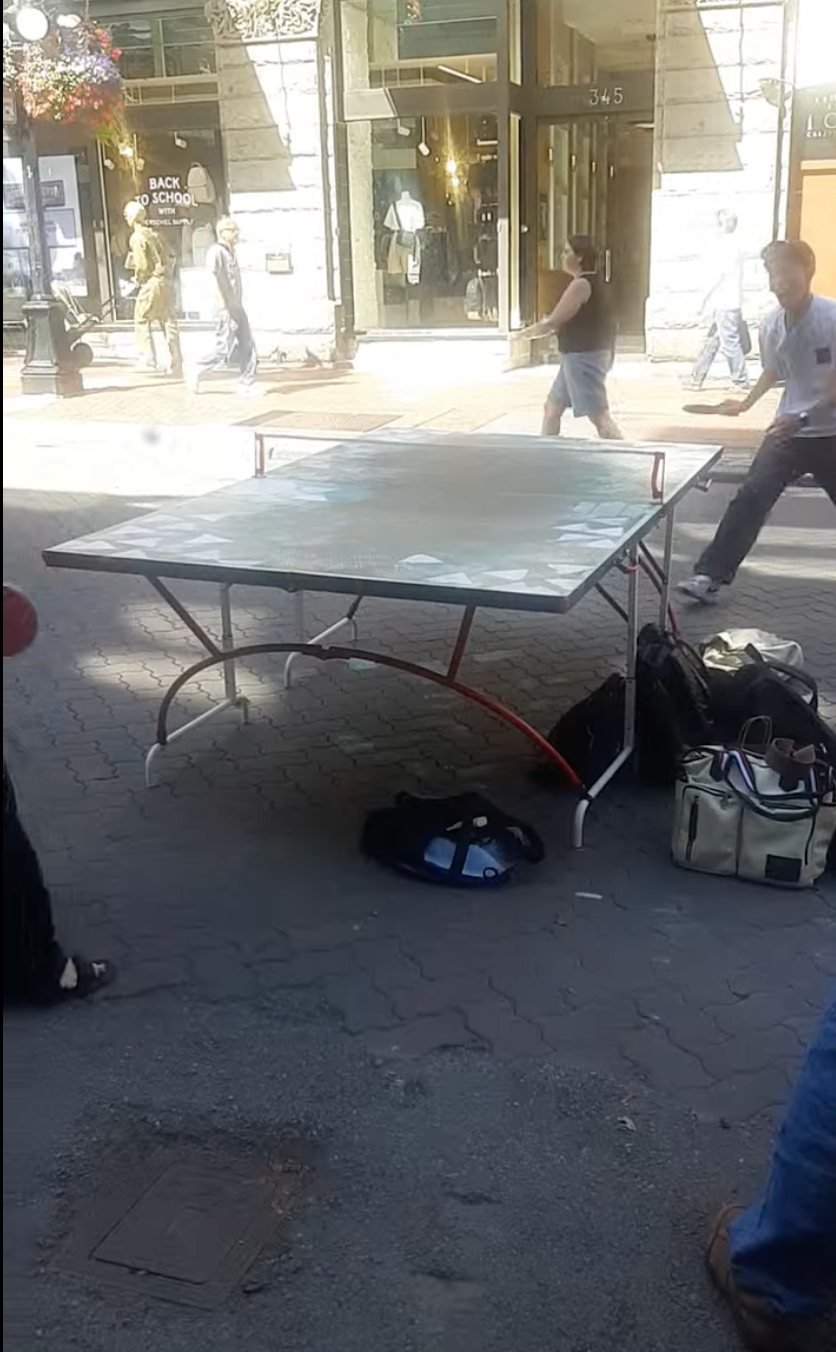
  • ARC-001.5SONIC PING-PONG: INTERACTIVE TABLE TENNIStwo-year activationAn interactive table-tennis installation in which play generated and transformed sound.interactive installation

TF-001installation · 2023–

The Gong Library

Record

Frame no.
TF-001
Status
active
Years active
2023–
Format
Installation, Interactive, Participatory
Duration
Continuous during opening hours
Venues
Temporary Frames Studio at Hypha Arts, Vancouver, BC (with touring installations)
Collaborators
  • Raj Gill — lead producer
  • Collaborating artists: Miel Nicholson, Tyrell Warren, Jacob Oudshoorn
  • Gong Library Ensemble — Matthew Ariaratnam, Irene Senent, Adrian Avendaño, Raj Gill

Description

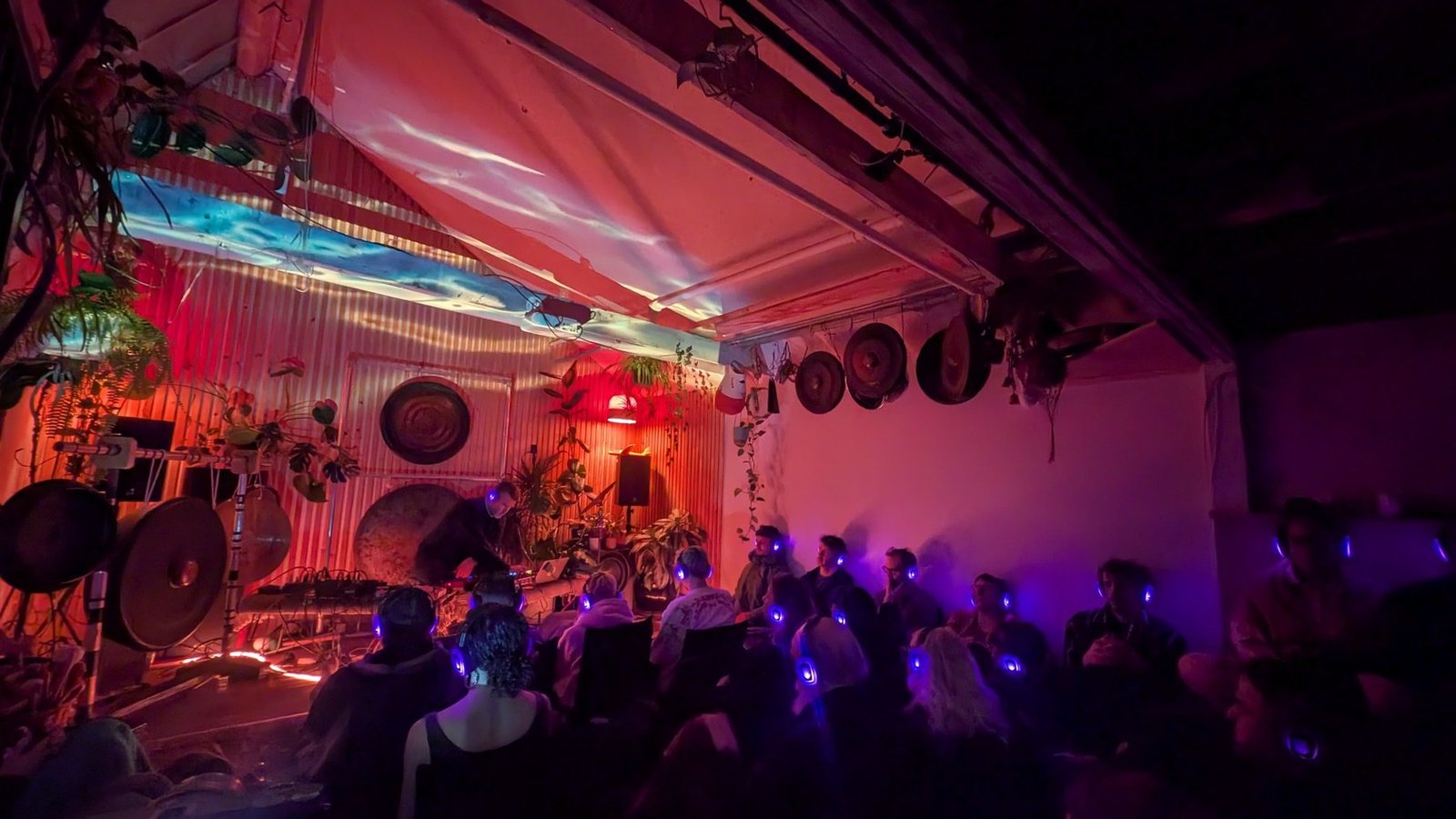
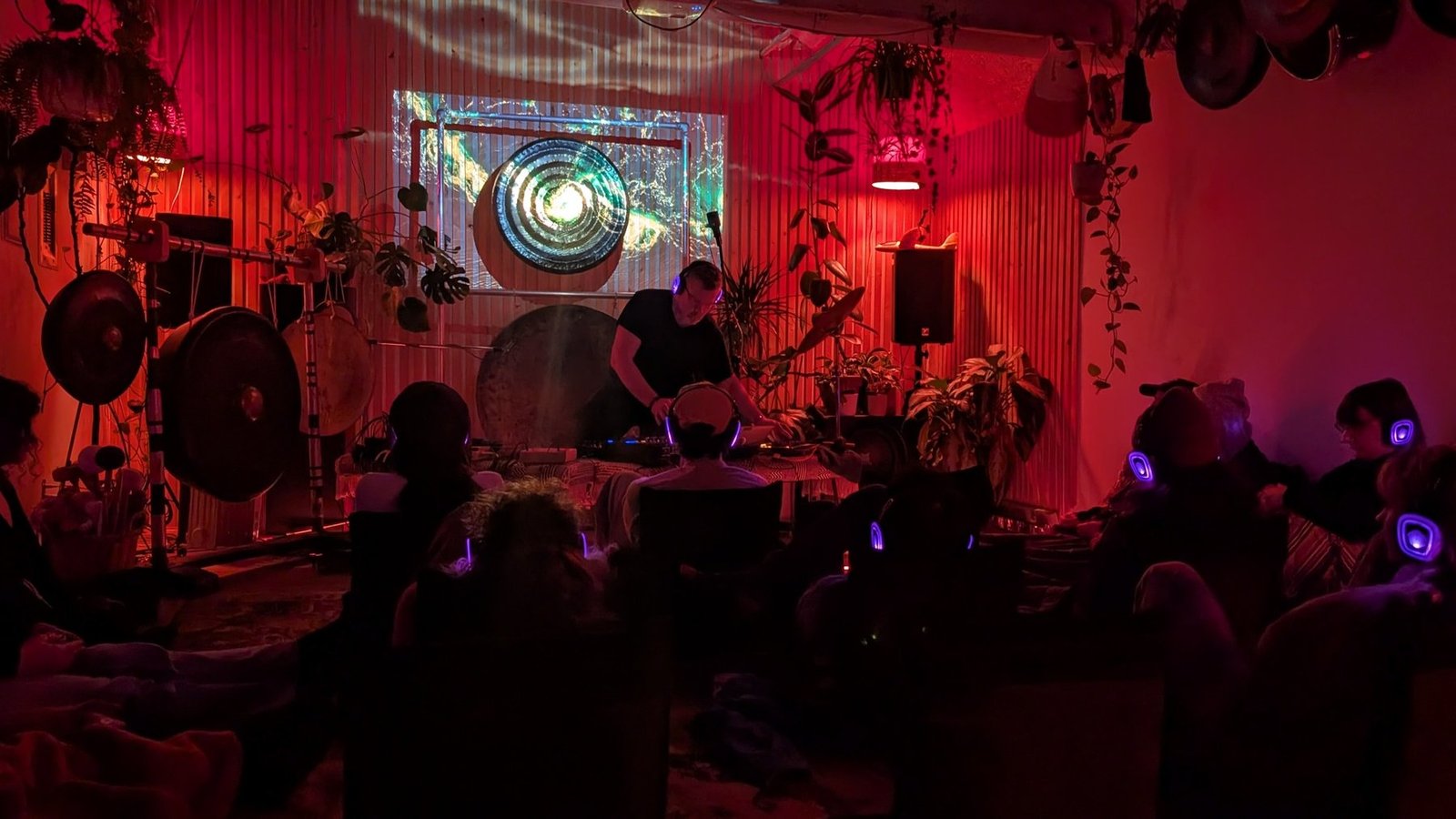
A collection of gongs and resonating instruments alongside an 18-voice just intonation soundscape, tuned to four primary gongs.

As the gongs are played, their acoustic waves modulate the sine waves in the space, creating an interactive environment in which physical and digital frequencies shape one another.

Community Practice

The Gong Library invites artists, musicians, and community members into playful exploration with its instruments, found objects, and traditional instruments. These encounters give rise to conversation and organic relational happenings, where making art and music unfolds alongside shared exchange.

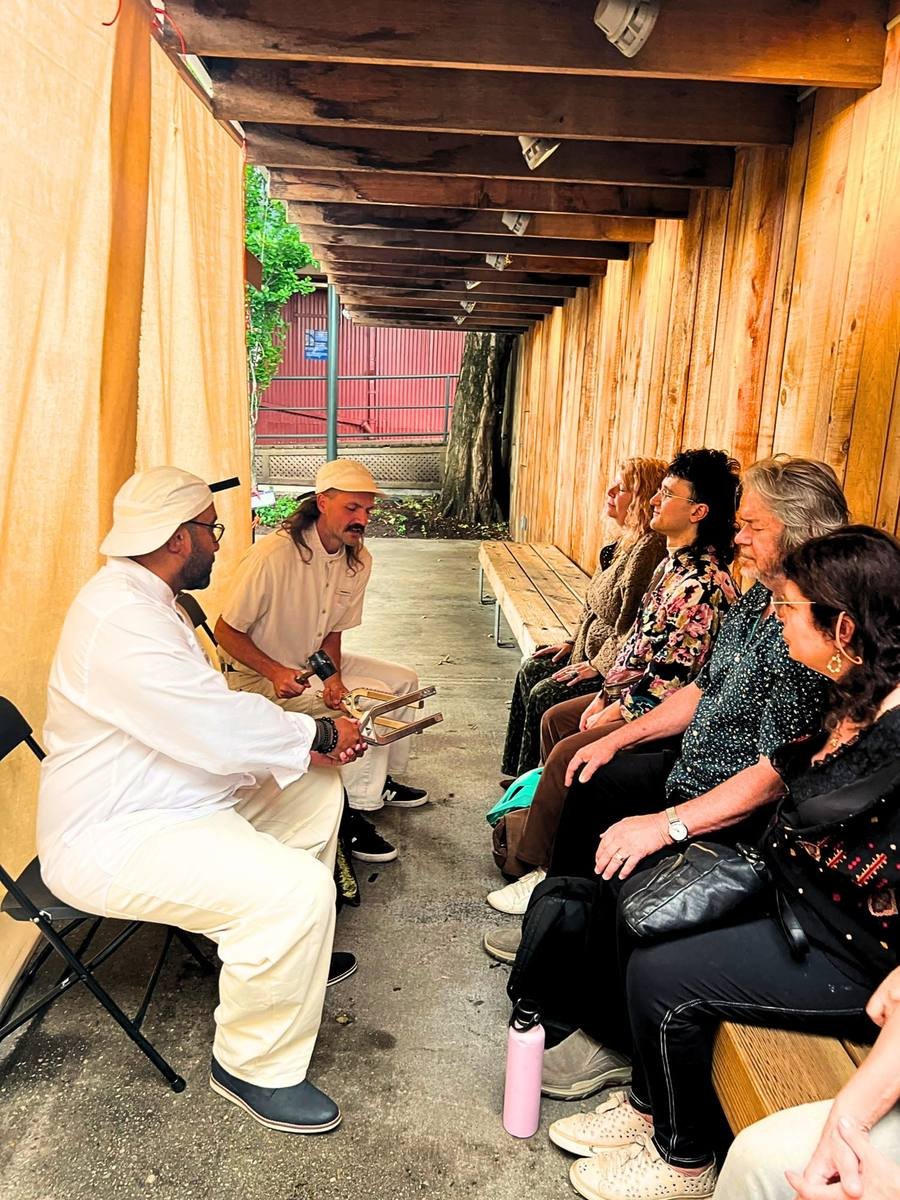
We also facilitate instrument-led meditations, exploring ways to bring sound wellness into dialogue with contemporary music and art practice.

Gong Library Ensemble

The Gong Library Ensemble brings together Matthew Ariaratnam, Irene Senent, Adrian Avendaño, and Raj Gill in a shared practice of improvisation, resonant metal, and deep listening.

Drawing from experimental music, classical and avant-garde traditions, minimalism, sound art, and pulse-driven rhythm, the ensemble creates immersive live environments using gongs and an evolving collection of instruments from the Gong Library alongside guitar, violin, and percussion. Their performances move between dense, high-intensity textures and spacious melodic passages, inviting audiences into a playful, collective encounter with sound.

Watch

Watch video 1 on YouTube · Watch video 2 on YouTube

Instrumentation & Technology

The library houses a carefully curated collection bridging physical and electronic mediums:

Acoustic Resonance

An extensive physical collection housing over 20 different types of gongs from various regions of the world, in addition to diverse percussion instruments, bells, and other global resonating instruments. This also includes a precise set of seven planetary chimes tuned to specific frequencies based on the Cosmic Octave system.

Digital Integration

Custom electronic synthesis and high-fidelity sound systems that integrate with physical strikes to generate complex, enveloping sonic environments. This features an 18-voice just intonation sine wave landscape tuned to the four principal gongs. When the gongs are struck, their acoustic sound waves actively modulate the sine waves in the space, creating a highly interactive and unique sonic experience where physical and digital frequencies shape one another.

Key Installations & Activations

The installation continues to evolve as a highly adaptable, interactive acoustic experience, touring across regional festivals and public spaces:

  • Indian Summer Festival: Ocean Artworks, Granville Island Installation (July 17, 2026)
  • Vines Art Festival: Featuring a live performance by the Gong Library Ensemble (2025)
  • Sh’bang Festival: Bellingham, Washington, USA (2024)

Documentation

Photos were taken from the Indian Summer Festival 2026 Gong Library installation.
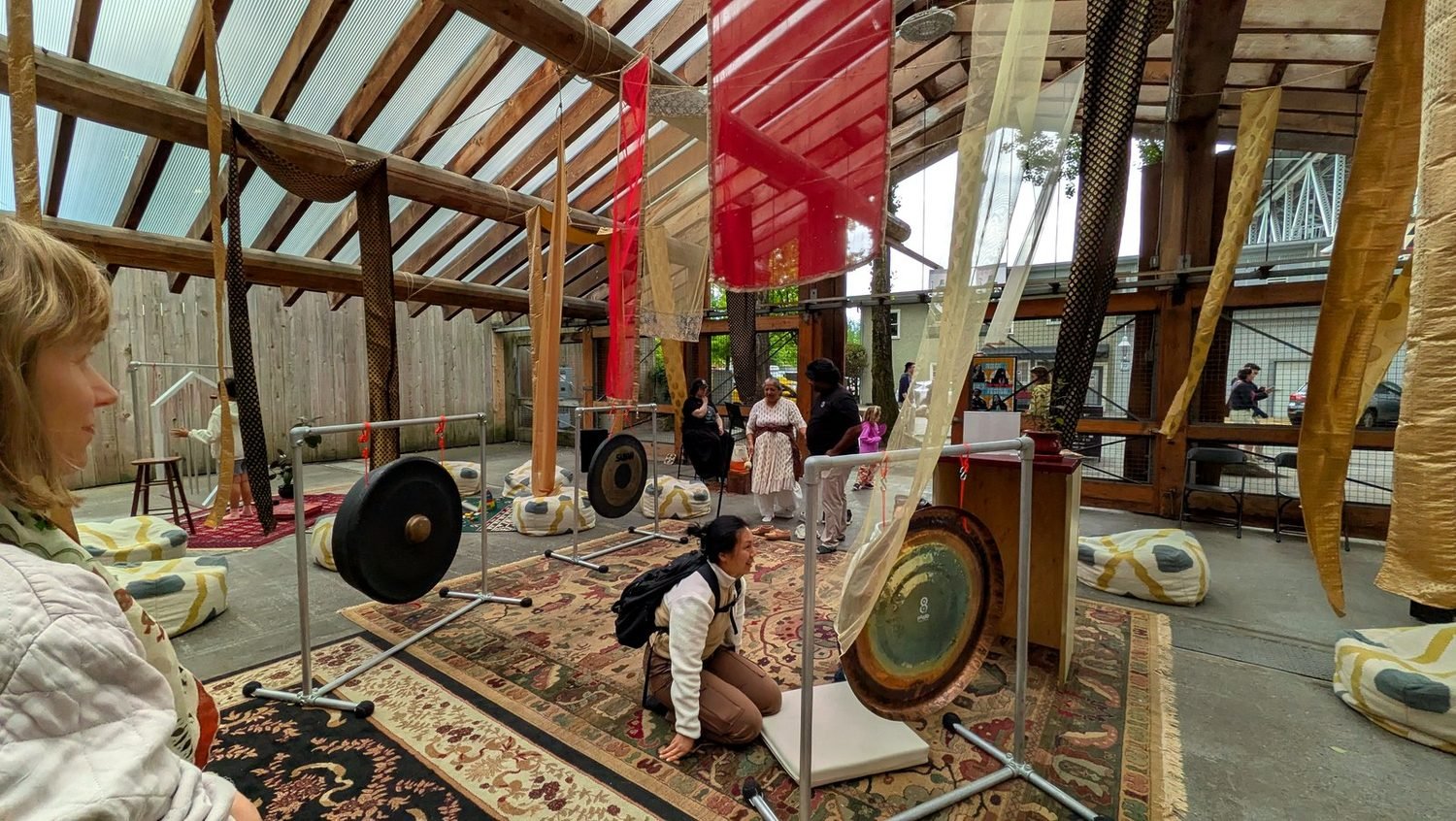
A visitor kneels to play a gong while others sit and stand nearby beneath hanging fabric banners.
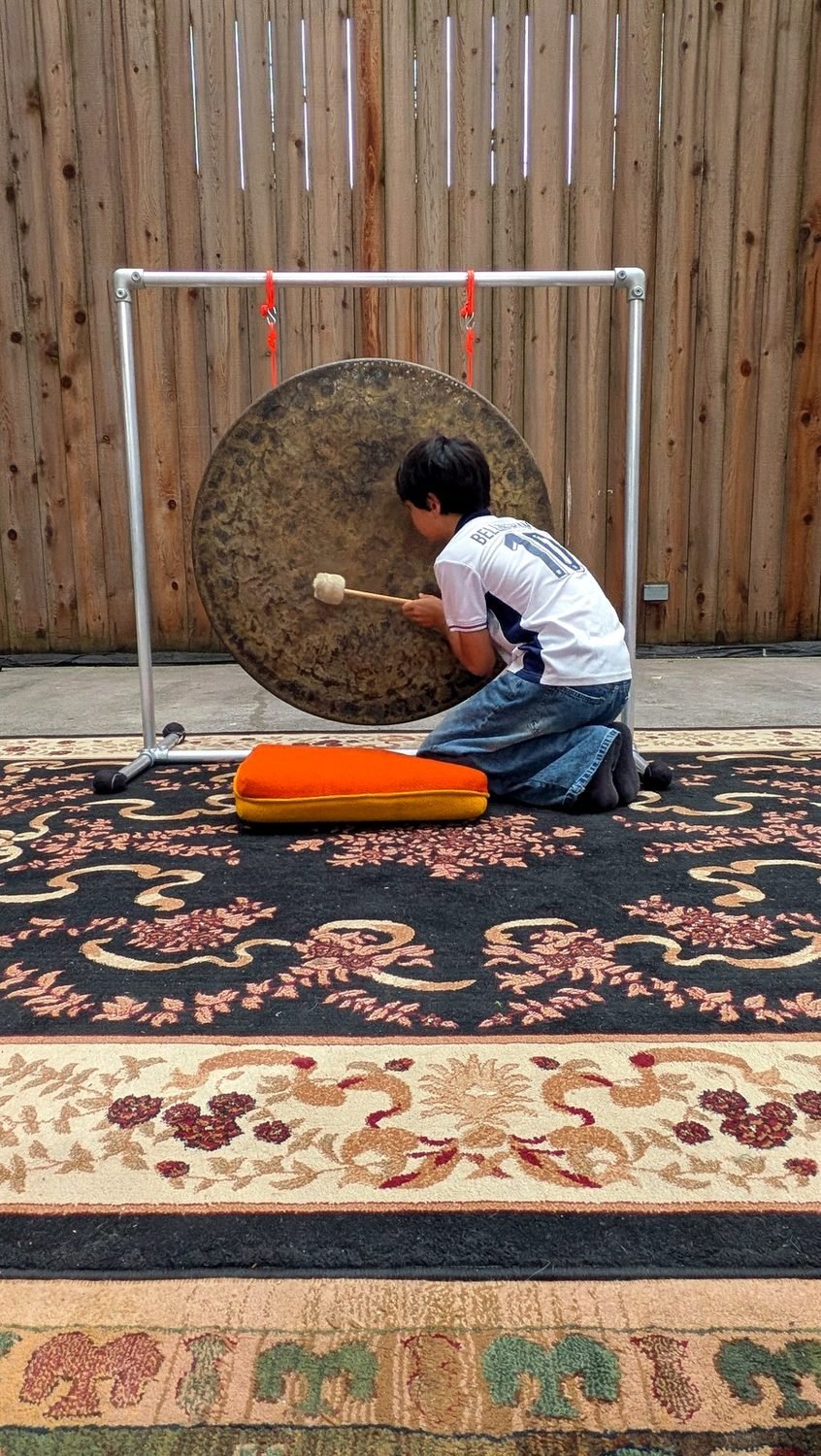
A child kneels close to a large gong, mallet in hand, with an orange cushion beside them.
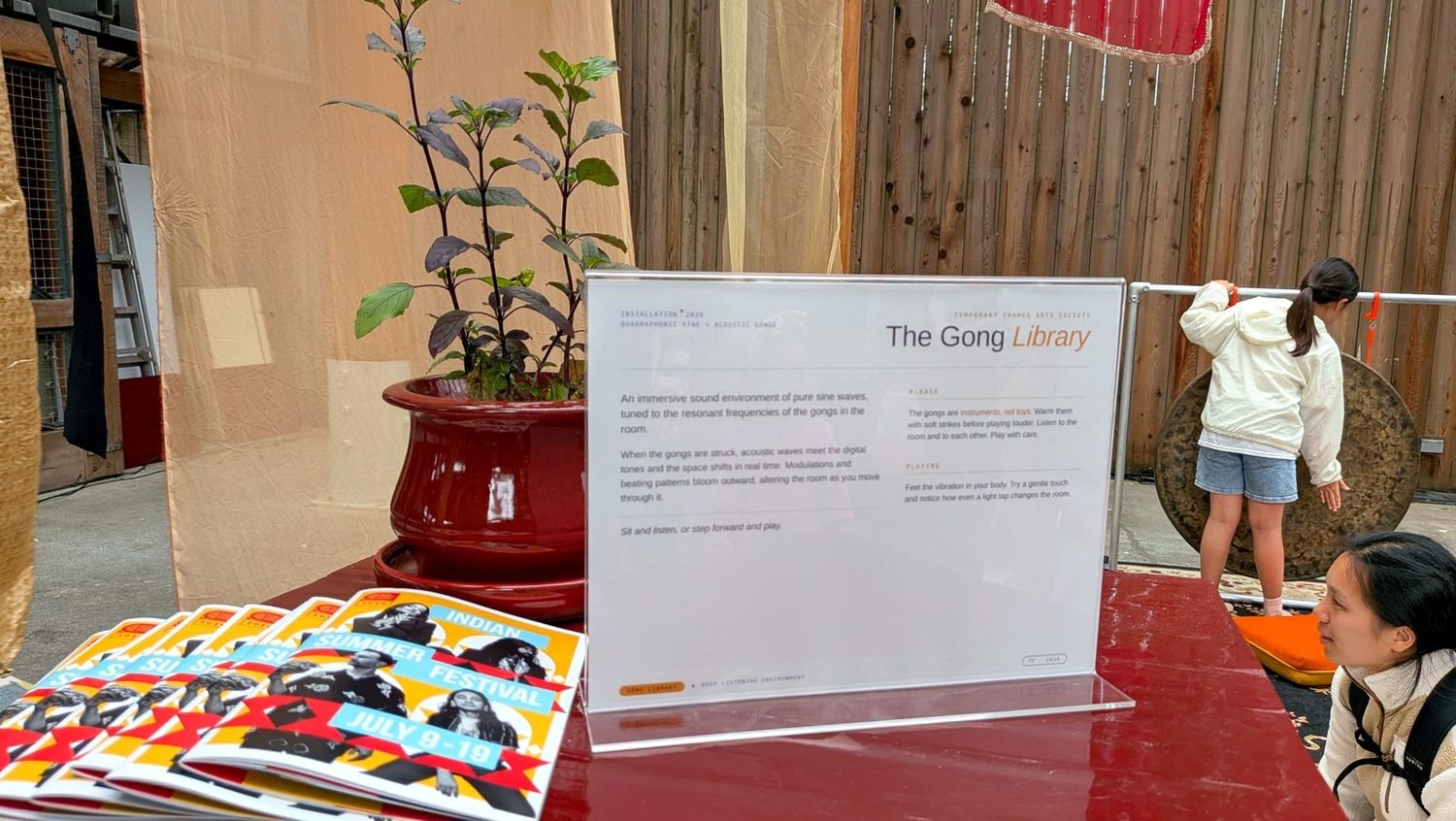
A printed Gong Library information placard and a stack of Indian Summer Festival programs on a table, with a visitor playing a gong in the background.

TF-002immersive experience · 2025–

Imaginal Airlines

Record

Frame no.
TF-002
Status
active
Years active
2025–
Format
Immersive experience, participatory, interdisciplinary
Duration
2½ hours
Venues
Hypha Arts and Temporary Frames Studios, Vancouver, BC (with touring performances)
Collaborators
See The Team, below.
Funders
Creative BC; European DigiScore Project
Partners
Hypha Arts

Description

Produced by: Temporary Frames

Imaginal Airlines is an immersive, relational art experience that merges theatrical narrative, sound, and participatory design. Rather than presenting itself as theatre, the project commits fully to the airline as its container: artists take on the roles of crew, and visitors arrive as passengers entering a collective journey.

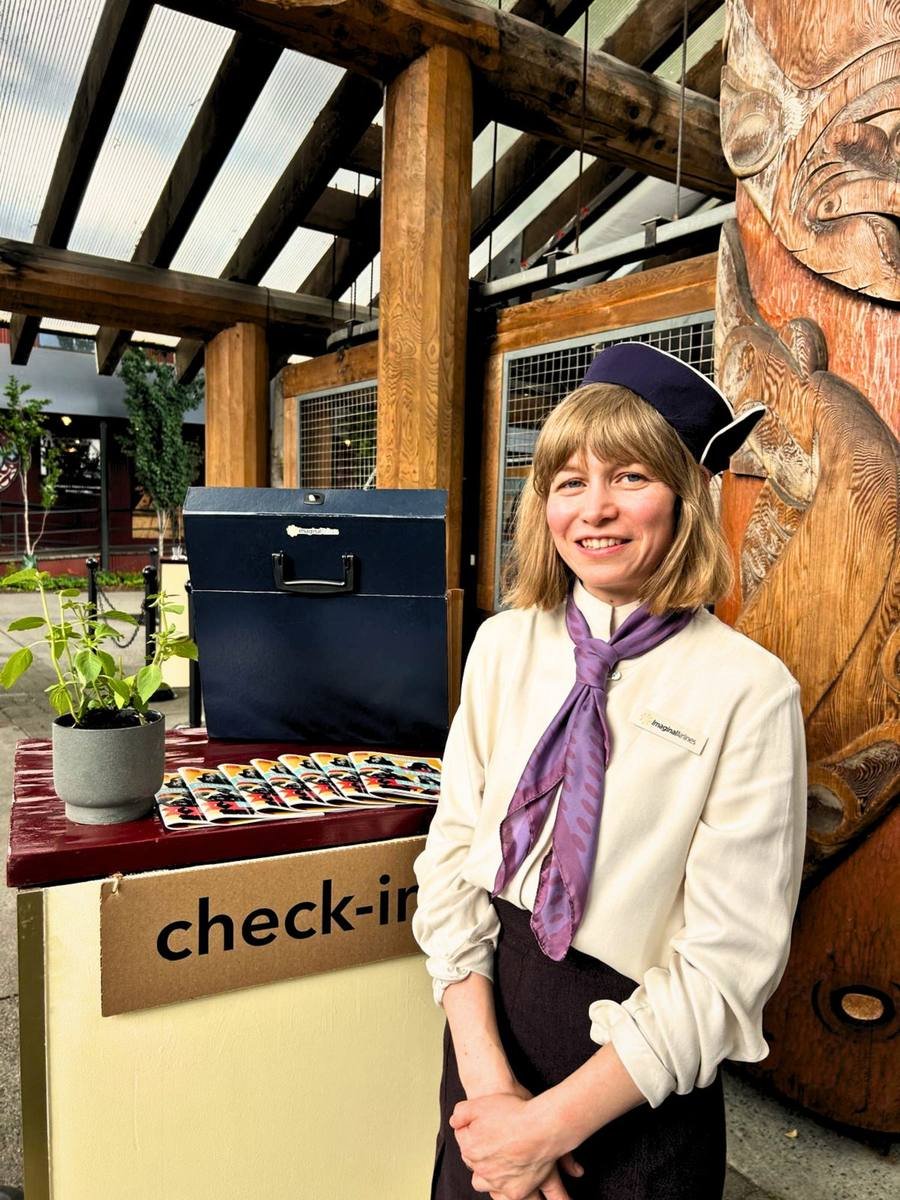
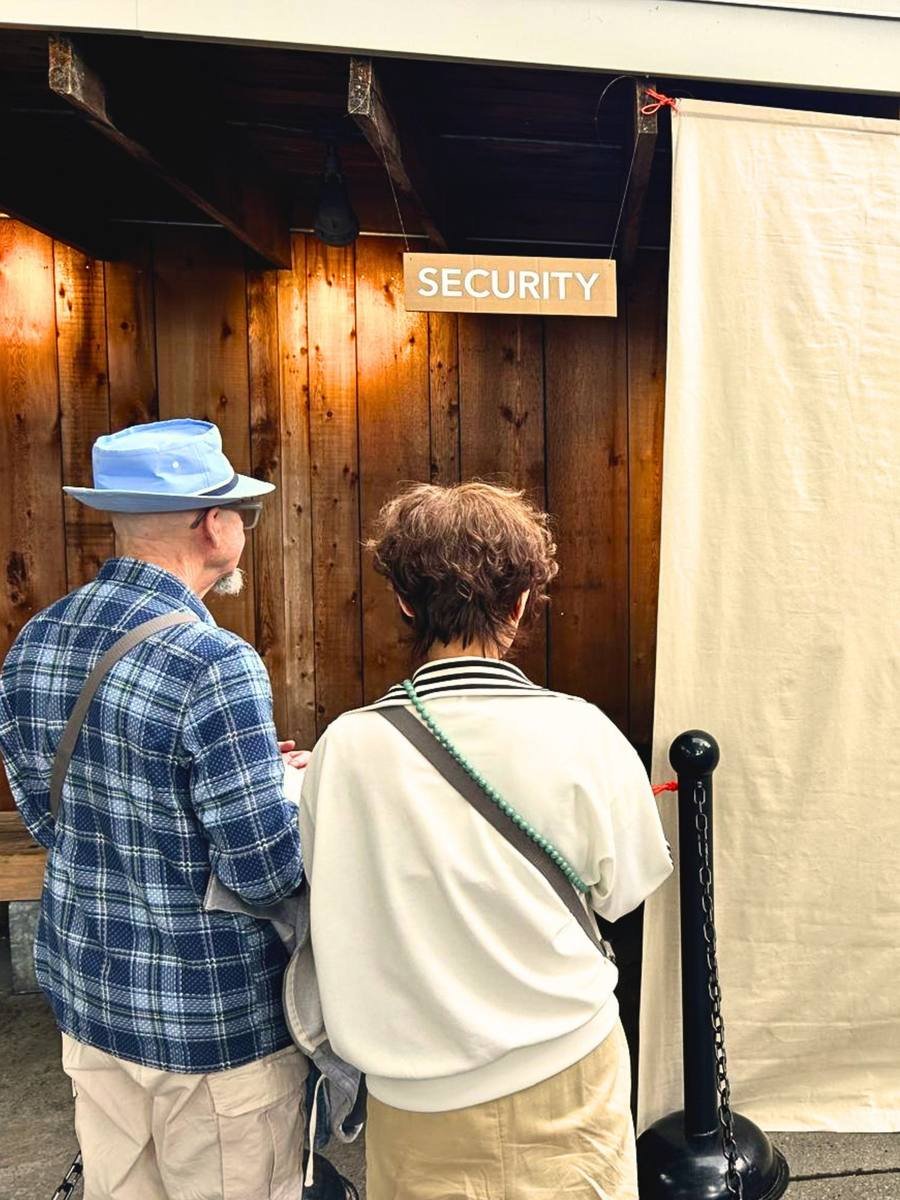
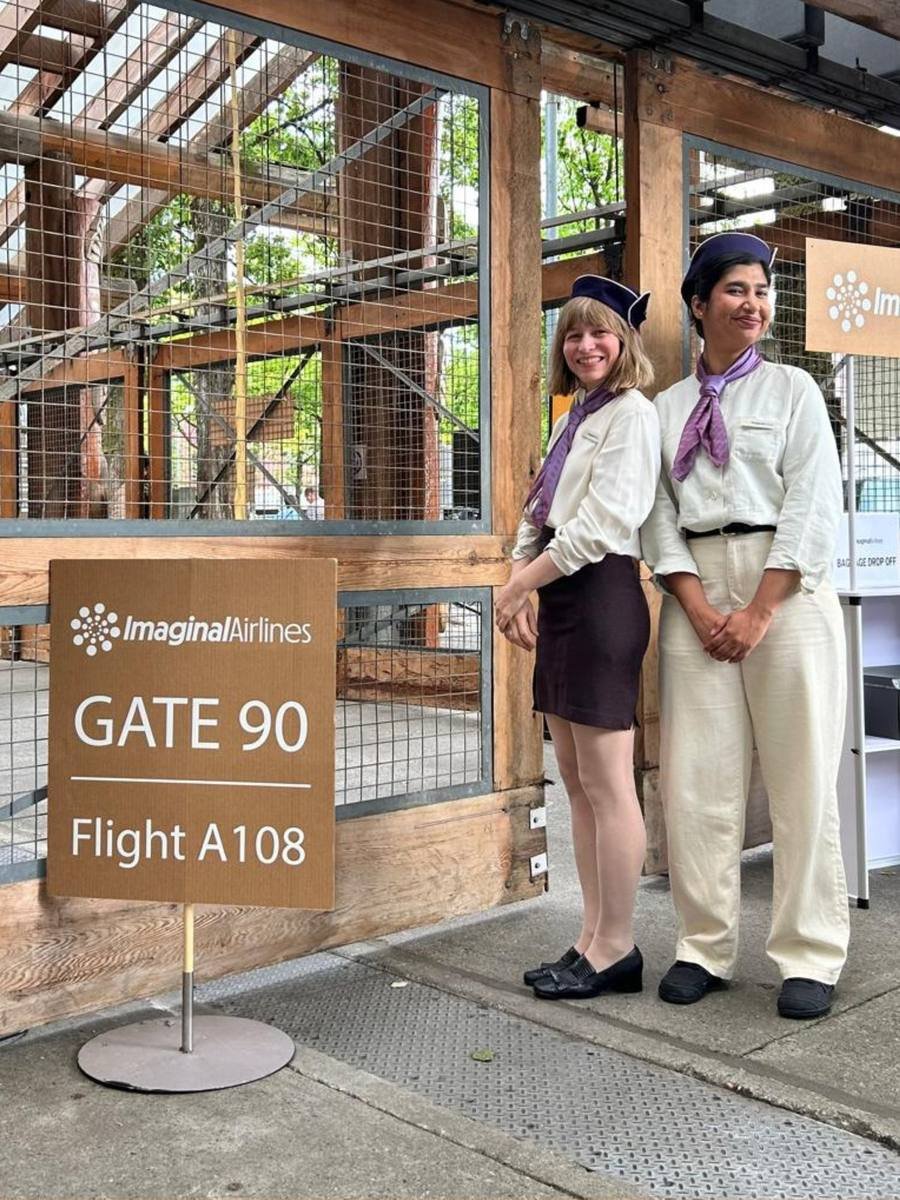
The experience begins before anyone enters the venue. Participants encounter Imaginal Airlines through a custom-designed website, where they book their flight and receive travel information and a boarding pass. On arrival, they move through a reimagined airport and plane experience: check-in, security, boarding, safety announcements, and pre-flight instructions are transformed through original poetry, sound, and open-ended meditative framing. The venue becomes a temporary terminal and cabin—an immersive world that shifts familiar rituals of air travel toward attention, imagination, and shared presence.

Imaginal Airlines is a situational artwork shaped by acoustic depth. Each flight is guided by a custom animated digital score that shapes live musical improvisation, resonant instrumentation, and experiential soundscapes, inviting somatic embodiment and sensory exploration.

The live music and sound for current flights are created by the Imaginal Cells sextet. Future flights will invite other artists and musicians to develop and guide distinct flight paths, expanding the project’s sonic language, artistic relationships, and public reach.

www.imaginalairlines.com

The Flight System

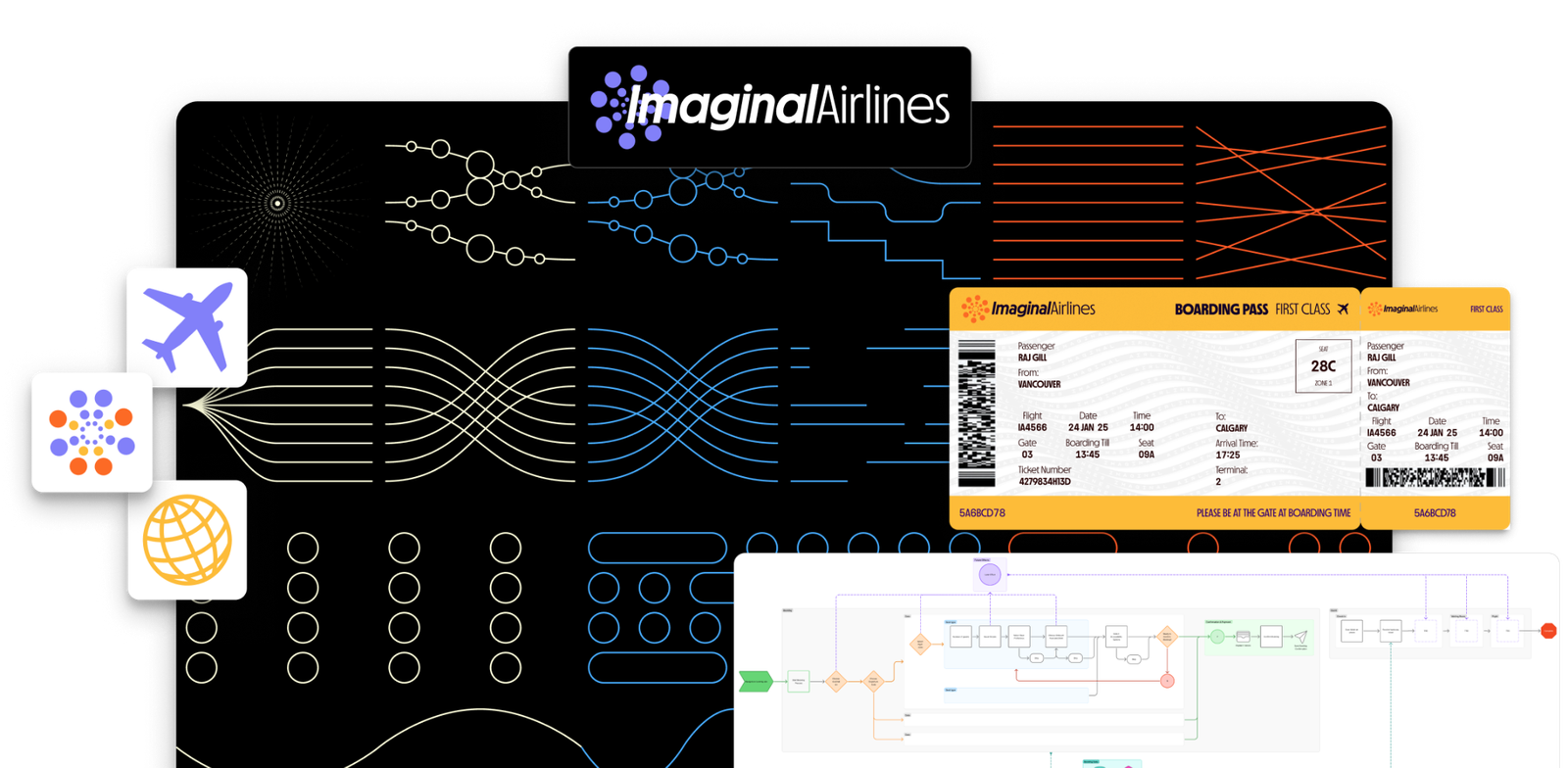
Imaginal Airlines visual system showing the project identity, animated digital score symbols, boarding pass, passenger icons, and platform architecture.
Imaginal Airlines visual system
Animated score language, passenger-facing identity, boarding materials, and digital platform architecture. Visual system designed by Eli Muro.

Gallery

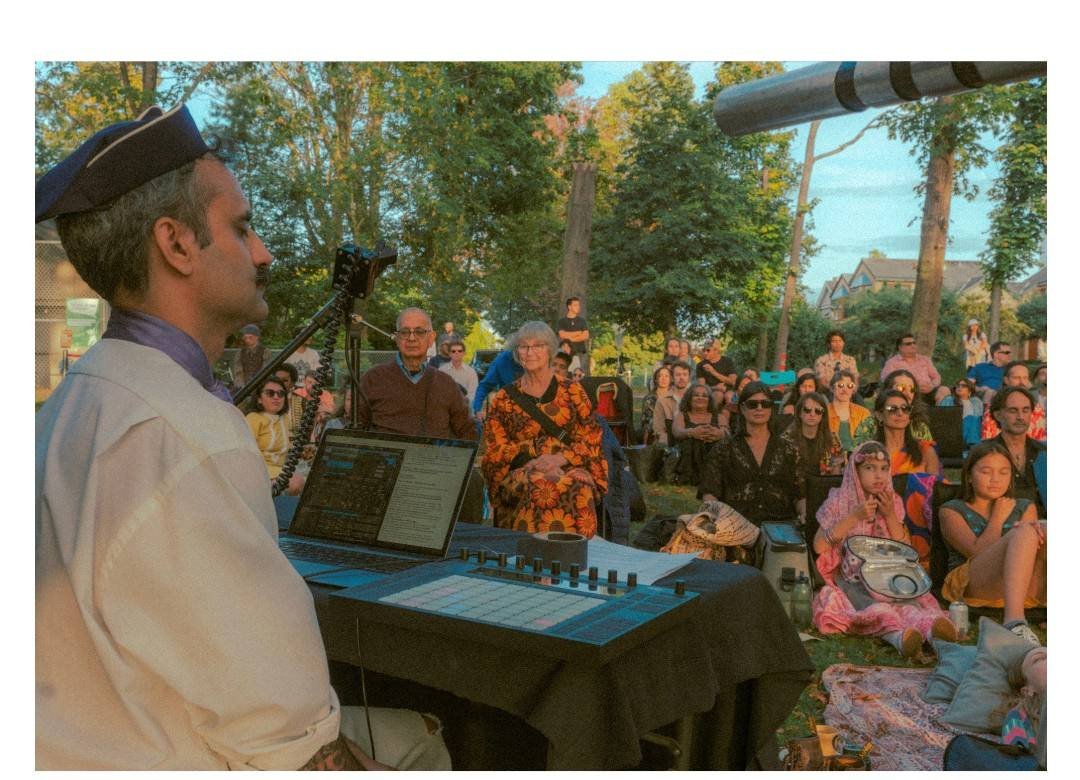
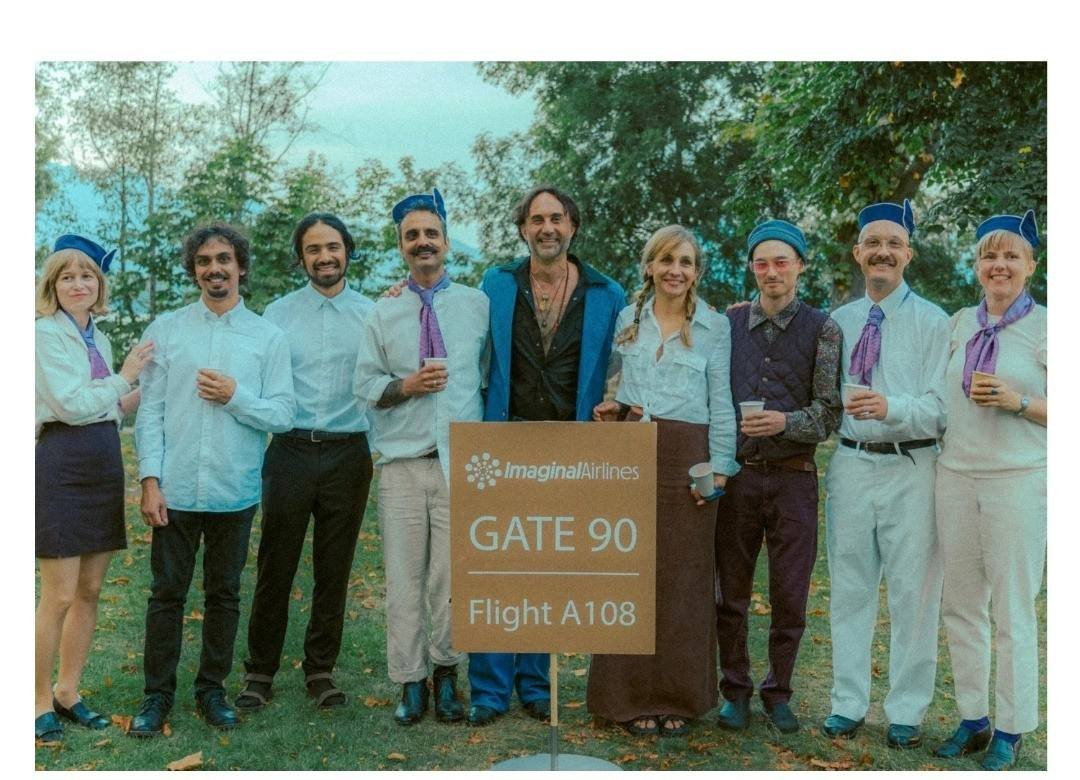
Passengers gathered outdoors for an Imaginal Airlines experience
Outdoor flight — Photo by Aliana Bella.
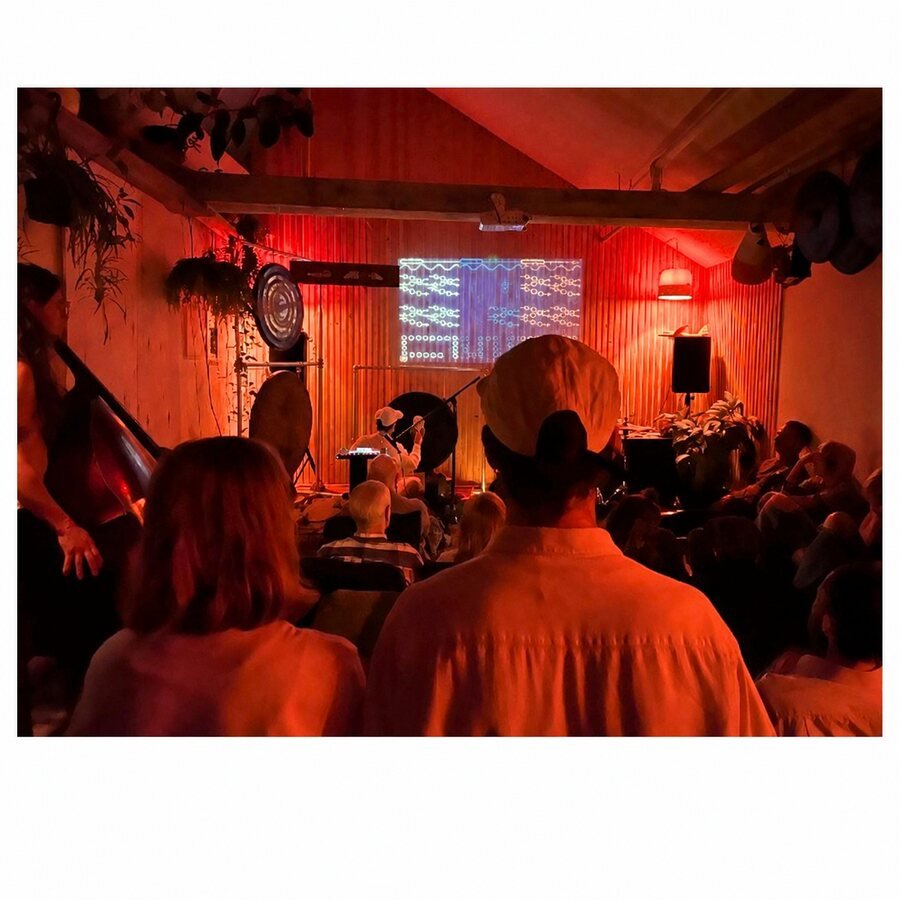
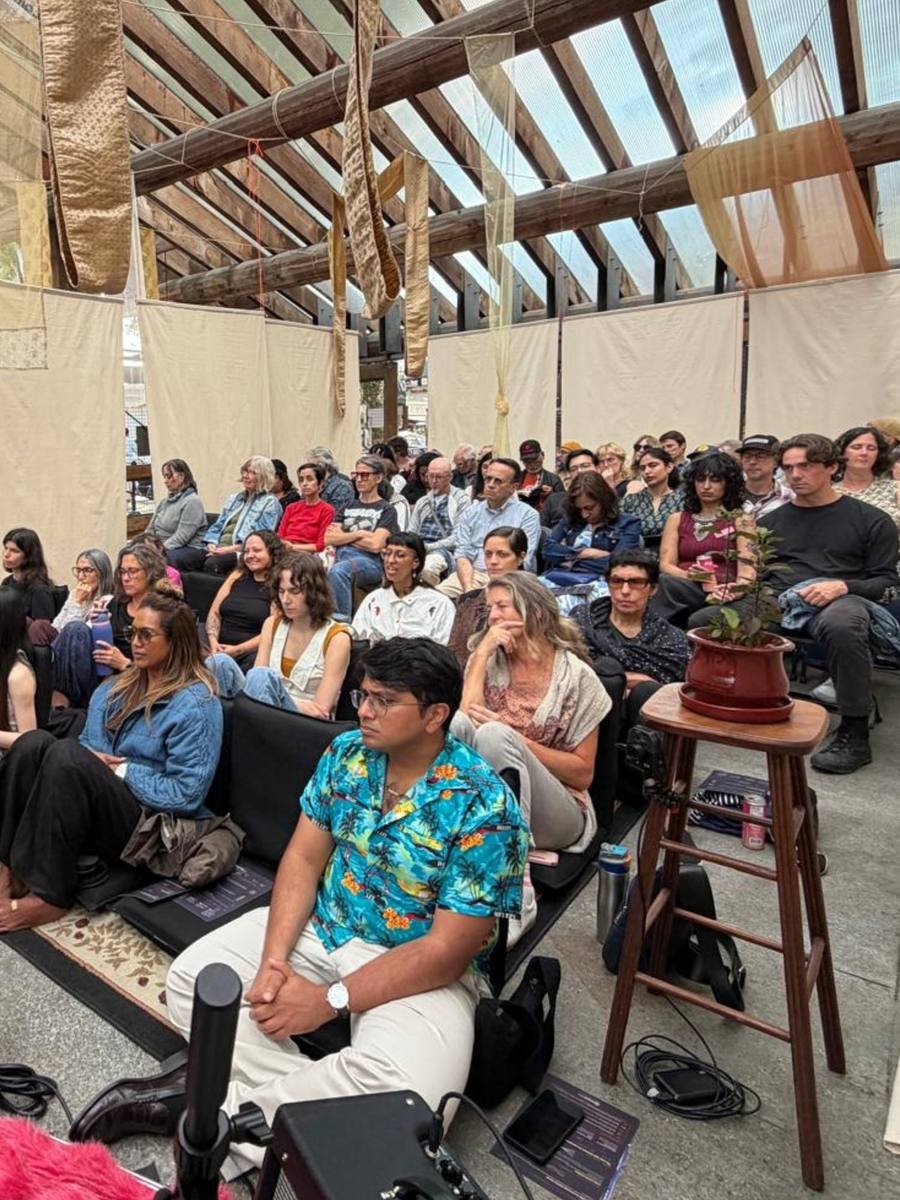
Audience gathered inside a red-lit Imaginal Airlines performance at Hypha Arts
Hypha Arts — Photo by Caroline Ballhorn.
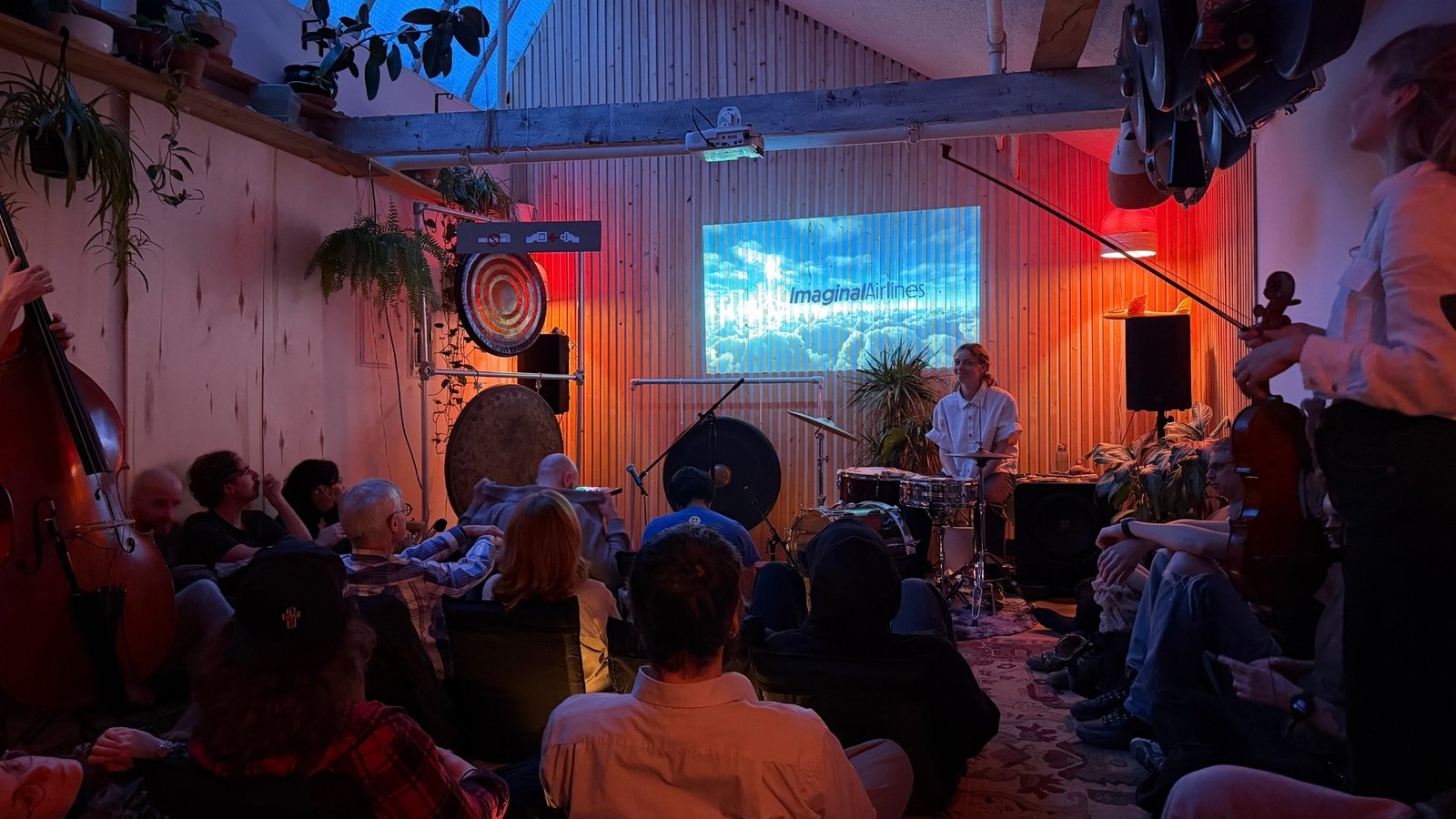
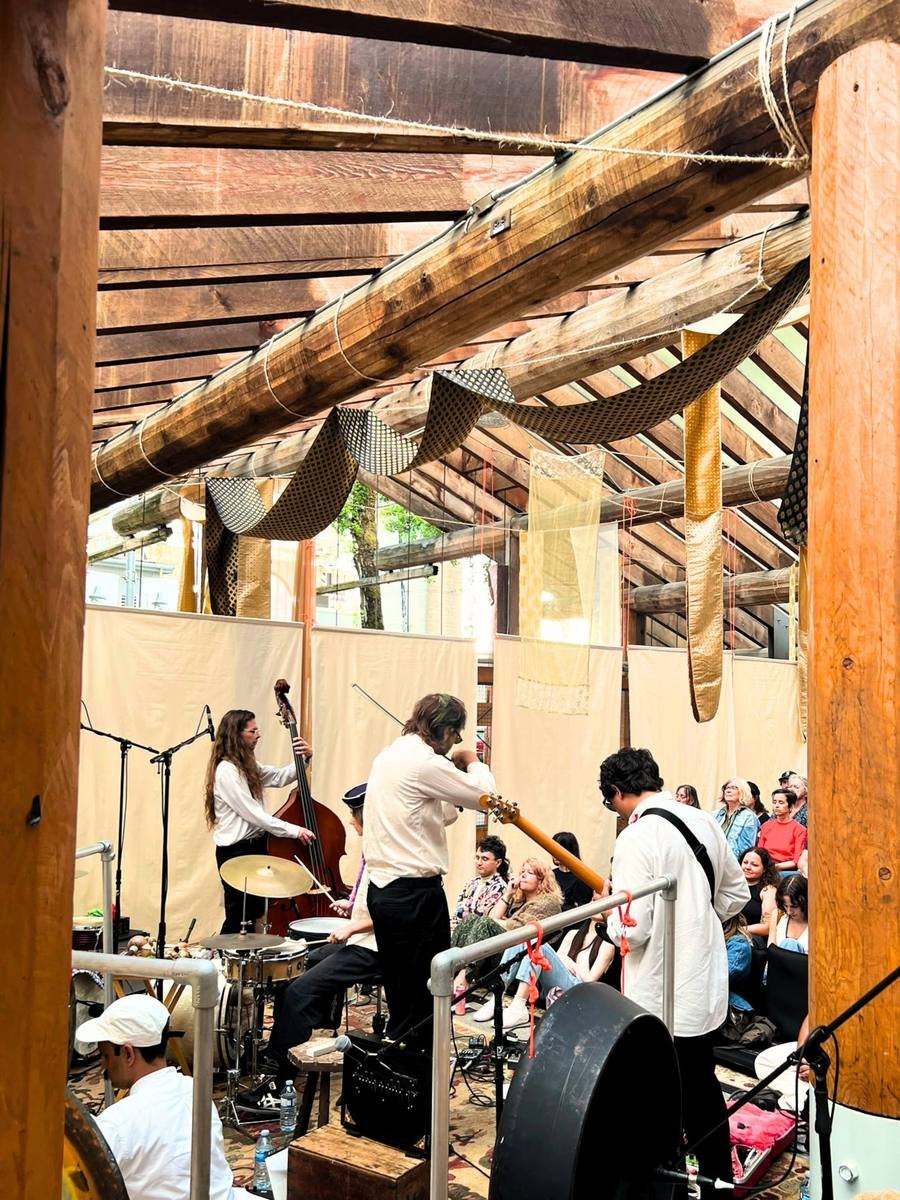
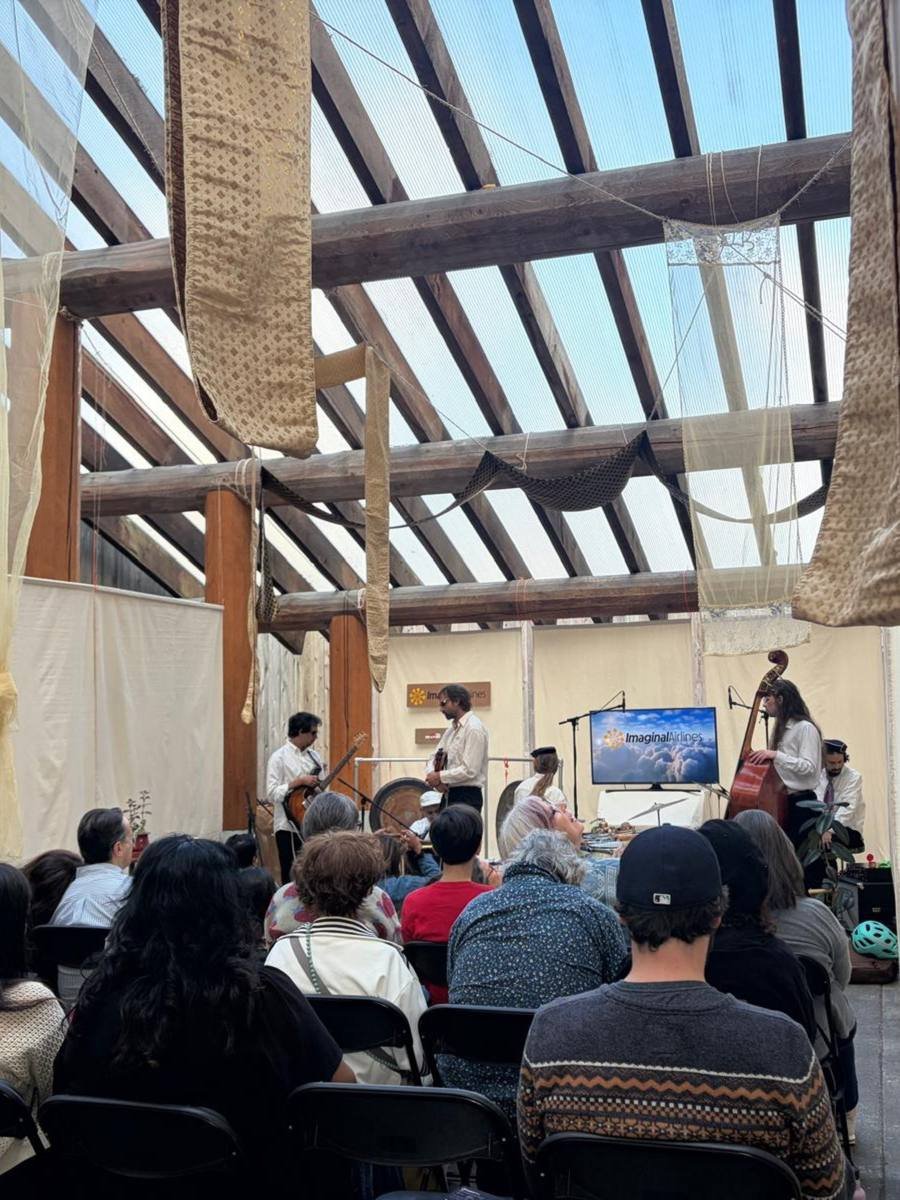
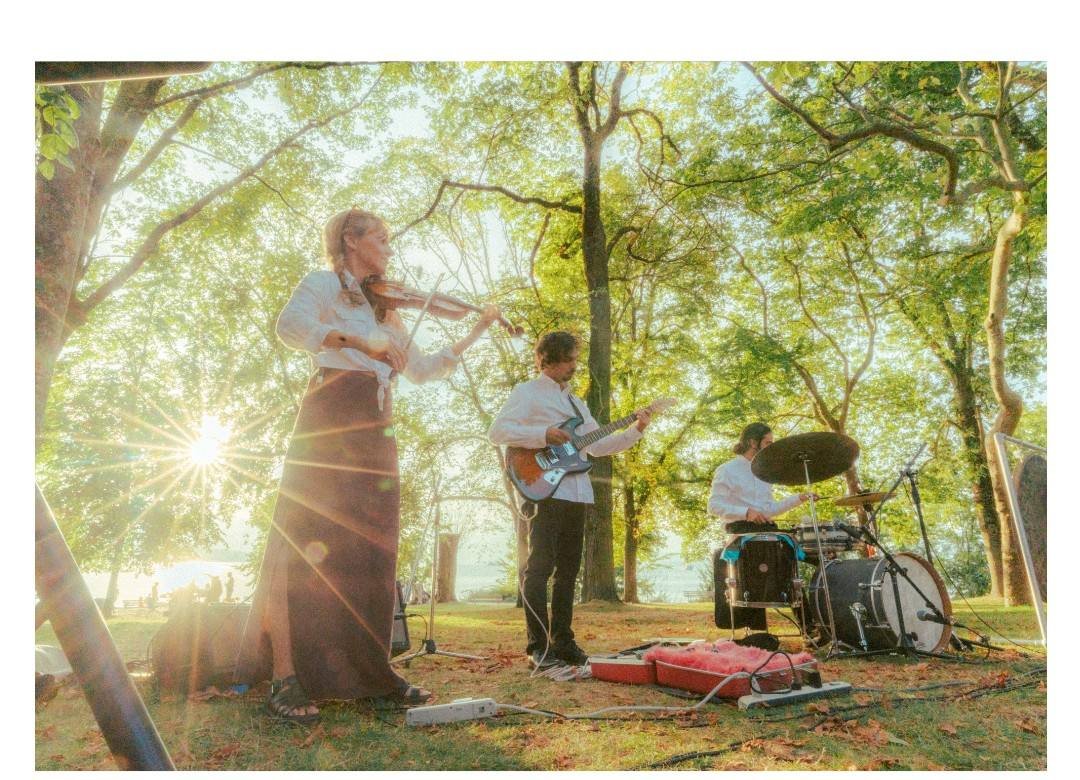
Audience and musicians gathered for an Imaginal Airlines performance at Hypha Arts
Flight A108 — Live performance at Hypha Arts.
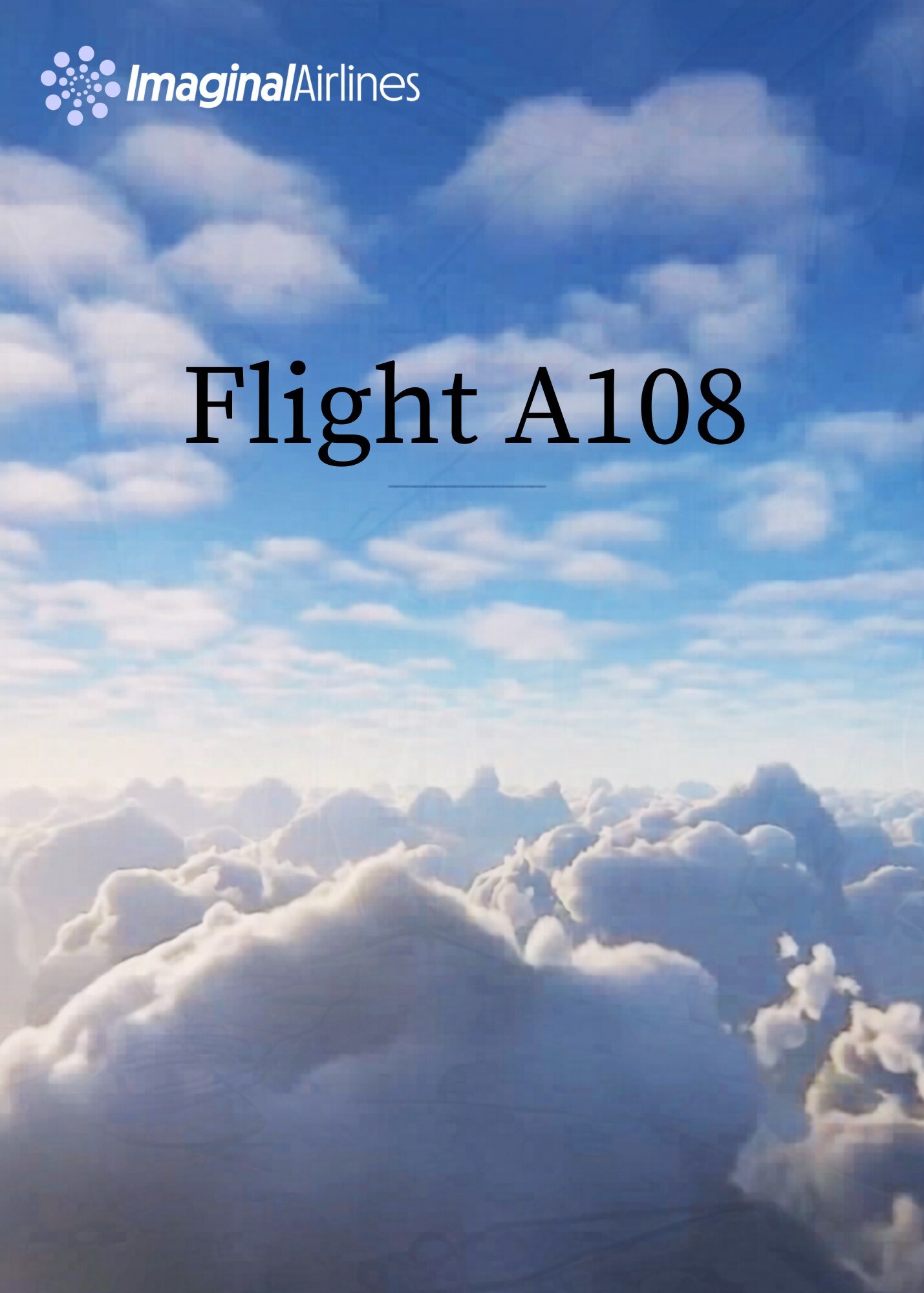
Imaginal Airlines Flight A108 visual with the logo above a field of clouds
Flight A108 — Indian Summer Festival, 2026.

Explore further

  • TF-002 Neural-Field Annealing Animated digital score The animated score system, six-phase annealing arc, and live technical architecture. European DigiScore Project
  • TF-002 Gallery 2025–2026 Photographs from Imaginal Airlines flights and performances. photography

The Team

Imaginal Airlines is made through a collaborative, interdisciplinary team of artists and musicians who shape the passenger experience.

Raj GillCreative Director and Co-Producer
Miel NicholsonCo-Producer and Wardrobe
Eli MuroWebsite and system design, graphic design, and digital score system development — muro.studio/projects/imaginal-airlines
Caroline BallhornSet Design — carolineballhorn.com
Laine ButlerMotion Graphics — lainebutler.com
Tyrell WarrenDramaturg and Lead Production
Dr. Ken FieldsMentorship and guidance — artsmesh.com/team

Imaginal Cells Sextet

Nikko WhitworthDouble bass
Matthew AriaratnamGuitar and pedals
Adrian AvendañoDrums
Jen YakamovichDrums
Irene SenentViolin
Raj GillPercussion and gongs
Special Guest
Aiden AyersViolin

Past and Current Cabin/Flight Deck

We have a rotating cast of crew members.

  • Miel Nicholson
  • Raj Gill
  • Kiefer McQuillan
  • Kate Kennedy
  • Tyrell Warren
  • Tarun Nayar
  • Emily Lisa
  • William Singh
  • Jaanum Jaswani

Performance History & Archive

  • June 2024 | Byrne Creek Secondary: The original flight — an improvisation and clown-focused session for students and staff, with Raj Gill and Nayanna Fielkov. Funded by ArtStarts. The seed of what would become Imaginal Airlines.
  • September 2024 | Sh’Bang Festival of Ideas (Washington, USA): First iteration flight.
  • September 13, 2025 | Hadden Park Field House: The inaugural live execution of the Imaginal Airlines immersive project.
  • November 2025 | West End Seniors' Network (West End, Vancouver): A community-oriented flight for seniors, led by Raj Gill and Miel Nicholson.
  • February 2026 | West End Seniors' Network (West End, Vancouver): A community-oriented flight for seniors, led by Raj Gill and Miel Nicholson.
  • March 27–28, 2026 | Hypha Arts, East Vancouver: The first indoor version, integrating the digital score and audio wheel.
  • July 2026 | Indian Summer Festival: A refined iteration with new poetic elements and deeper integration of acoustic instrumentation and rhythmic direction.

TF-002gallery

Imaginal Airlines Gallery

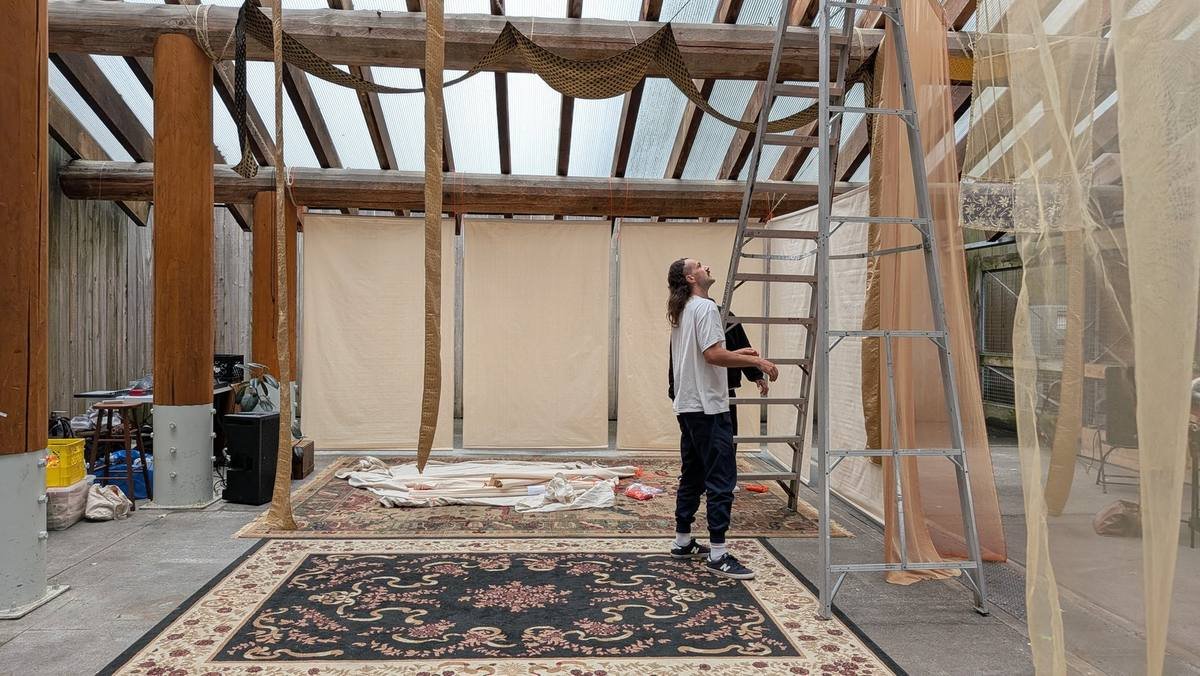
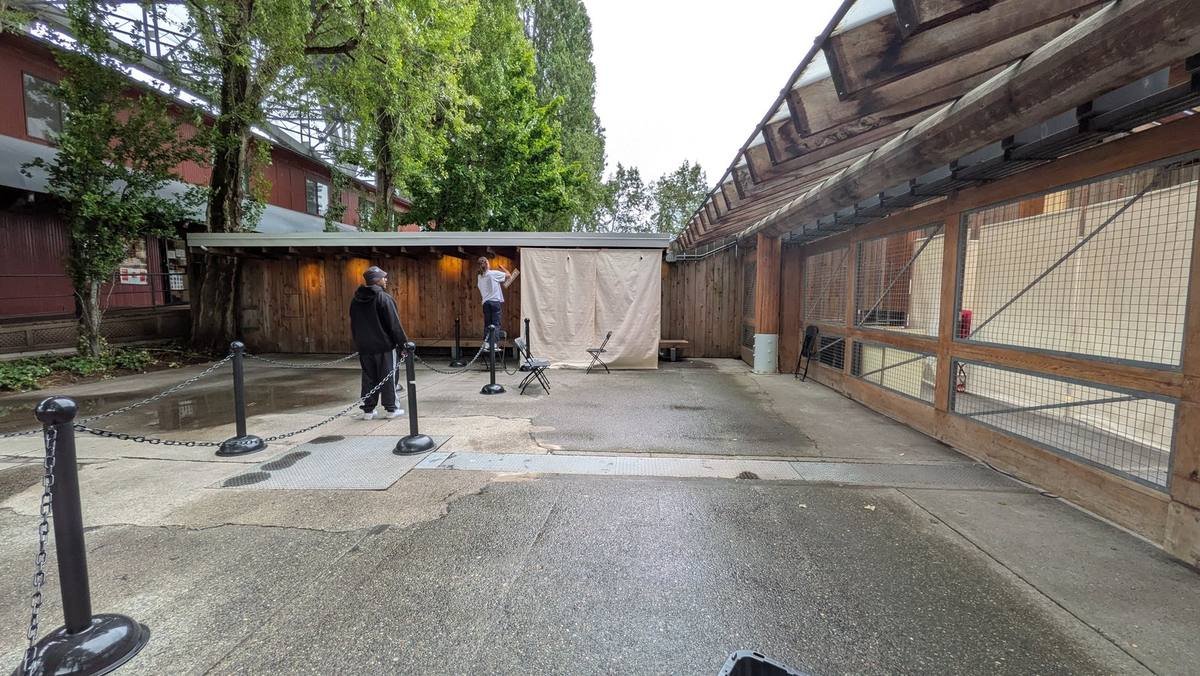
Build & Install — Indian Summer Festival, July 2026

Ocean Art Works Pavilion, Granville Island — load-in and construction.

Indian Summer Festival 2026 build documentation

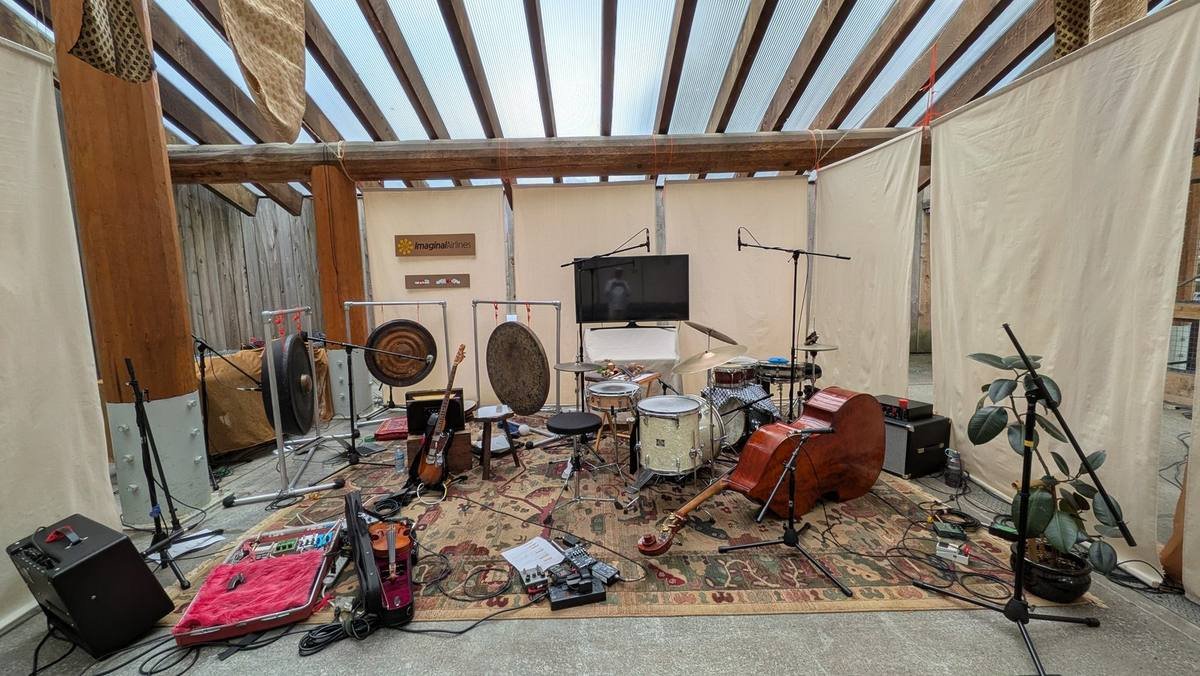
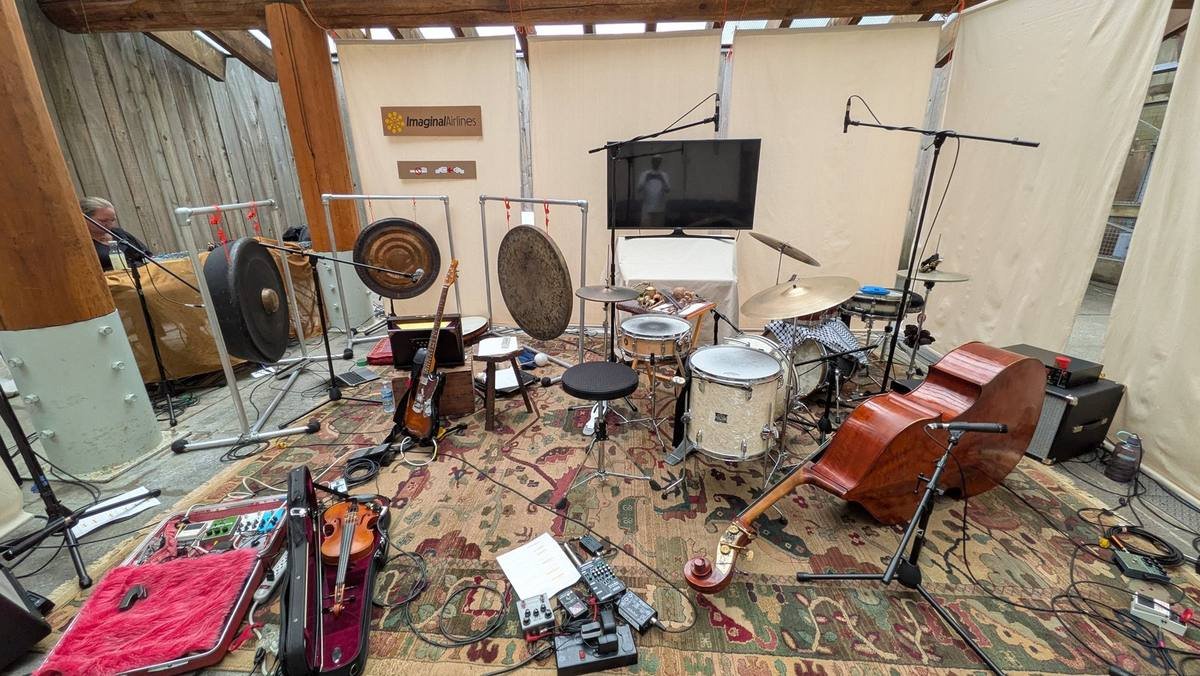
Flight Day — Indian Summer Festival, July 2026

Boarding, the Gong Library, and Flight A108 at Ocean Art Works Pavilion.

Indian Summer Festival 2026 flight day documentation

Hadden Park Field House — September 2025

The first outdoor flight at the Temporary Frames residency.

Hadden Park Field House first outdoor flight documentation

TF-002animated notation · structured improvisation · live system

Neural-Field Annealing

Animated notation Live conducting Responsive visuals

Overview

A sonic flight plan that moves an ensemble and its audience from order into controlled chaos, through silence, and toward a newly organised state.

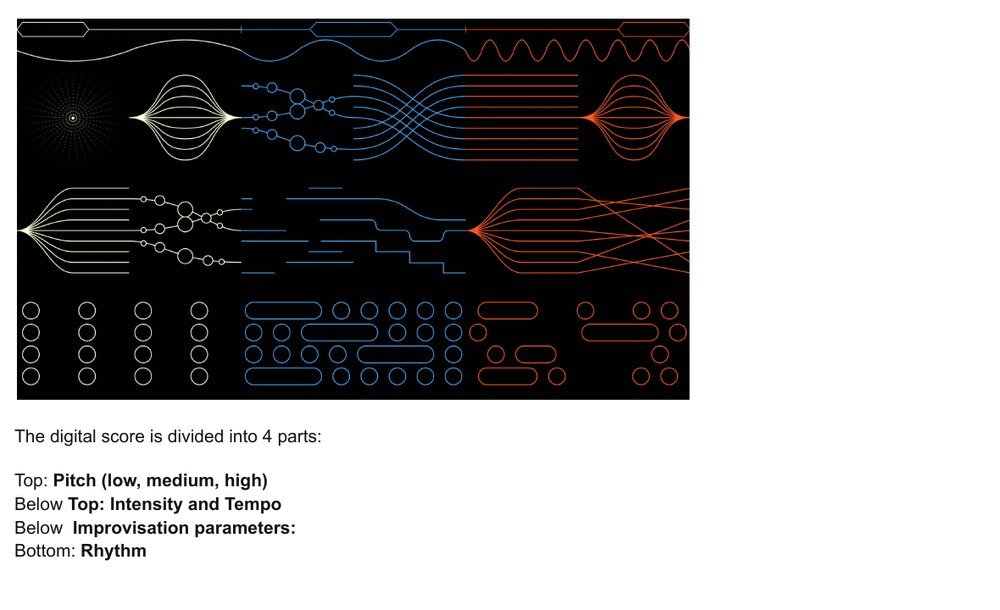
Neural-Field Annealing is an animated performance system created for Imaginal Airlines. Projected symbols, light states, and occasional sound cues give improvising musicians a common direction without fixing the notes they play.

The score translates energy, tempo, pitch, rhythm, texture, and attention into a visual language. It supports cohesion and decisive transitions while preserving individual agency, intuition, and deep listening.

The conceptual arc is inspired by work developed at the Qualia Research Institute (QRI), particularly Michael Edward Johnson’s 2019 essay Neural Annealing: Toward a Neural Theory of Everything. The essay proposes a cycle in which energy builds, established patterns loosen, a system searches for new organization, and cooling stabilizes a revised state. Imaginal Airlines translates that sequence into musical form; it does not claim to reproduce a neurological process.

DigiScore Funding

Development of Neural-Field Annealing was funded by the DigiScore European Union grant, awarded to Raj Gill and his team to develop the score.

DigiScore mandate: “We investigate the transformation of the music score through computational technologies. Digital scores utilising computational technology and digital media are emerging worldwide as the next evolutionary stage in the concept of the music score. They are generating new music experiences, innovative compositional approaches, novel performance opportunities, and broader accessibility for a vast number of musicians and music cultures around the world.”

Selected Score Symbols

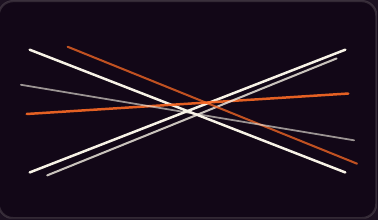
Dialogue of Dissonance score symbol with intersecting lines

Dialogue of Dissonance

Contrasting pitch, rhythm, dynamics, or timbre creates tension and musical conversation.

Pulse and Groove score symbol with connected circles

Pulse and Groove

A steady rhythmic foundation that others can join, reinforce, or play against.

Thematic Variation score symbol with changing melodic lines

Thematic Variation

A motif is reinterpreted through changes in pitch, rhythm, dynamics, or shape.

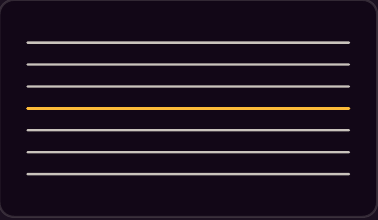
Drones and Sustained Tones score symbol with parallel lines

Drones and Sustained Tones

Long, continuous sound creates a resonant base that can evolve slowly over time.

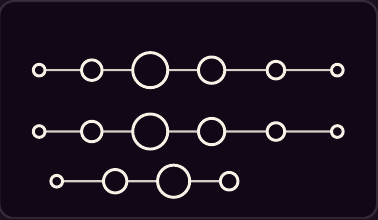
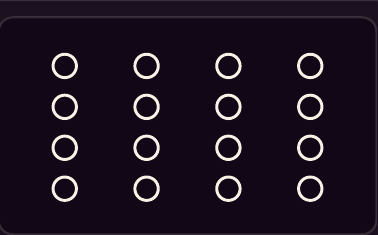
Steady Pulse score symbol with evenly spaced circles

Steady Pulse

A regular beat grounds the improvisation and supports repetition or groove.

Rhythmic Freedom score symbol with irregularly spaced circles

Rhythmic Freedom

Irregular timing, syncopation, and changing pace encourage spontaneity and play.

These are still frames from the score's actual visual vocabulary. During performance, the symbols can move, change colour, or develop over time; musicians translate the cues through their own instruments and playing practices.

How the Score Is Read

01 / Pitch

Register

Low, medium, and high fields position the ensemble within a shared spectral range.

02 / Energy

Intensity + Tempo

Movement and light indicate the speed, pressure, and overall energy of a phase.

03 / Action

Improvisation Cue

Dissonance, drone, variation, pulse, echo, layering, or another mode of interaction.

04 / Time

Rhythm

Steady, free, flowing, cyclical, call-and-response, or silence-led timing.

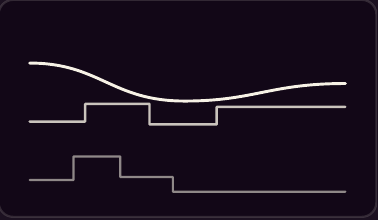
Animated digital score interface showing pitch, intensity, improvisation cues, and rhythm
Score interface — Multiple directions remain visible as one evolving field, so players can read the whole ensemble state at a glance.

Attention flash: a red light flashes three times before a new prompt, giving players roughly one bar to look toward the screen while continuing their current cue.

Silence override: when all lights go dark, every other instruction pauses. The ensemble holds a shared silence before the next movement begins.

The Neural-Field Annealing Arc

For Flight A108, the annealing arc is carried through six musical phases. The sequence moves from activation into a coherent groove, increases pressure until structure breaks down, and then uses silence, tonal clarity, and a fragile return to let a changed form settle.

01 / Activation

Takeoff

Begin in silence and build the sound of a plane taking off: low rumble, rising pitch, and increasing density. At full roar, the field opens into flight.

00:00–03:00 · Rising energy
02 / Coherence

Cruise

A repeating pulse becomes the shared field. Players enter one at a time, fit into one another’s gaps, and make mutations small enough that change remains continuous.

03:00–18:00 · 110→120 BPM · D Mixolydian
03 / Pressure

Descent

Tempo drops while weight and density rise. Long low tones and wide gaps gather in waves, each larger than the last, gradually destabilizing the earlier groove.

18:00–38:00 · 35–40 BPM · D Phrygian
04 / Disintegration

Breakdown

Structure dissolves into free tempo, dissonance, friction, and noise. The ensemble plays against itself, building to a clear peak and a simultaneous stop.

38:00–40:00 · Free tempo · Atonal
05 / Reorientation

Silence and Solo

All lights go dark and the ensemble holds one full minute of silence. A single player then introduces the simplest possible D-major material, with bass joining quietly.

40:00–45:00 · Silence → D Major
06 / Recrystallization

The Return

The Cruise groove returns at a fraction of its former volume—recognizable, but quieter and more fragile. The music simplifies, fades, and lands in complete silence.

45:00–55:00 · D Major · Landing

The arc connects Flight A108’s musician manual to the annealing metaphor: energy build → coherence → pressure → disintegration → reorientation → recrystallization. It remains a responsive performance form; timing and transitions can be shaped by the conductor, ensemble, and room.

The Score in Performance

Performance documentation · YouTube
Gong Library Ensemble using Neural-Field Annealing. Watch directly on YouTube ↗

The Gong Library Ensemble uses the score to coordinate resonant metal, guitar, violin, and percussion. Shared cues support changes in density and intensity while leaving space for each musician's timing, touch, and response.

Sonic Mandala

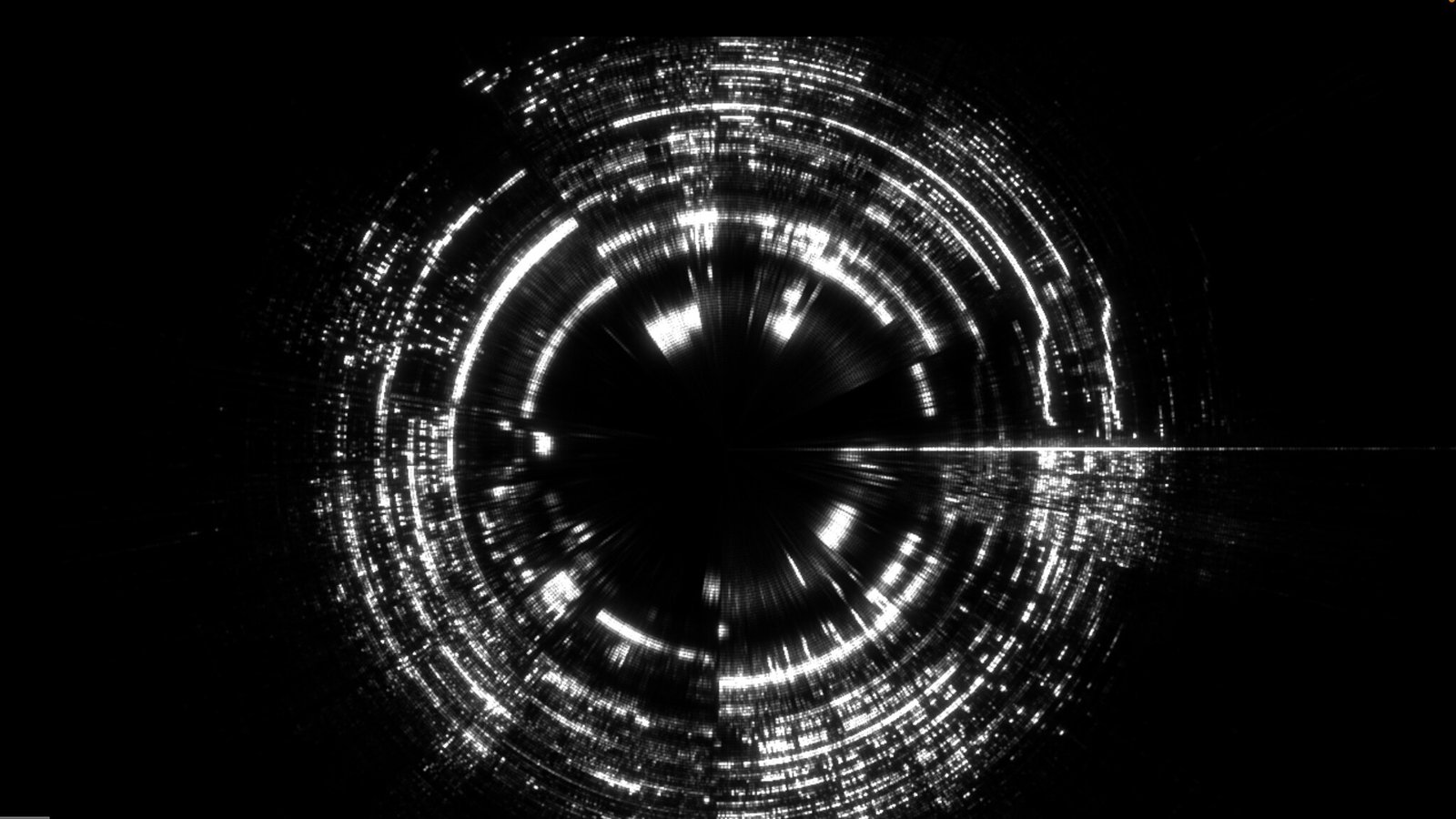
Black-and-white sonic mandala generated from the live ensemble frequencies during Imaginal Airlines Flight A109
Flight A109 · March 2026 — A sonic mandala generated from the live performance.

The sonic mandala is a real-time spectral image produced from the ensemble's combined frequencies. FFT analysis in TouchDesigner maps peaks, resonances, and changing density into concentric visual traces. Because it is generated by the sound in the room, every flight leaves a different visual fingerprint.

Live System

The system connects live conducting, animated notation, projection, lighting, and sound-responsive visualization. Its purpose is to create enough shared structure for musicians to take risks together.

Live conducting
Ableton Live and Push 2 launch score scenes, sequence phases, and shape rhythm, intensity, and timing.
Control data
MIDI and continuous-controller information connect the conductor's actions to the visual and lighting systems.
Visual score
TouchDesigner assembles, triggers, and projects the animated symbols for the musicians.
Environment
Projection, DMX lighting, attention signals, phase colours, and the FFT sonic mandala operate as one responsive field.

Credits

Composition + Creative DirectionRaj Gill
Systems + Graphic DesignEli Muro
Motion GraphicsLaine Butler
Live EnsembleImaginal Cells and Gong Library Ensemble
Digital Score FundingDigiScore European Union grant — awarded to Raj Gill and his team
Additional SupportCreative BC

TF-006music / listening · episodic

International Drone Day

Record

Frame no.
TF-006
Status
active / episodic
Documented iteration
2025
Hours
10:00 AM–4:00 PM
Format
Daytime experimental music / deep listening event
Location
Hypha Arts and Gong Library, Vancouver, BC
Project
A Gong Library and Temporary Frames Arts Society project
Project Producer / Co-curator
Raj Gill
Co-curator
Matthew Ariaratnam
Presented with
Hypha Arts

Project Overview

Hosted in 2025, International Drone Day was a dedicated exploration of sustained sound, deep listening, and immersive acoustic environments. Deliberately structured as an “early show,” the event ran continuously from 10:00 AM to 4:00 PM, shifting the typical late-night context of experimental music into a daytime setting. The gathering brought together a diverse lineup of sound artists, musicians, and collectives to celebrate drone music as both a sonic practice and a communal, relational experience. Across the day, the event moved through Indian classical, gamelan, modular synth, acoustic, gong-based, live electronics, and electroacoustic approaches to drone-inspired music.

Spatial Curation and The Lineup

To create distinct auditory environments, the event was physically and conceptually divided across two rooms:

The sonic palette across the program included Indian classical, gamelan, modular synth, acoustic, gong-based, live electronics, and electroacoustic practices.

The Hypha Arts Main Space

Dedicated to electronic drone and digital synthesis, creating an immersive, frequency-driven atmosphere.

The Gong Library

Focused entirely on acoustic and live instrumentation, offering a grounded, resonant, and physical sonic experience.

Artists & Contributors
  • Putu Swaryandana Ichi Oka
  • Akhil Jobanputra
  • Souns (Michael Red)
  • how to survive a high rise hotel fire — collective started by bassist Nikko Whitworth and oboist Haley Bird
  • J.T. Gladysz
  • Screens — Harley Small and Jordaniel Bennett
  • Gong Library Resource — Irene Senent, Matthew Ariaratnam, and Raj Gill

Thematic Context

International Drone Day prioritized acoustic intimacy and collective resonance. By programming the performances during the day and physically separating the electronic and acoustic elements into two distinct spaces, the event allowed attendees to curate their own auditory journey. It offered participants a shared, daytime meditative space to explore the physical and emotional impacts of sustained audio across different mediums, reinforcing the use of sound and spatial design as structural tools to build temporary, immersive community containers.

Documentation

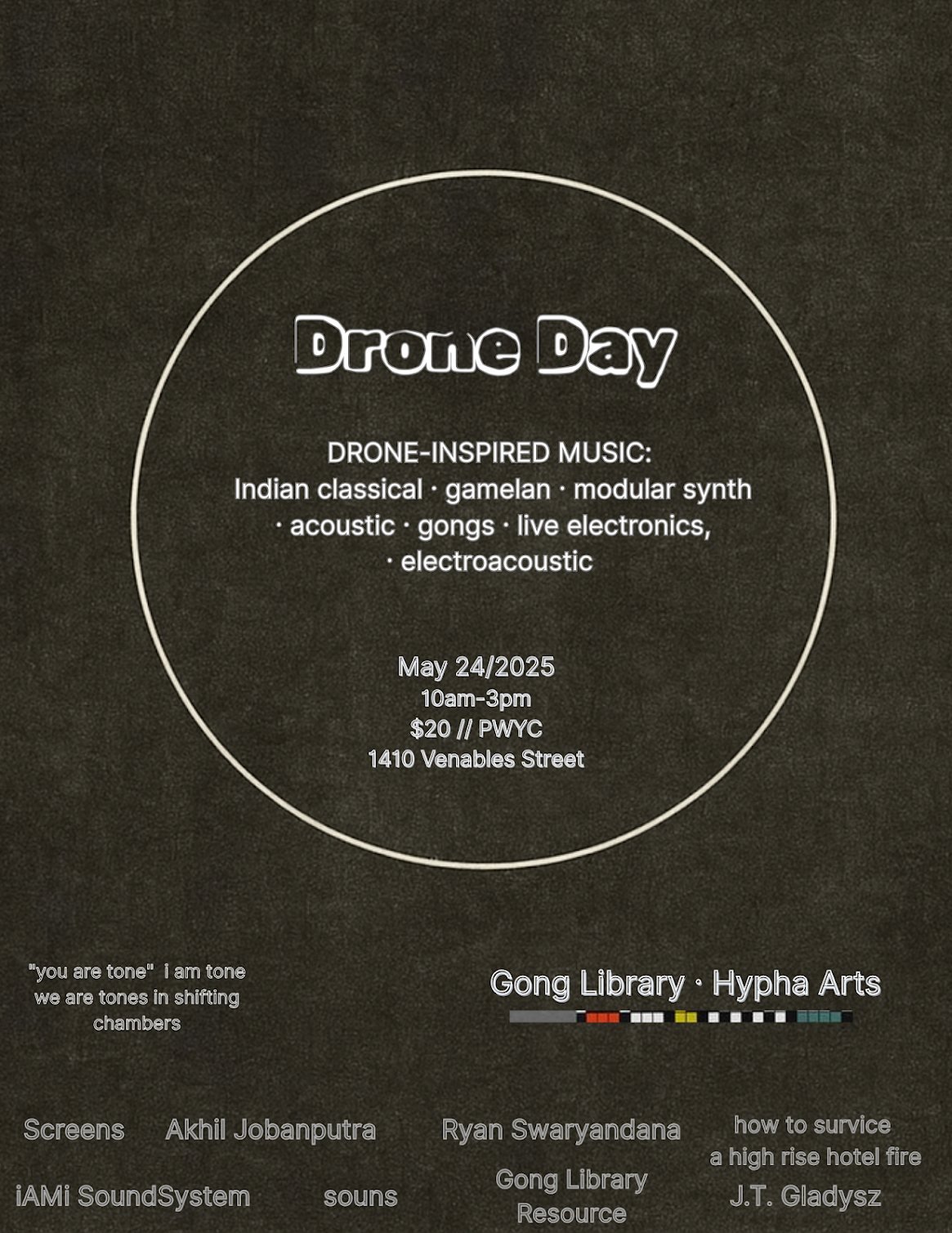
Archival materials and photographs from the 2025 edition of International Drone Day.

Promotional poster for International Drone Day listing the date, venue, and participating artists.
Promotional poster for the 2025 edition of International Drone Day.
A schedule poster for International Drone Day showing set times and room assignments.
Set-time poster for the 2025 edition.
Audience members and children seated in the Hypha Arts main space during J.T. Gladysz’s performance.
Daytime audience gathering in the Hypha Arts main space during J.T. Gladysz’s performance.
Akhil Jobanputra performing in the Gong Library, surrounded by gongs and hanging instruments.
Akhil Jobanputra performing in the Gong Library.
Nikko Whitworth and Haley Bird of how to survive a high rise hotel fire performing in the Gong Library.
how to survive a high rise hotel fire — Nikko Whitworth and Haley Bird performing in the Gong Library.

TF-000gallery · 2018–2021 (concluded)

Wheel of Time Gallery

Record

Frame no.
TF-000
Status
Concluded via demolition, 2021
Years active
2018–2021
Format
Experimental art space
Location
Kids Castle, 2655 Renfrew Street, Vancouver, BC
Property
Leased from The Molnar Group
Producer / Curator
Raj Gill
Lead Installer / Spatial Designer
Tyrell Warren — main collaborator
Also housed
CLOUD Studio — garage converted to movement and clowning workspace
Exhibition cycles
7 (over 40 artists and musicians)
Relationship to TF
Foundational incubator for the Temporary Frames Arts Society

Description

Active for three years before the property's eventual demolition, the Wheel of Time Gallery served as the foundational incubator for the Temporary Frames Arts Society. The gallery leased the property from The Molnar Group at 2655 Renfrew Street, transforming it into a living mandala and a dynamic community hub. Over its lifespan, the gallery hosted seven distinct exhibition cycles, showcasing the work of over 40 local and international artists and musicians before concluding its physical existence in 2021.

Project statement

The conceptual framework for the gallery emerged from a chance encounter with the Kalachakra ("Wheel of Time") Tantra at the Dorje-Ling Dharma Centre on Cortes Island — a Tibetan Buddhist teaching focused on the cyclical nature and inevitable impermanence of all material forms. Rather than resisting the structural fate of the teardown house, the project actively "annealed" it.

Drawing upon Hakim Bey's concept of the Temporary Autonomous Zone (TAZ), as well as the philosophical frameworks of Nietzsche's eternal return, Bergson's duration, Dewey's Art as Experience, and Ron Fricke's cinematic work Samsara, the property was treated as a living, breathing canvas. It provided a rare, uncommodified environment to rework, rewrite, and reimagine what a domestic home could be. It operated simultaneously as a gallery, an active studio, and a living space, with many participating artists serendipitously finding their way into the project through chance encounters in the city.

Exhibition history — the cycles

Cycle #1 — Grand Opening“How well do you know your neighbours?” — February 4, 2018. Artist talk and performance. Artists: Tyrell Warren (Artist-in-Residence), Filiz Fuchs, Raj Gill.
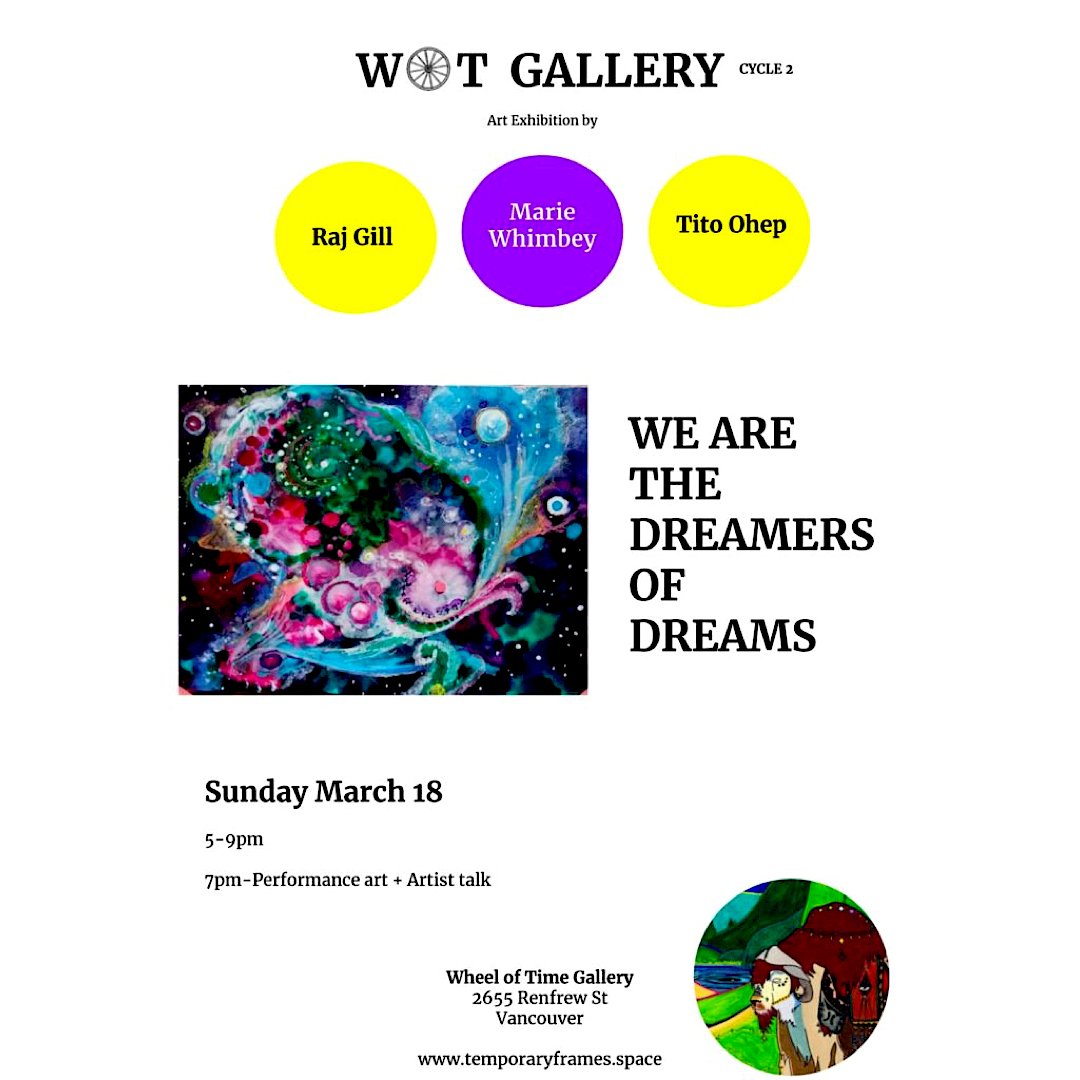
Cycle #2“We Are the Dreamers of Dreams” — March 18, 2018. Artist talk and performance. Artists: Raj Gill, Marie Whimbey, Tito Ohep.
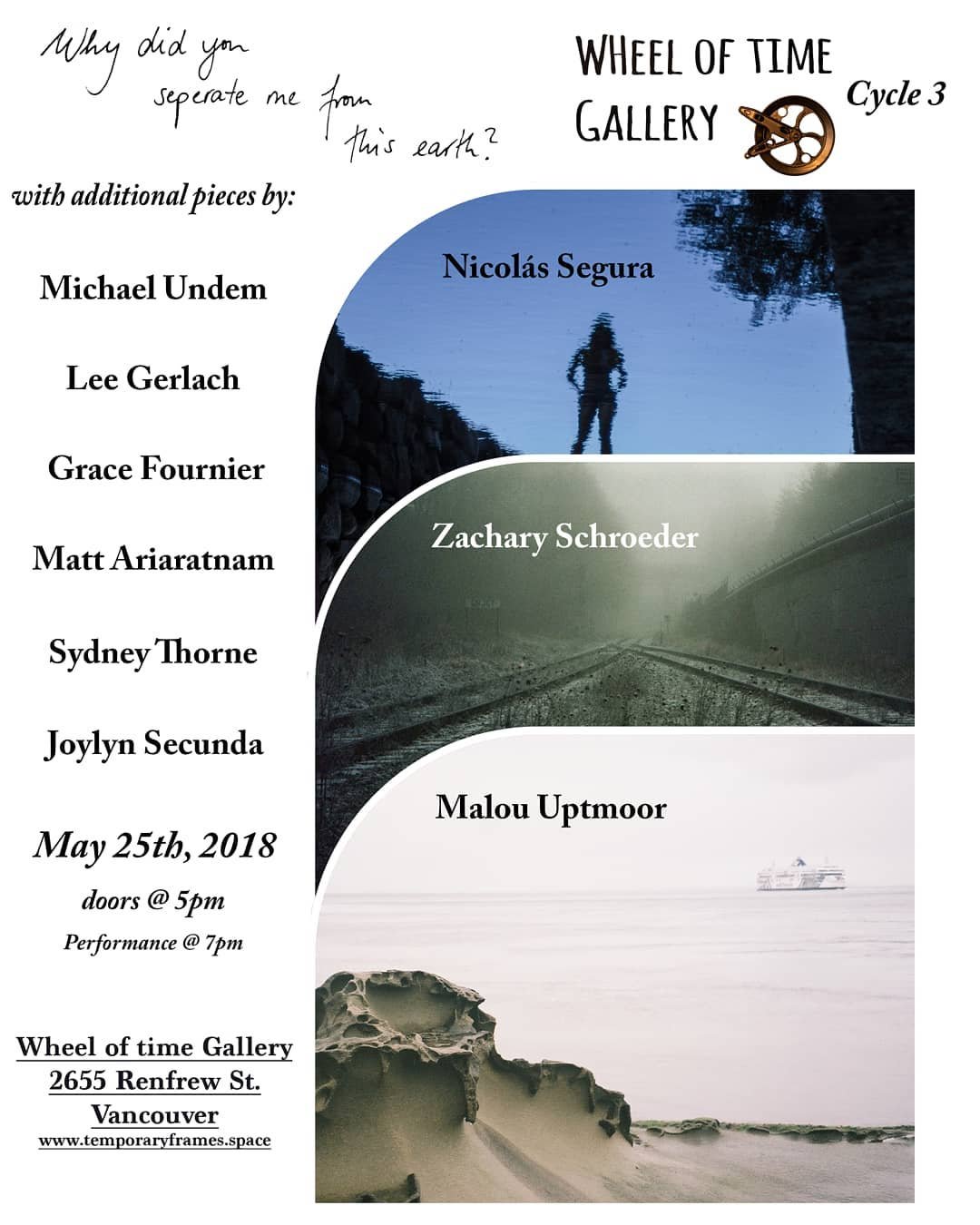
Cycle #3“Why Did You Separate Me From This Earth?” — May 25, 2018. Artist talk and performance. Artists: Nicolás Segura, Zachary Schroeder, Malou Uptmoor, Michael Undem, Lee Gerlach, Grace Fournier, Matt Ariaratnam, Sydney Thorne, Joylyn Secunda.
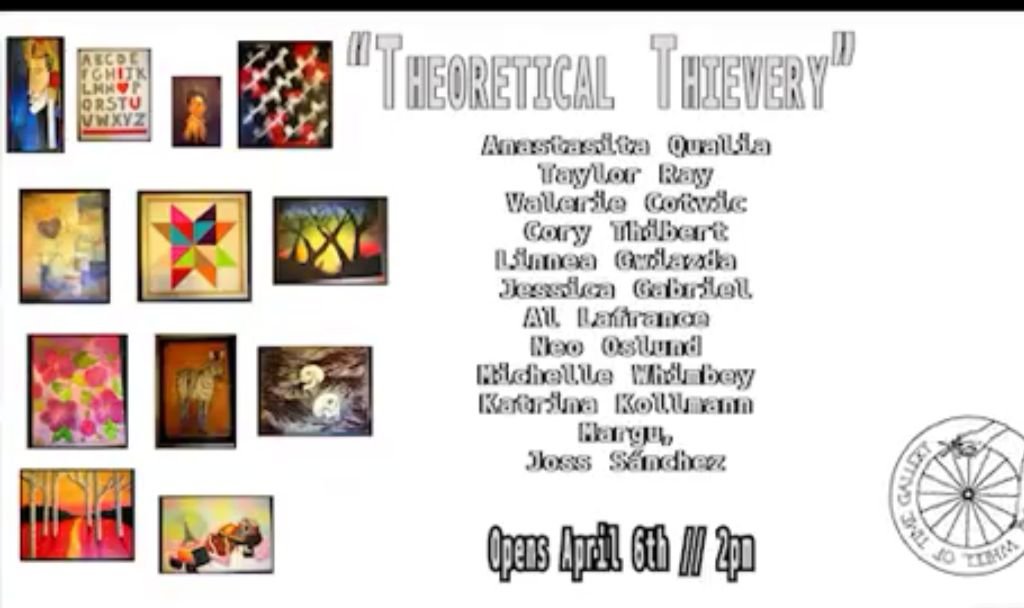
Cycle #4Theoretical Thievery — opened April 6. Artist talk and performance. Curated by Al Lafrance. Artists: Anastasia Qualia, Taylor Ray, Valerie Comic, Cory Thibert, Linnea Gwiazda, Jessica Gabriel, Al Lafrance, Neo Oslund, Michelle Whimbey, Katrina Kollmann, Margo, Joss Sánchez. Musicians: DJ Bloomer, Sumwun, The Baker.
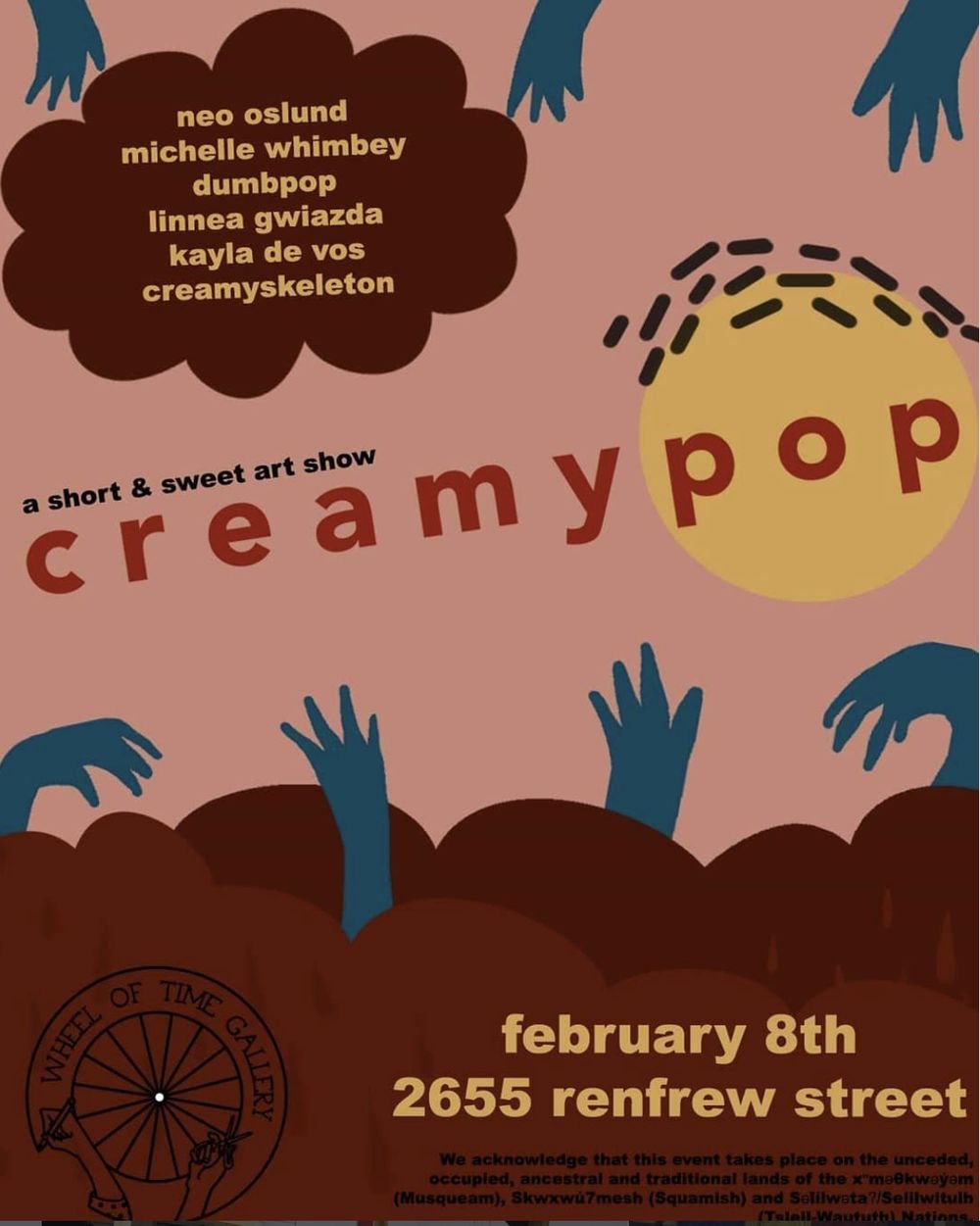
Cycle #5Creamy Pop: “A Short and Sweet Art Show” — February 8. Artist talk and performance. Curated by Matthew Ariaratnam. Artists: Neo Oslund, Michelle Whimbey, Dumbpop, Linnea Gwiazda, Kayla de Vos, creamyskeleton.
Cycle #6Jazz and Resurrection — artist talk and performance. Artists: Denise Fort, Anwar Nasar, Nico Woodward, Marcelo Vieira, Neo Oslund, Michelle Whimbey, Jimi James Fraser, Brad Pearson, Max Huberdeau.
Final cycleMy Mental Institution — solo exhibition by Raj Gill. Lead installer, spatial designer, and main collaborator: Tyrell Warren. Shaped by COVID-19 gathering restrictions, the planned final group show pivoted into a solo installation exploring “editions of reality” and the psychological loops we inhabit. Preserved digitally as a virtual tour.

Final exhibition — My Mental Institution

Location
Wheel of Time Gallery, 2655 Renfrew Street, Vancouver, BC
Artist
Raj Gill
Lead Installer / Spatial Designer
Tyrell Warren — main collaborator
Timeline
Final two months before building demolition, circa 2020–2021
Format
Site-specific solo installation / performance / virtual tour
Archive status
Final activation of the Wheel of Time Gallery; digitally preserved

My Mental Institution was the final exhibition at the Wheel of Time Gallery before the building was demolished. A planned group exhibition was reconfigured as a solo work in response to COVID-19 gathering restrictions, turning the enforced isolation of the period into part of the project’s subject.

A personal bedroom was transformed into an all-white installation, with the walls, ceiling, and floor painted white. The room became a self-constructed institutional space through which Gill examined repetition, perception, identity, and the psychological routines that can come to feel fixed or automatic.

Editions of Reality

The exhibition drew on Gill’s physical-theatre and clown training, particularly David MacMurray Smith’s framework of perceptual “editions of reality”: the ways perception is organized into meaning, predictability, repetition, and habitual patterns, alongside the possibility of interrupting those patterns through surprise or a return to apparent chaos.

Part of the work also grew from a formative 2005 volunteer experience at a mental health facility that raised questions for Gill about clowning, perception, repetition, and the ethics of encountering other people’s realities. Rather than using that experience to make claims about mental illness, the exhibition redirected the inquiry toward the artist’s own recurring behaviours and conditioned patterns: What loops do I inhabit? What becomes automatic? Where does a different choice become possible?

Within the white room, the “institution” therefore became both spatial and internal. The self could be understood simultaneously as the person caught inside recurring patterns and the observer capable of noticing, editing, or redirecting them.

Impermanence & Preservation

The exhibition also completed the Wheel of Time Gallery’s longer engagement with impermanence. The house had always been understood as temporary: a residential structure awaiting demolition that was gradually transformed into a gallery, studio, living space, and collective artwork.

In the final months, the impending demolition gave the exhibition a literal endpoint. Themes of cyclical time, repetition, destruction, and renewal—already present throughout the Wheel of Time project through the Kalachakra (“Wheel of Time”), Bergson’s duration, and the idea of eternal return—became embedded in the final activation of the building itself.

Because pandemic restrictions limited conventional public access and the building was nearing demolition, My Mental Institution was preserved digitally as a virtual tour, allowing a record of the final spatial transformation to remain after the physical site disappeared.

Virtual tour

A digital record of the Wheel of Time Gallery’s final site-specific exhibition, made before the building was demolished. Watch on YouTube.

Photographic documentation

Documentation stills from My Mental Institution, tracing the Wheel of Time Gallery from its active life through the final installation, virtual performance, and demolition of the house.

Street view of the Wheel of Time Gallery house behind a white fence and large tree
The site — Wheel of Time Gallery at 2655 Renfrew Street during its active life.
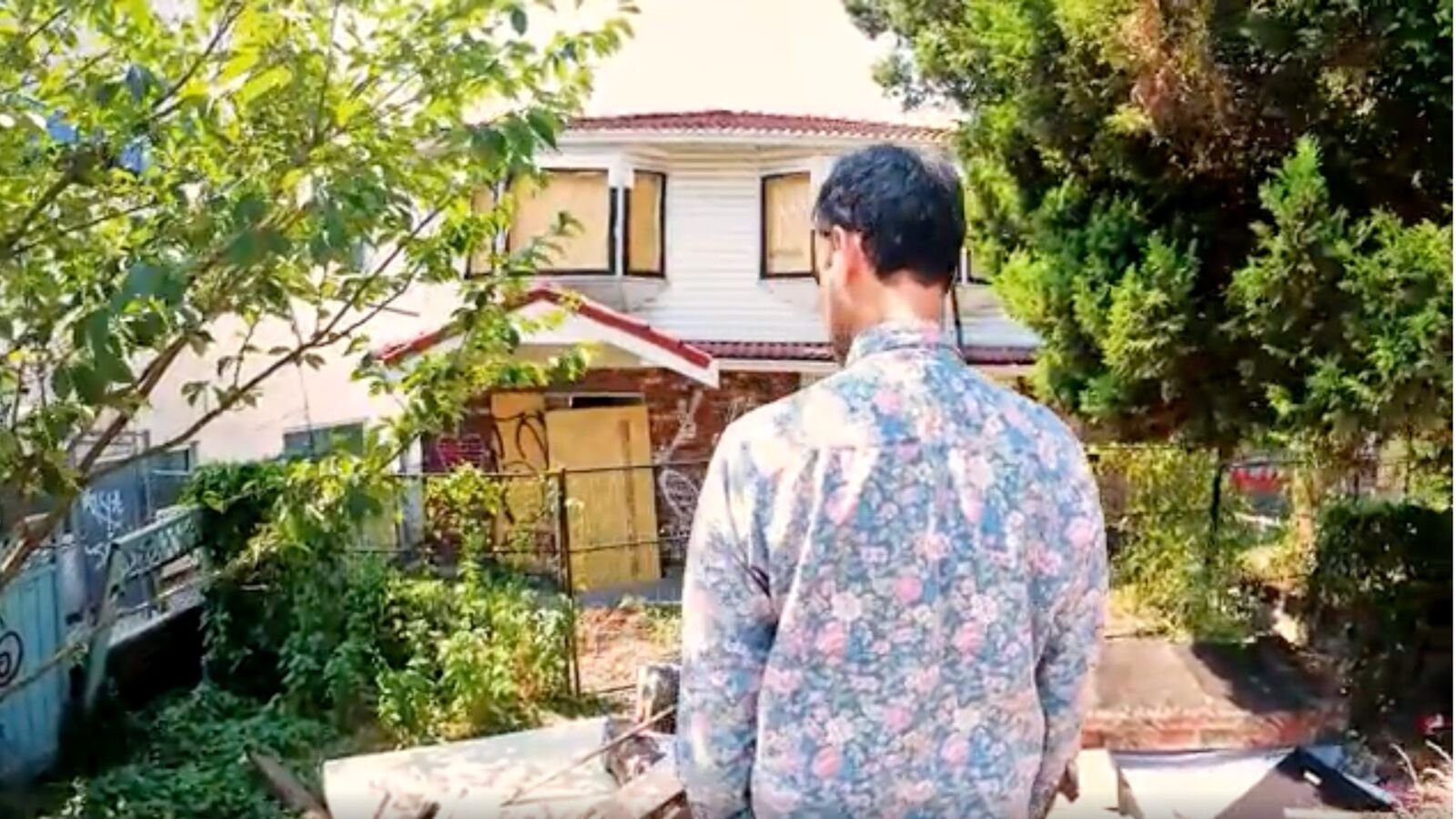
Front exterior of the boarded Wheel of Time Gallery house as Raj Gill stands in the yard
Final phase — Front exterior of the vacated property as it approached demolition.
Raj Gill facing the boarded rear exterior of the house amid an overgrown garden
Final phase — Rear exterior of the property before demolition.
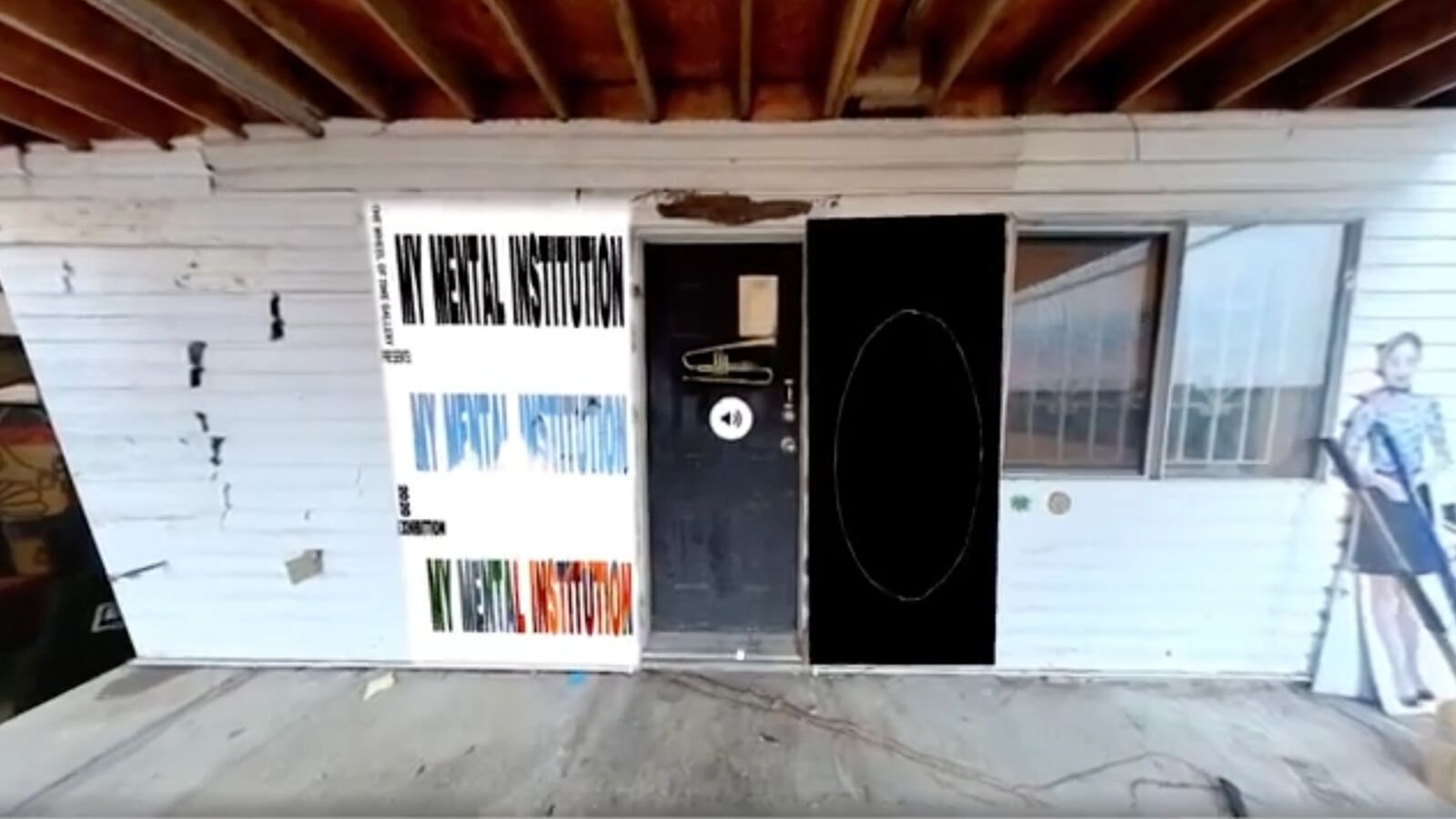
Exterior threshold of My Mental Institution with repeated title panels and a black doorway
Threshold — The entrance to My Mental Institution, with the exhibition title repeated across the exterior wall.
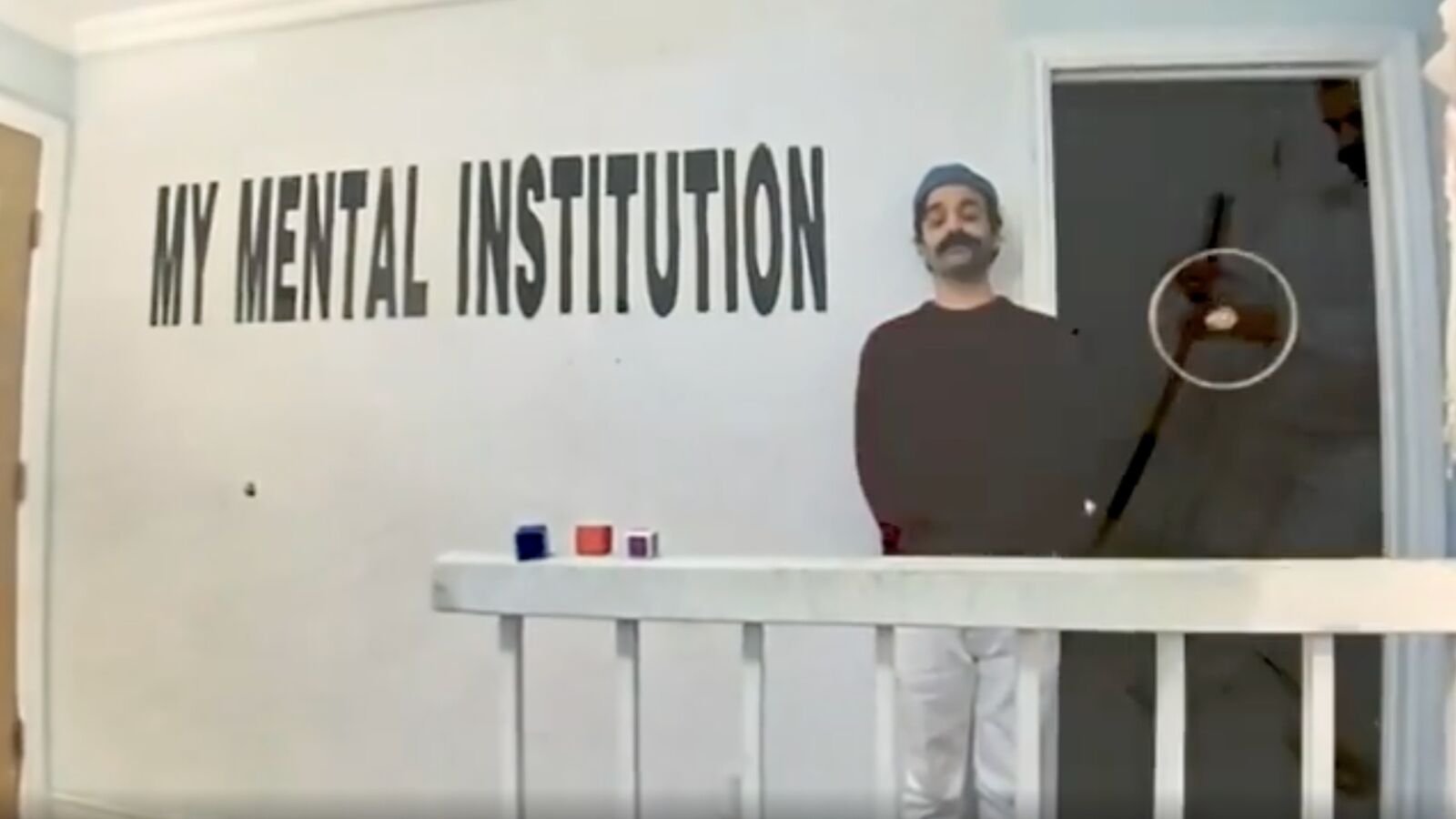
Raj Gill standing beside the My Mental Institution title wall at the entrance to the white room
Title wall — Raj Gill at the entrance to the all-white installation.
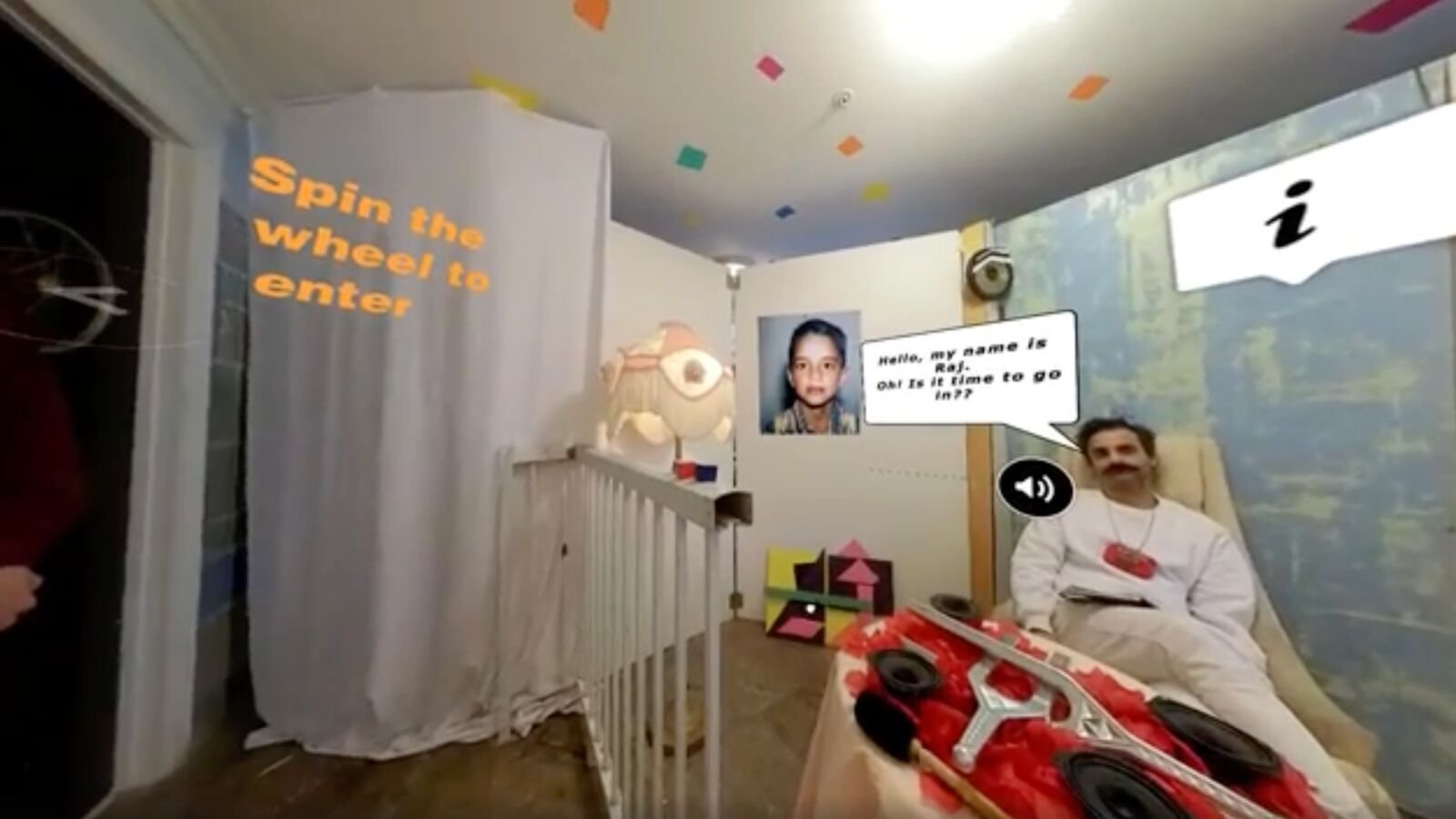
Interactive virtual-tour landing with Raj Gill, navigation prompts, projected text and personal imagery
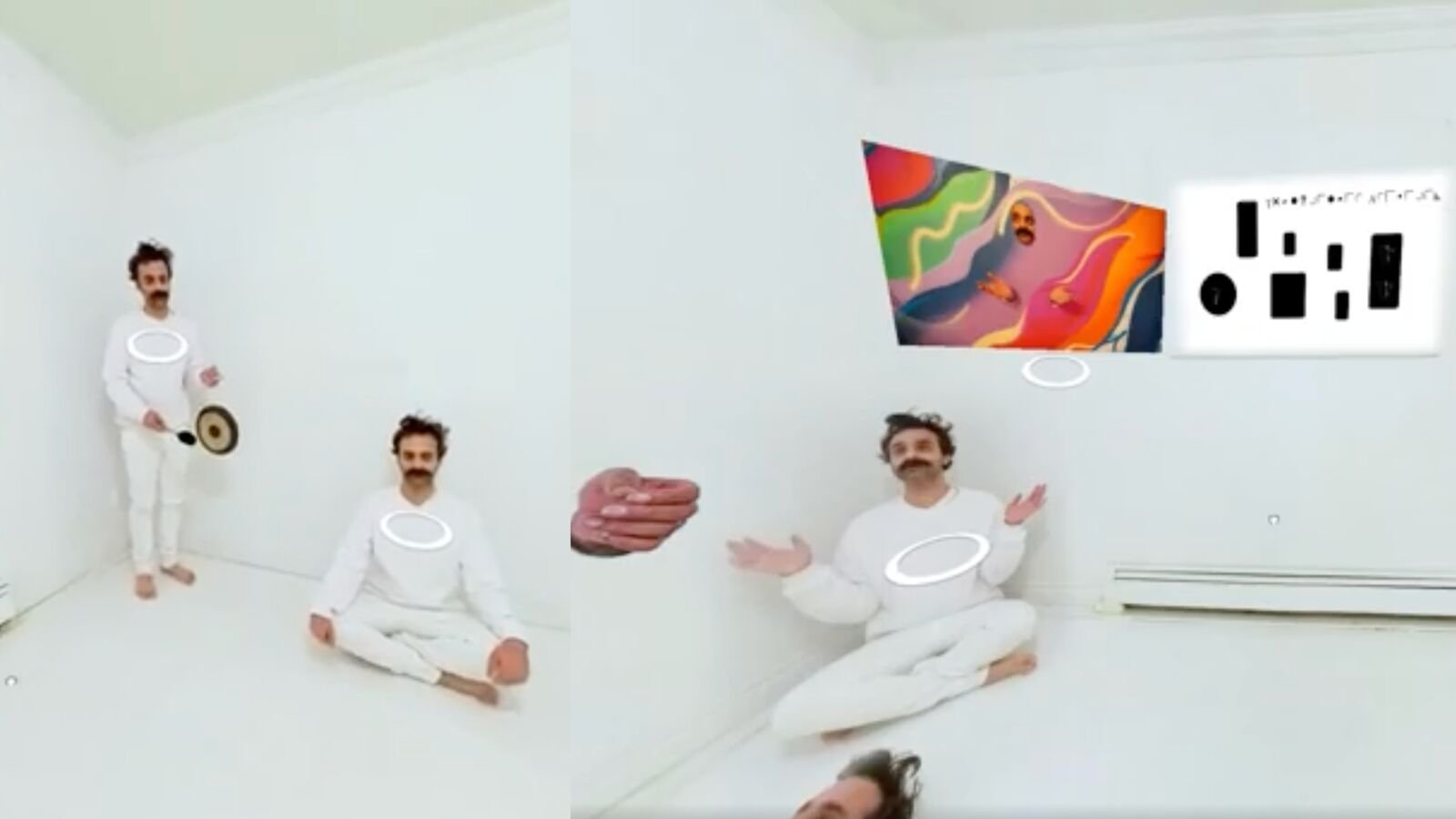
Virtual tour — Navigation prompts, personal imagery, sound cues, and a performed self occupy the upper landing.
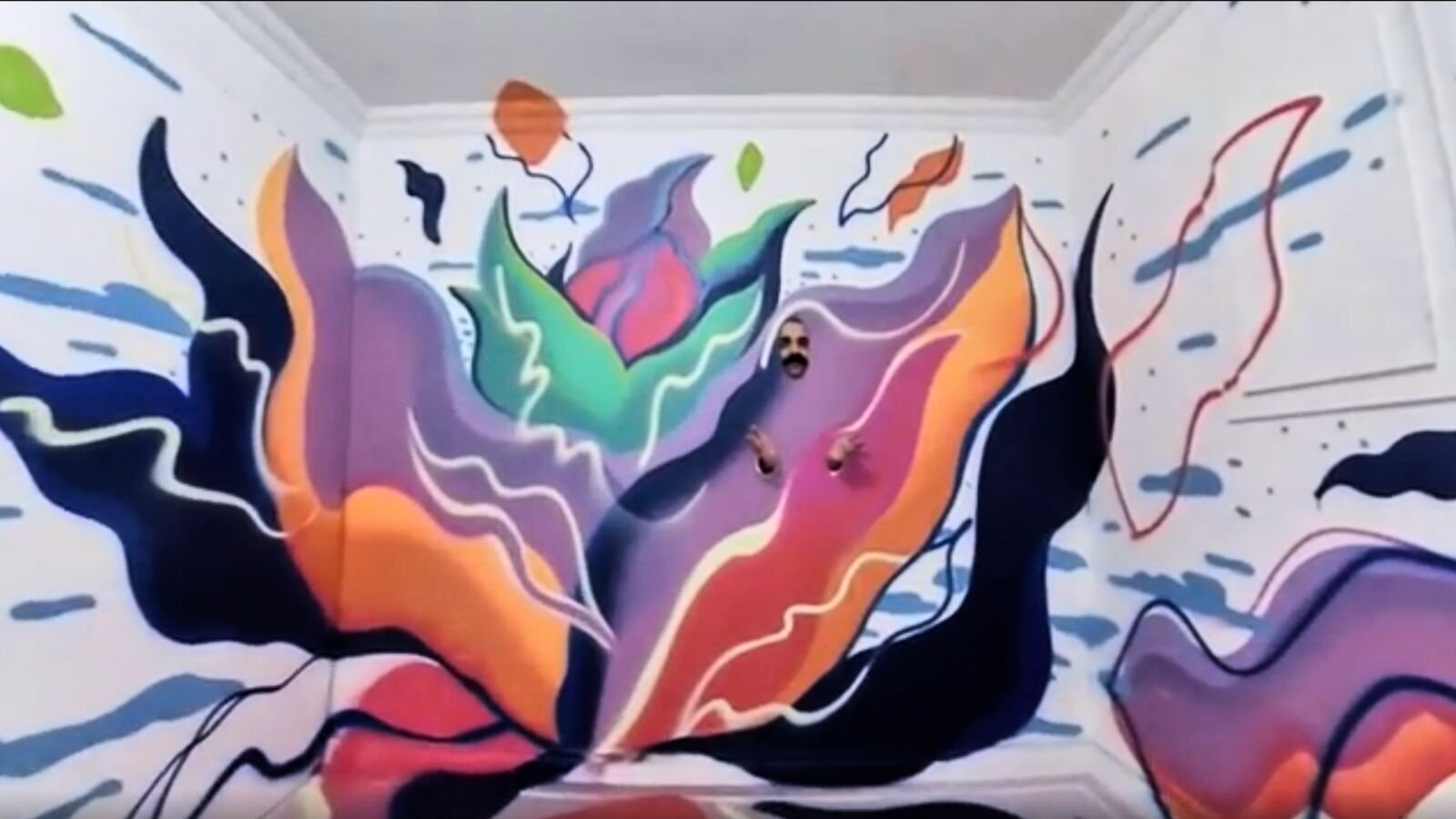
Raj Gill appearing within a colourful abstract mural painted across the walls of a room
Painted room — An immersive mural environment activated by the artist’s body.
Multiple versions of Raj Gill appearing in the white room alongside digital interface elements and artworks
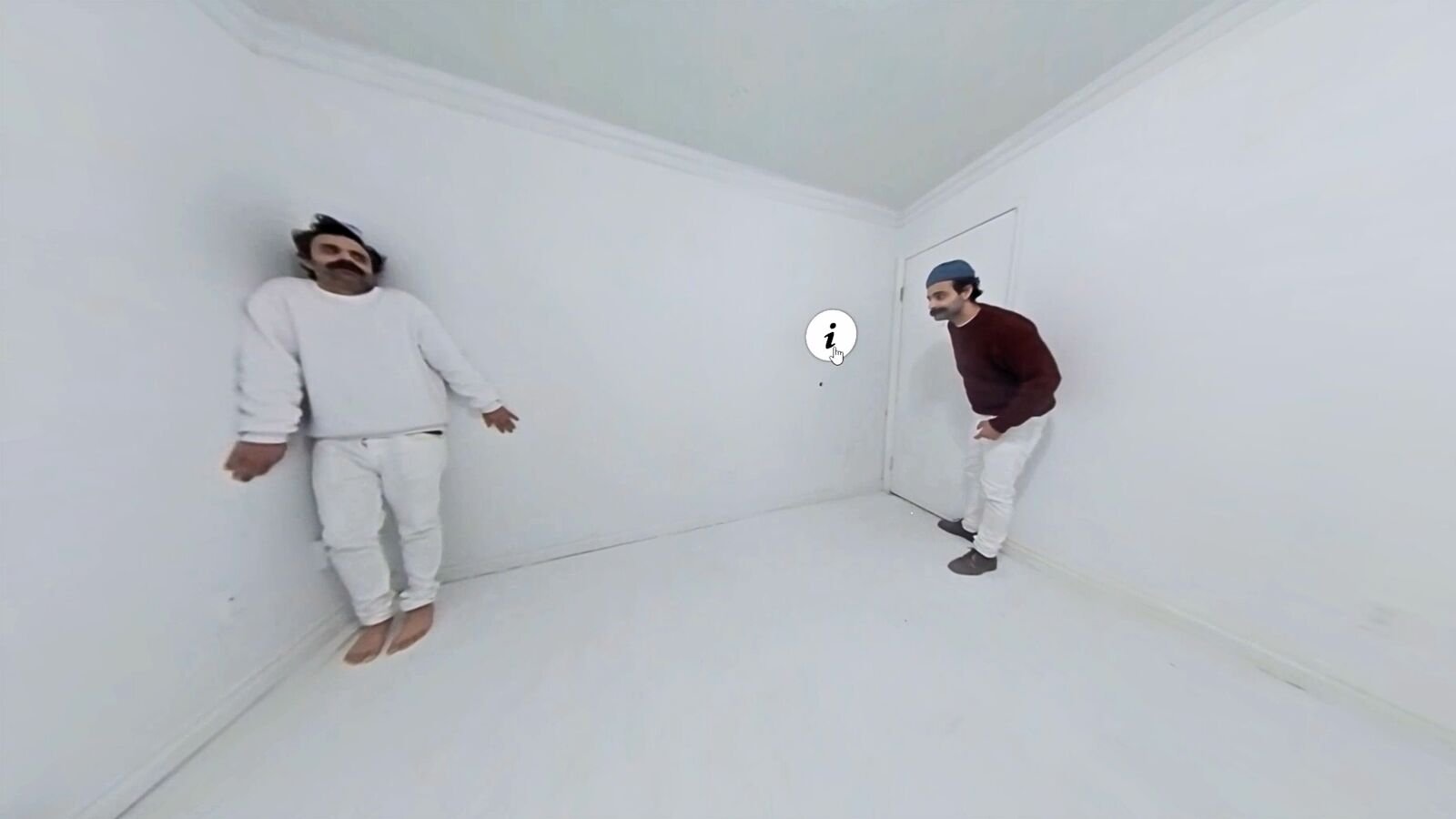
Editions of reality — Multiple performed versions of the artist appear within the installation and its digital interface.
Two overlapping views of Raj Gill moving inside the white room installation
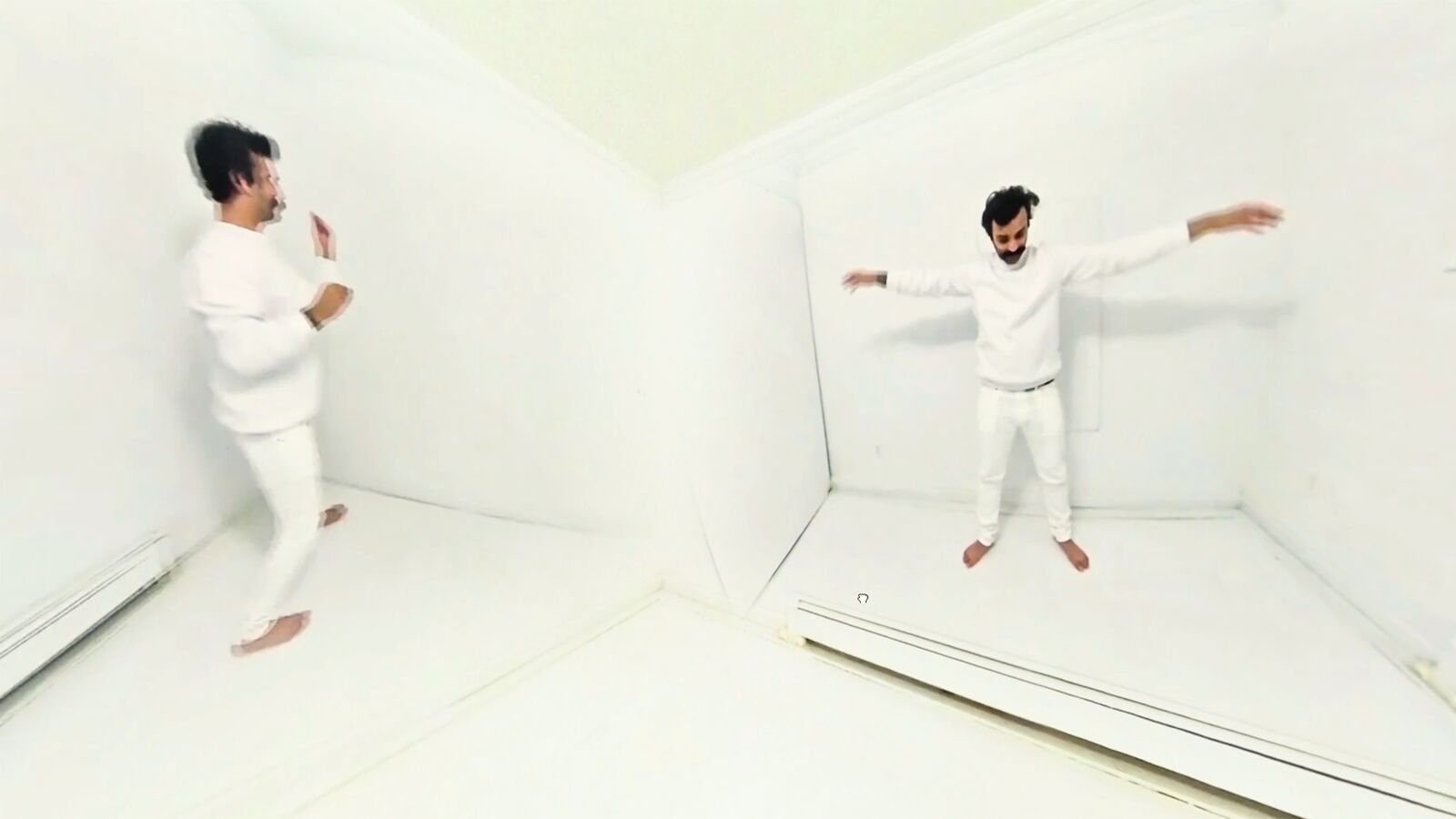
White room — Movement performance inside the room painted white from floor to ceiling.
Two contrasting versions of Raj Gill face one another inside a digitally distorted white room
Counterparts — Doubled figures meet inside the digitally preserved room.
Raj Gill performing with a reflective sculptural form inside the white room
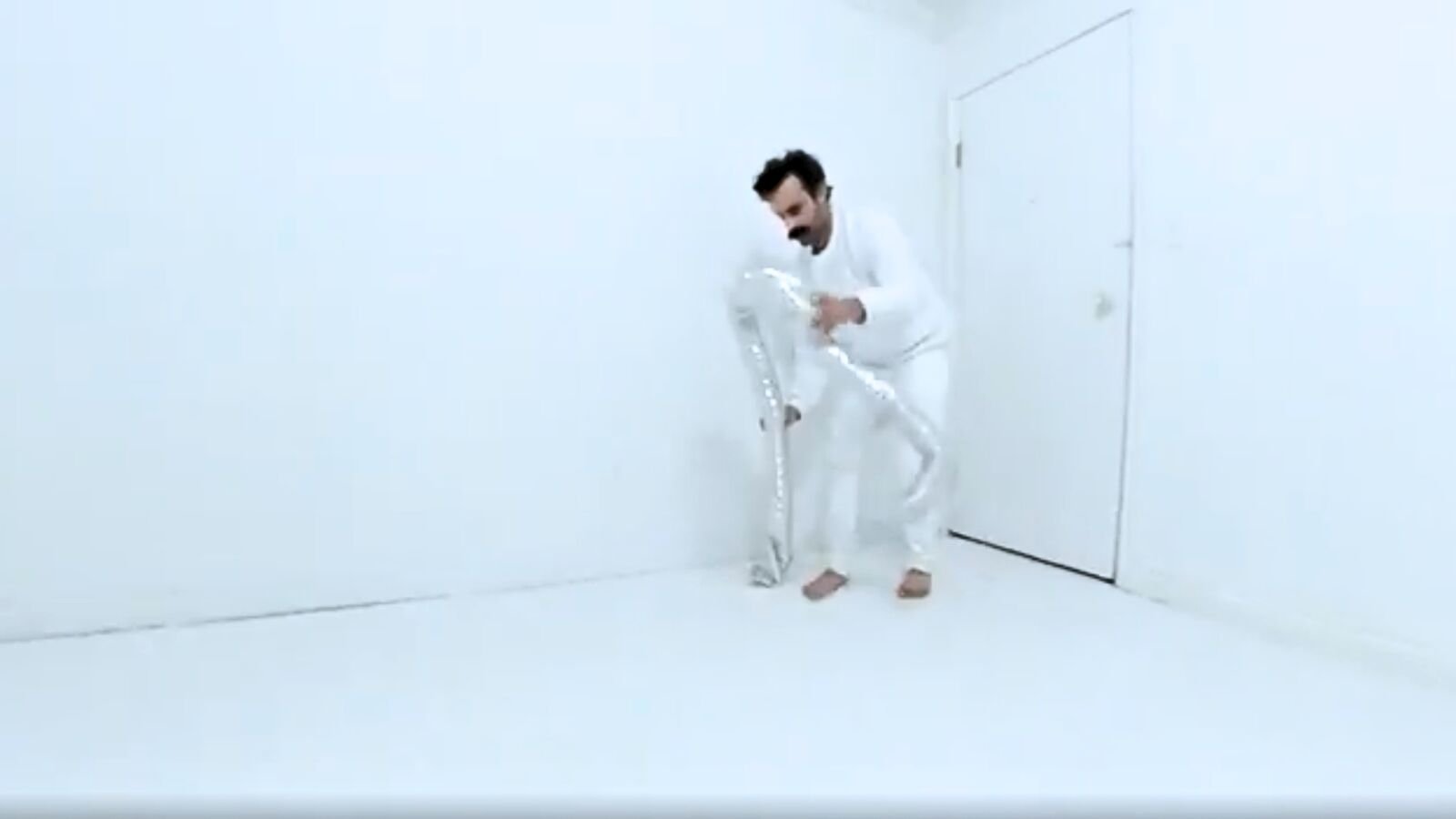
Material encounter — Performance with a reflective sculptural form inside the white installation.
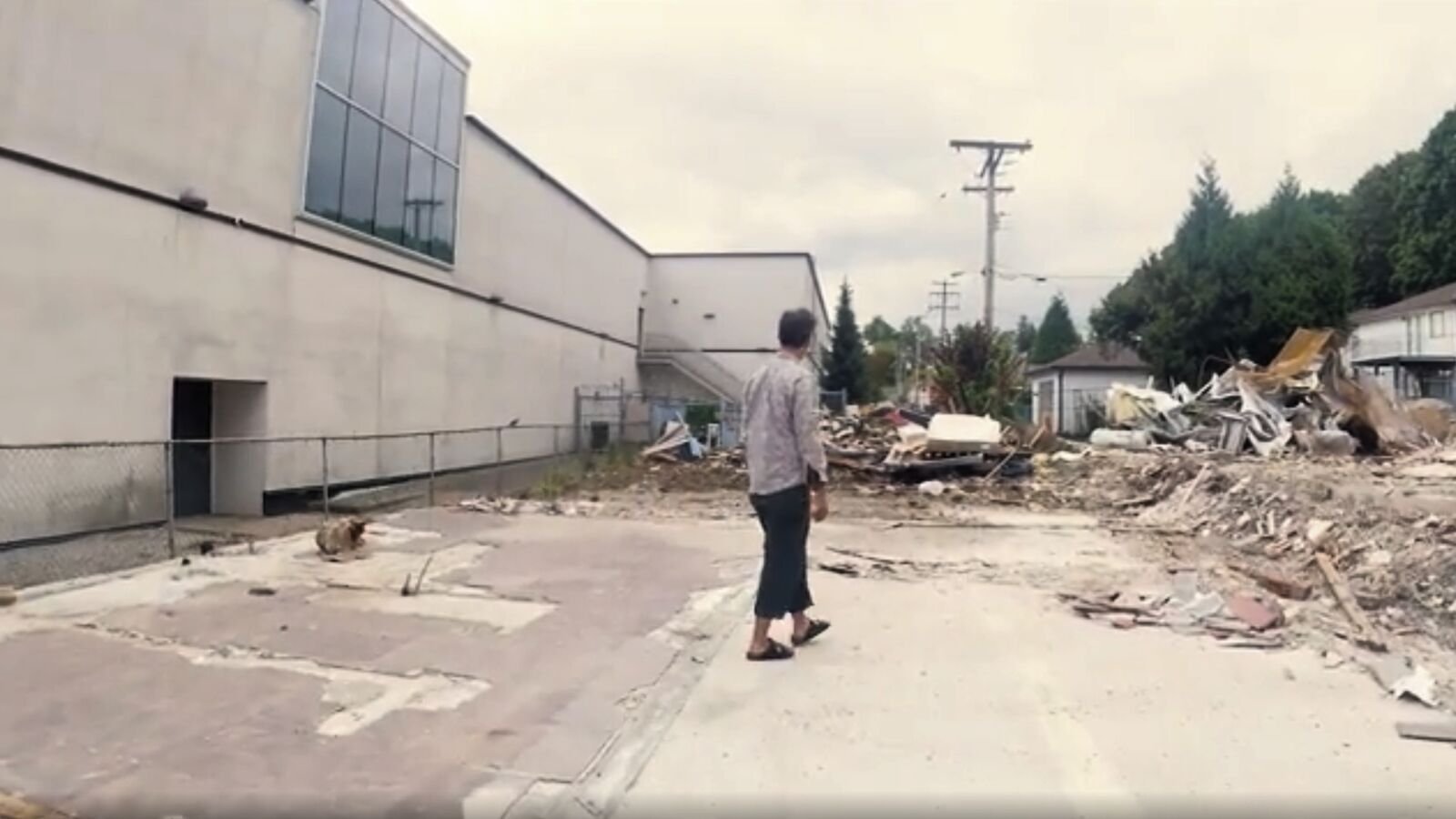
Raj Gill walking through the cleared site after the Wheel of Time Gallery house was demolished
After demolition — Raj Gill returning to the site after the house was removed.
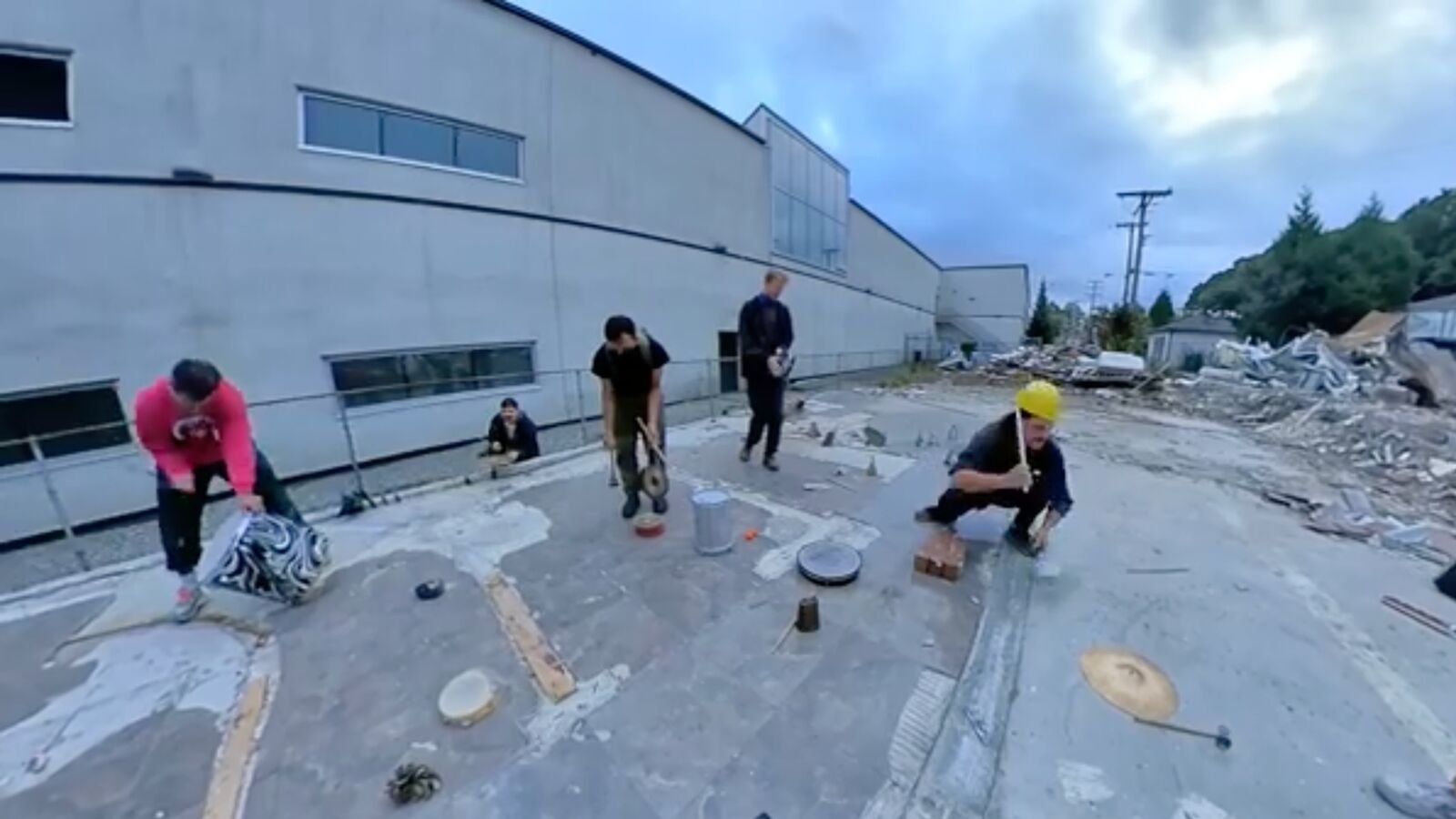
Four performers making sound with percussion and found materials on the cleared demolition site
Final site activation — Sound performance among the remains of the demolished building.

Related writing

The Genesis of the Wheel of Time Gallery and My Mental Institution — an essay and artist statement by Raj Gill →

Identity

Wheel of Time Gallery logo — a bicycle wheel with speed lines, a clown's boot at bottom, and a hand holding scissors

Event posters

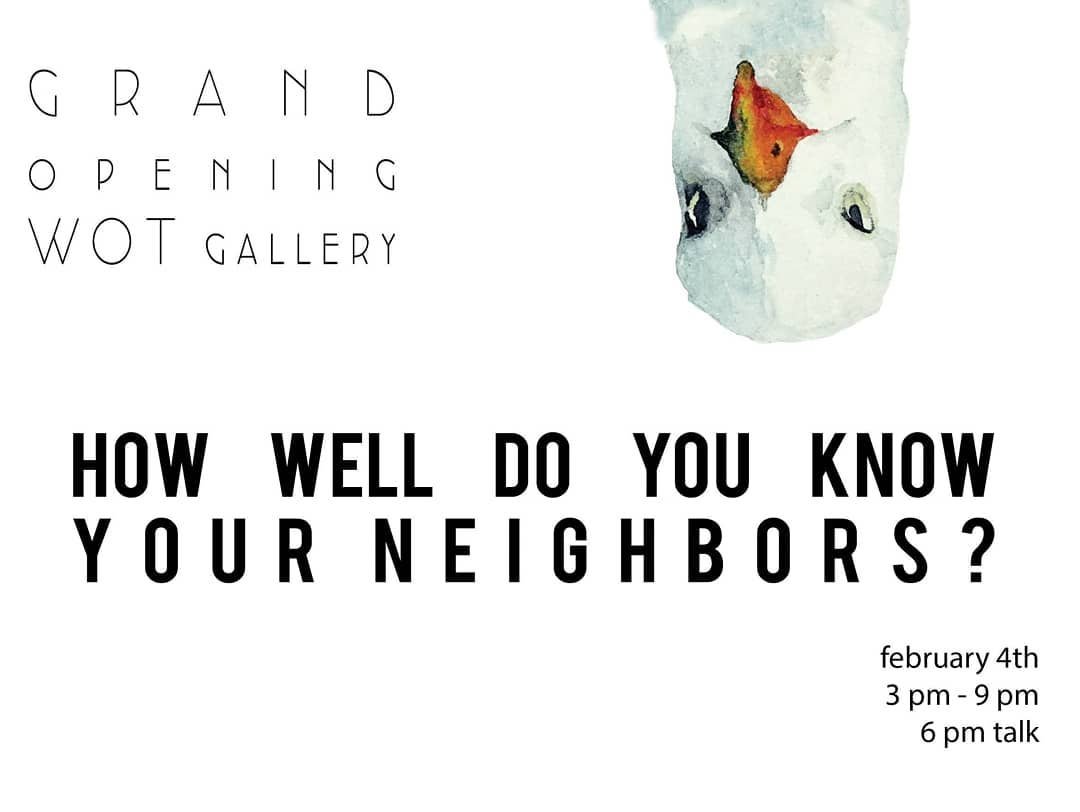
Cycle 1 poster — Grand Opening: How Well Do You Know Your Neighbors?
Cycle #1 — How well do you know your neighbours?
February 4, 2018
Cycle 2 poster — We Are the Dreamers of Dreams
Cycle #2 — We Are the Dreamers of Dreams
March 18, 2018
Cycle 3 poster — Why Did You Separate Me From This Earth?
Cycle #3 — Why Did You Separate Me From This Earth?
May 25, 2018
Cycle 4 poster — Theoretical Thievery, curated by Al Lafrance
Cycle #4 — Theoretical Thievery
April 6
Cycle 5 poster — Creamy Pop: A Short and Sweet Art Show
Cycle #5 — Creamy Pop
February 8

Documentation

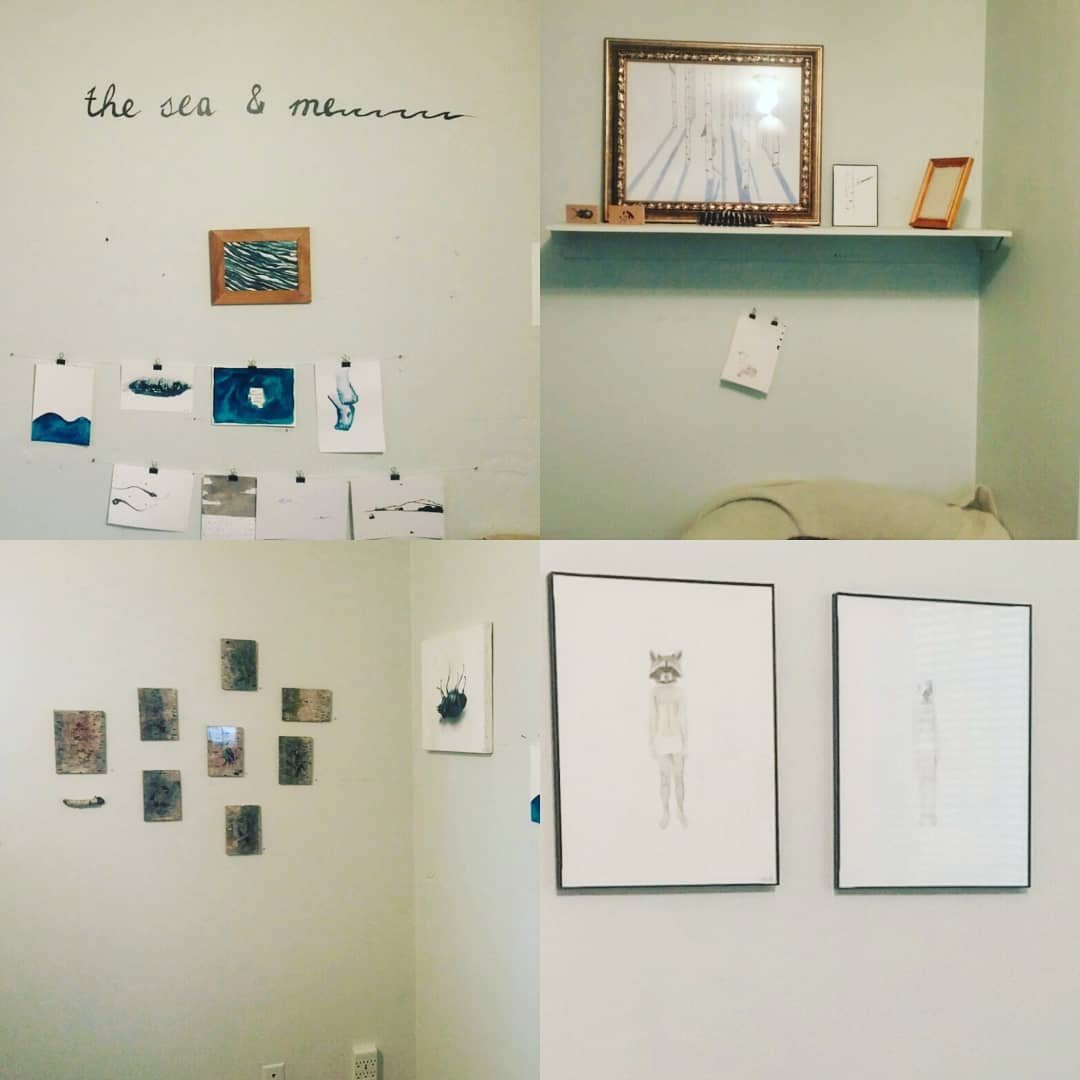
Four-panel installation view showing artworks hung on white walls
Installation views — Gallery interior showing works across multiple rooms. The domestic architecture of Kids Castle provided intimate, room-scale exhibition spaces.
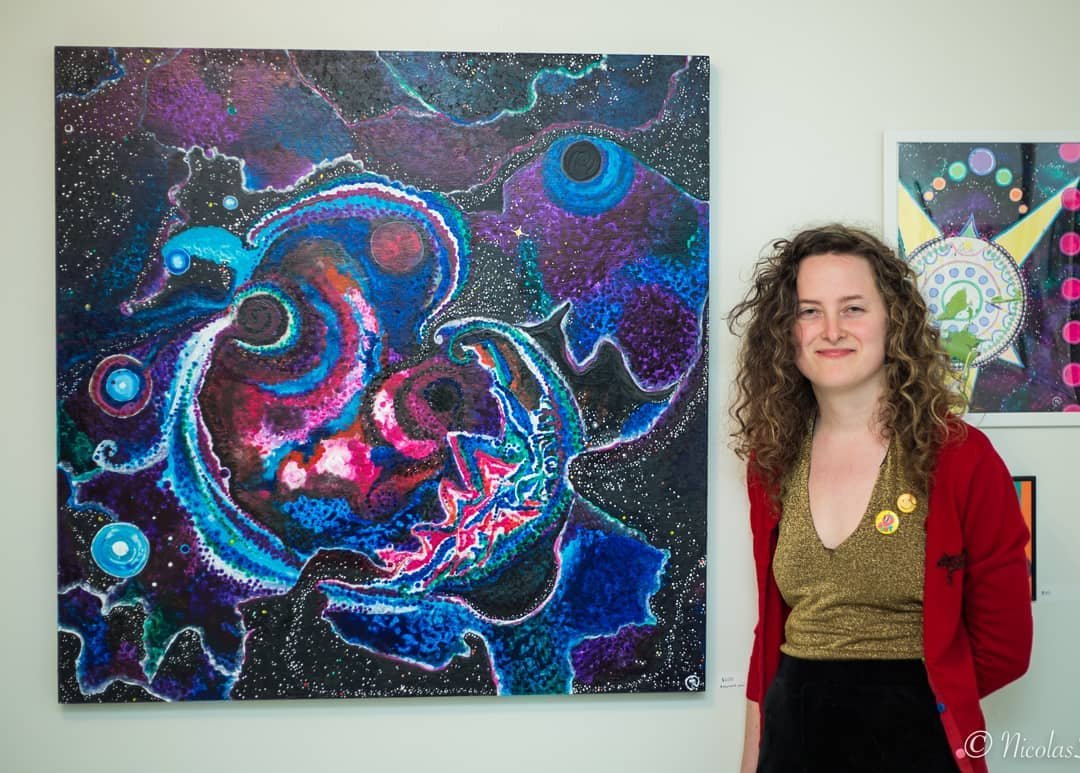
An artist standing beside a large-scale cosmic painting
Cycle #2 — Marie Whimbey with her painting at "We Are the Dreamers of Dreams." Photo: Nicolás Segura.
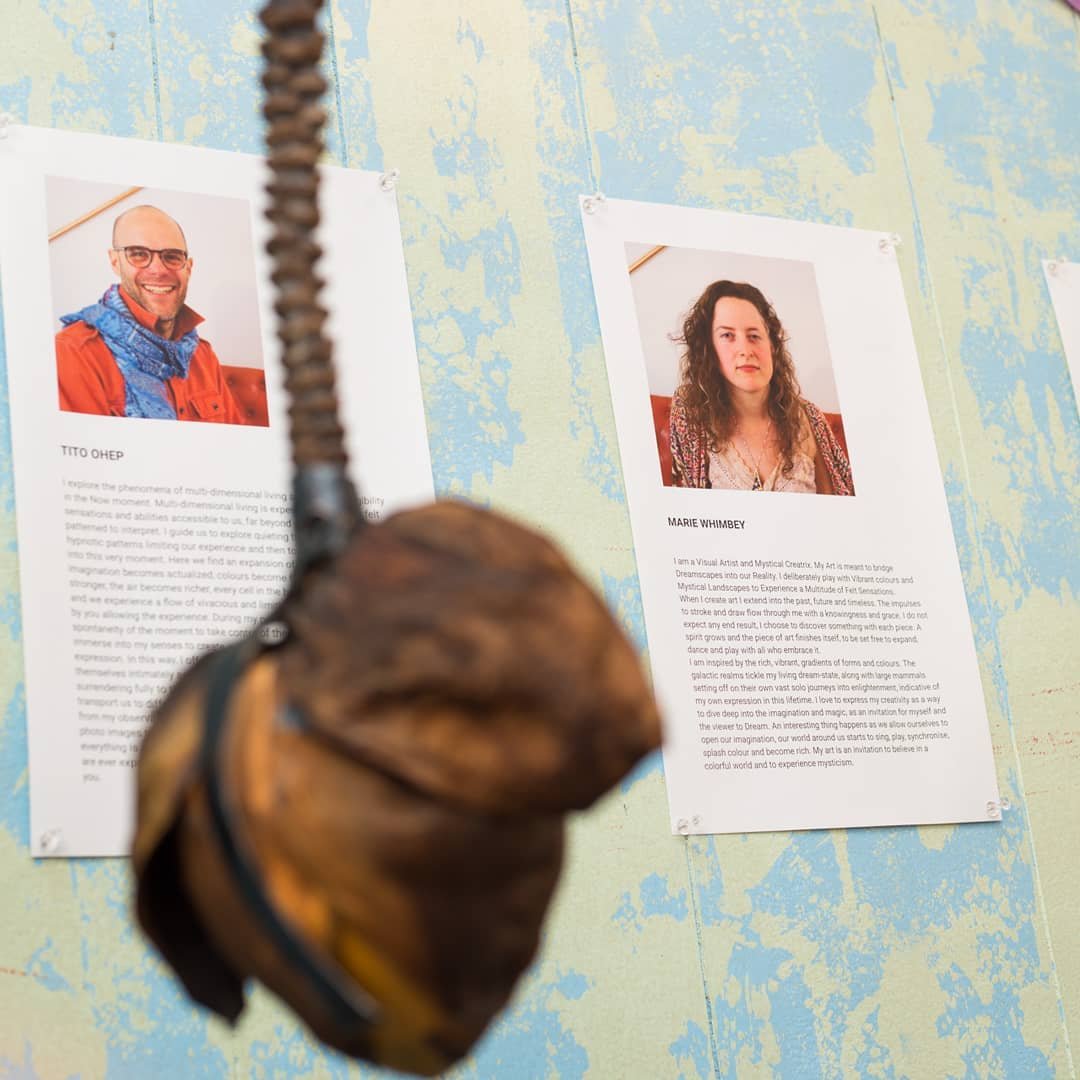
Artist statement sheets pinned to a blue-painted wall
Cycle #2 — Artist statements for Tito Ohep and Marie Whimbey installed on the gallery walls.
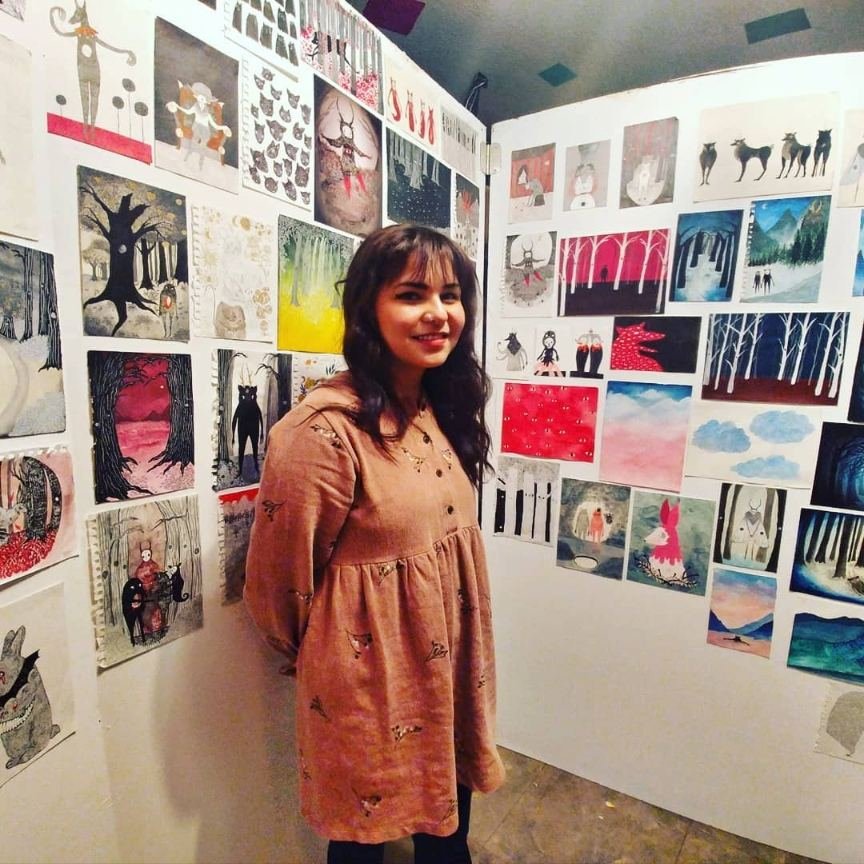
An artist standing in a corner of the gallery with walls covered in small illustrated paintings
Exhibition view — An artist with her work installed floor-to-ceiling across the gallery walls.
Two visitors looking at a wall of small framed photographs
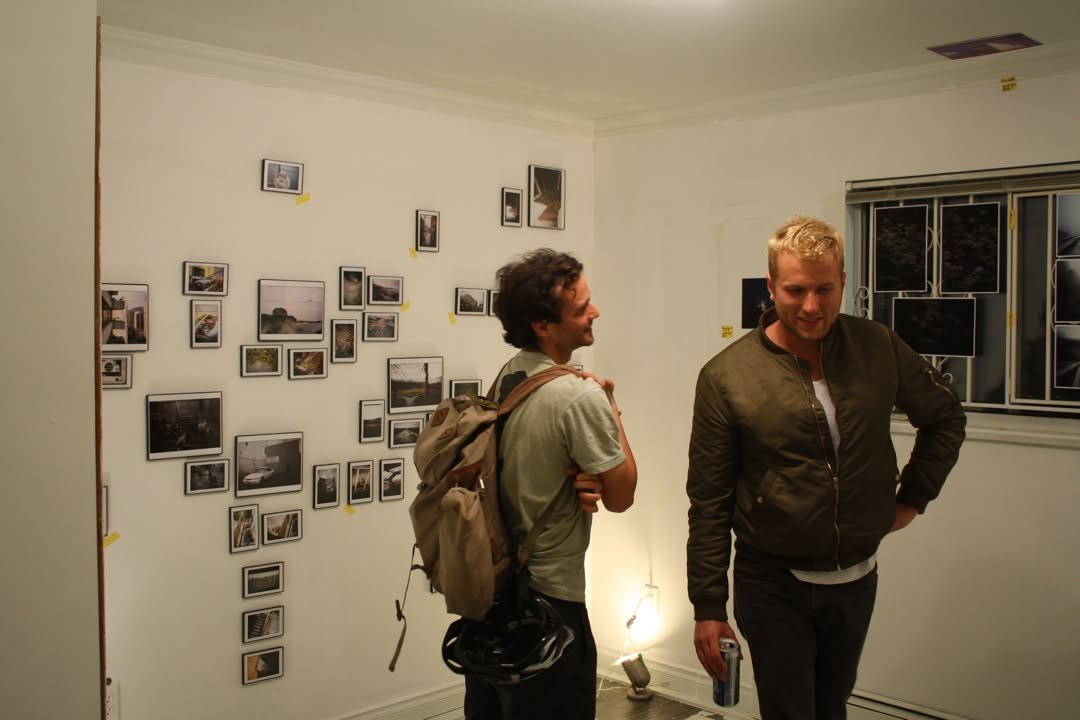
Exhibition view — Visitors viewing a photographic installation.
Watercolour painting of a figure seen from behind, with a fox head
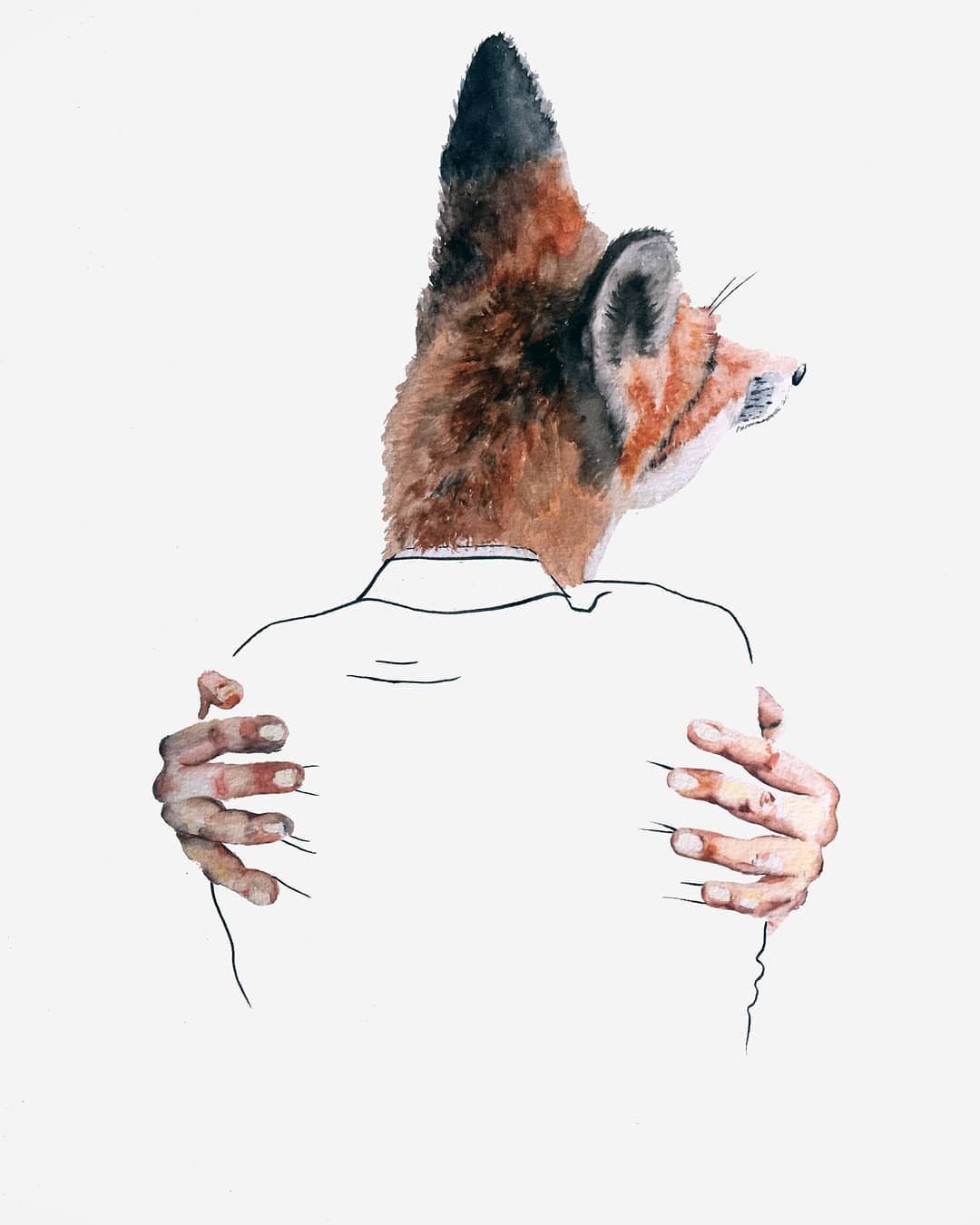
Artwork — Watercolour by Filiz Fuchs.
A ceramic sculpture of a pointed-hat figure reclining in an armchair
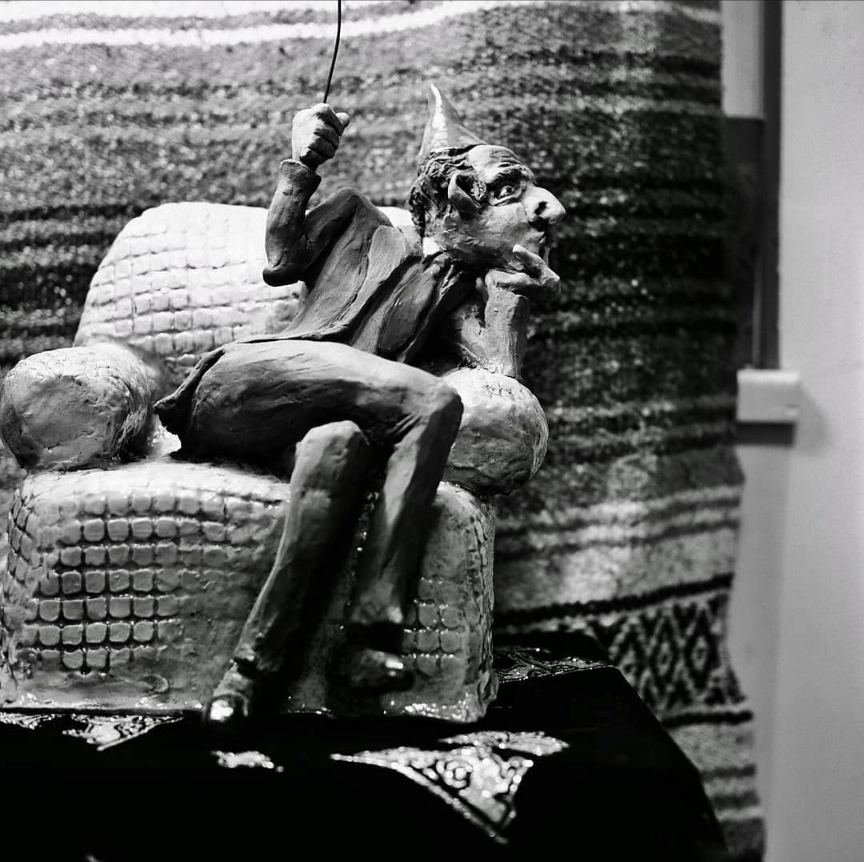
Artwork — Ceramic sculpture by Anwar Nasar.
A performer seated cross-legged in a leopard-print shirt with motion-blurred arms raised overhead
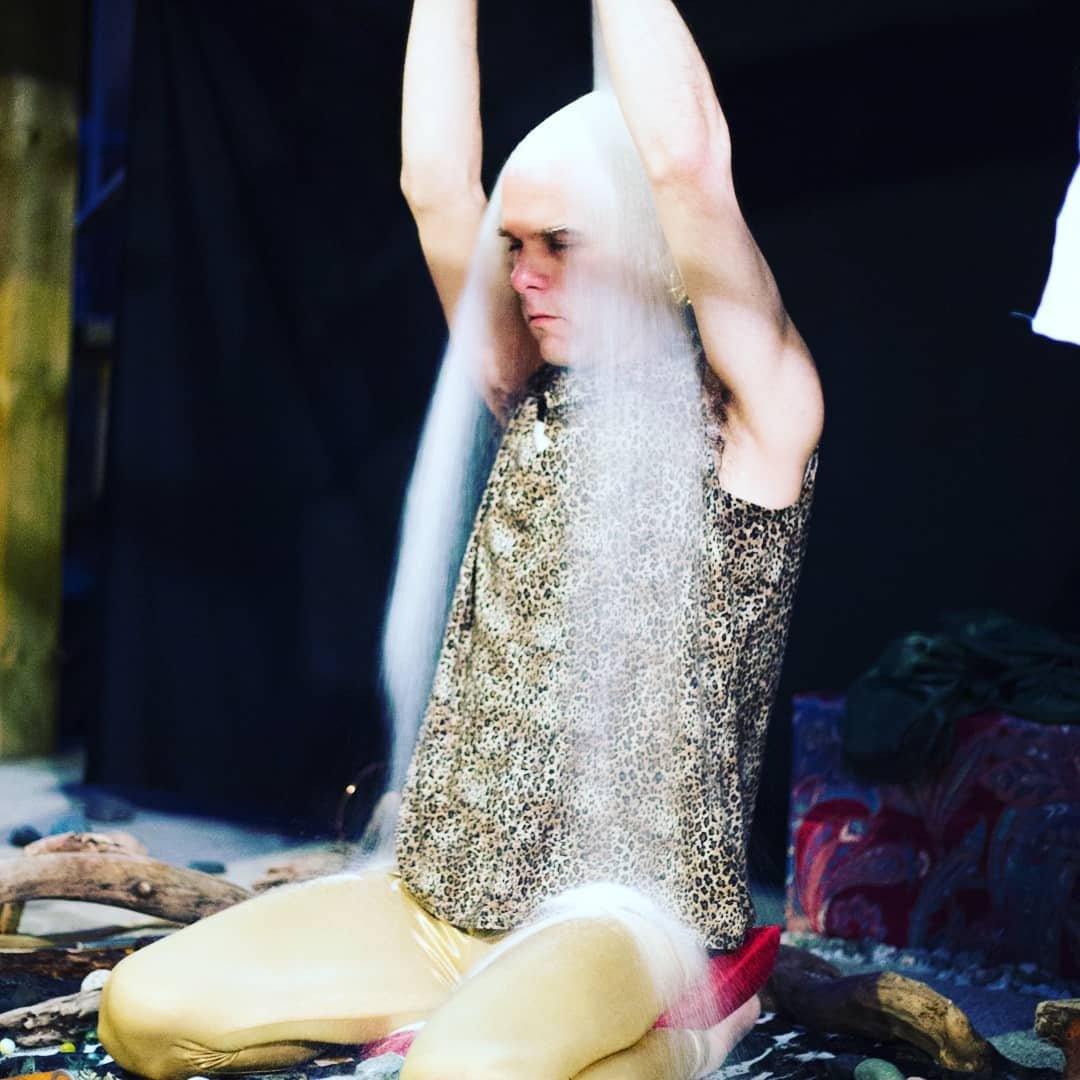
Performance — Live performance by Tito Ohep.
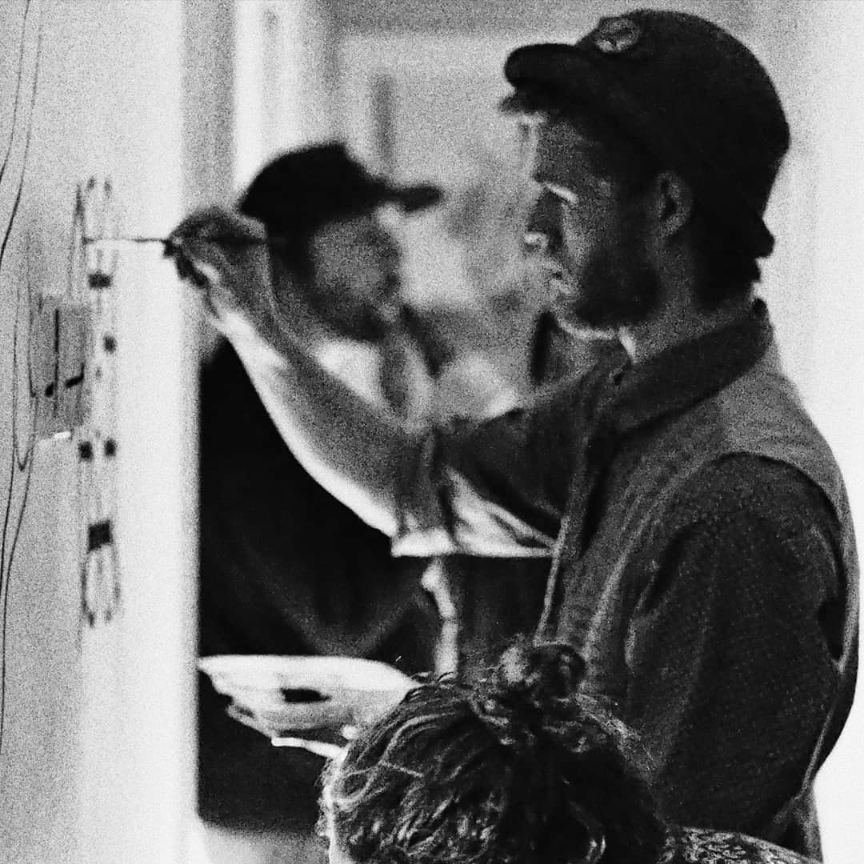
An artist painting on a wall in motion blur, holding a palette
Studio — Neo Oslund at work on the gallery walls.
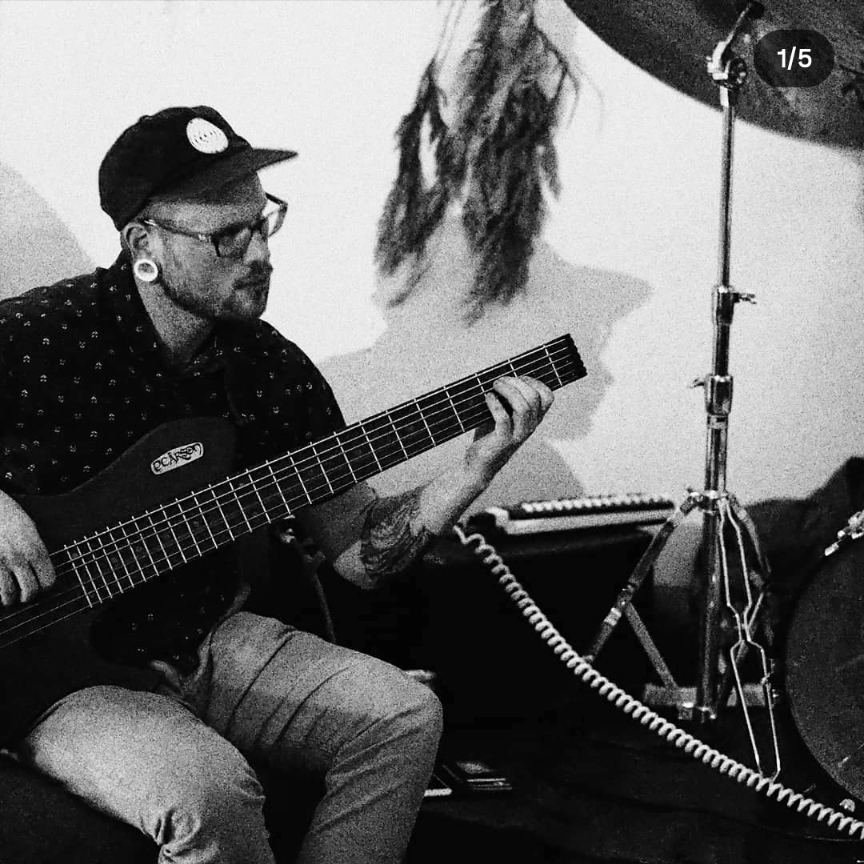
A musician playing bass guitar in a small room
Music — Brad Pearson.
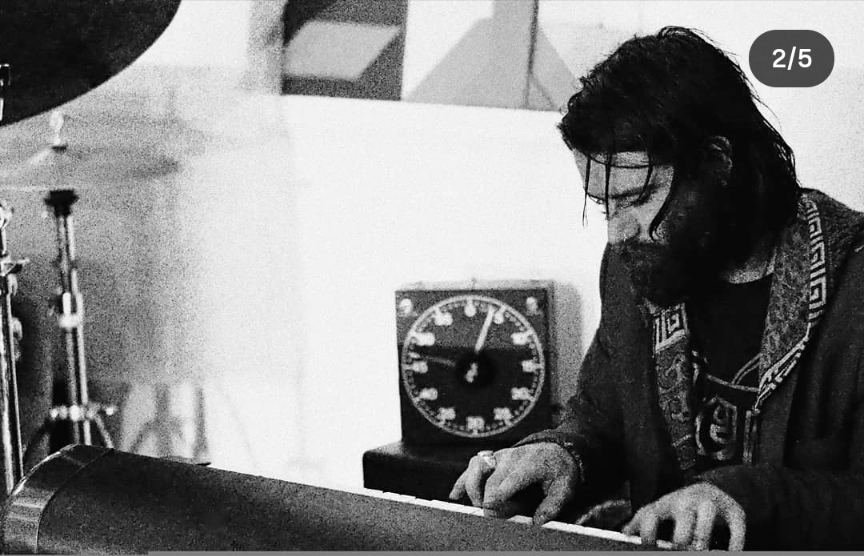
A musician playing keyboard, long hair falling forward, a clock on the wall behind
Music — Jimi James Fraser.
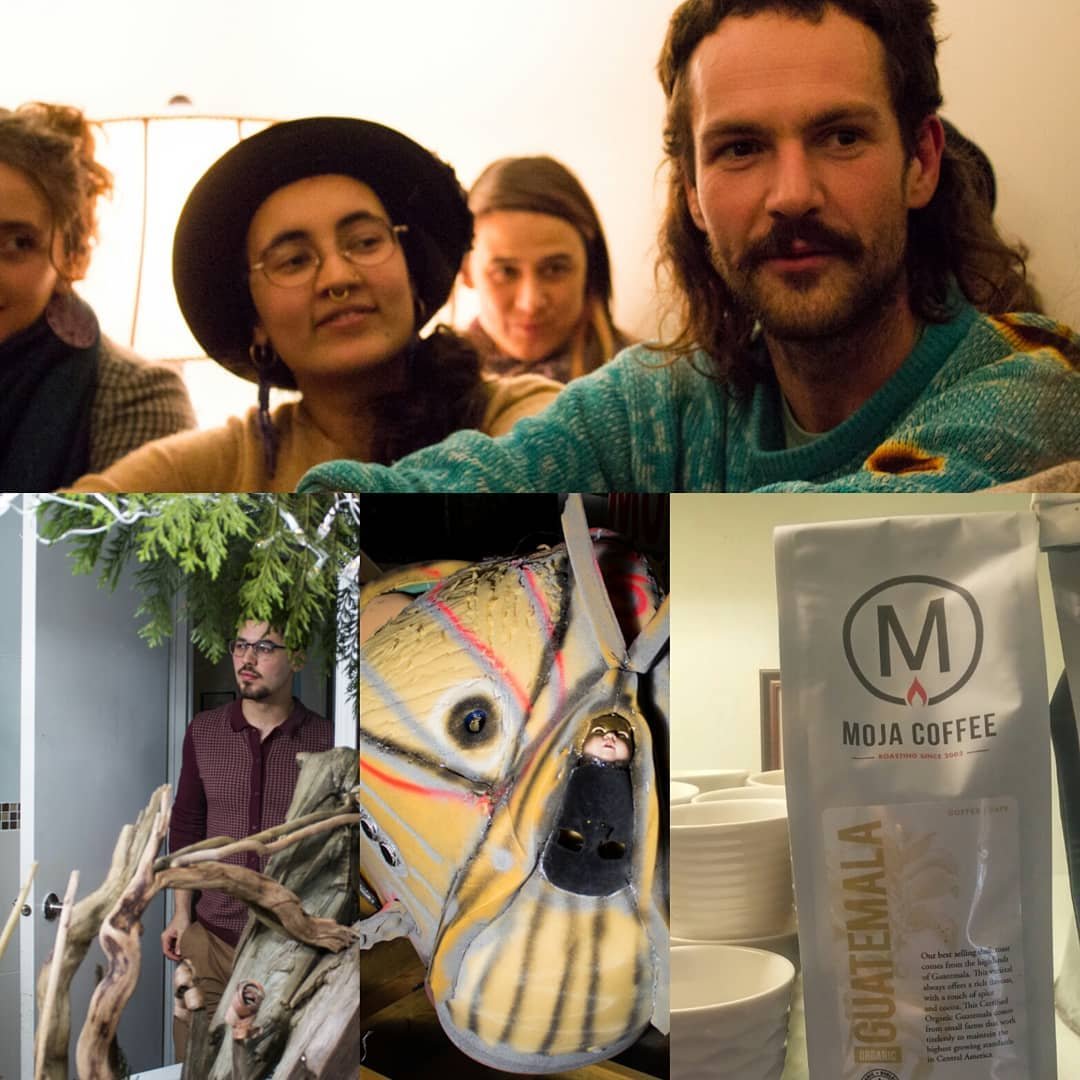
Collage of opening-night moments
Opening night — Scenes from a gallery opening at Kids Castle.
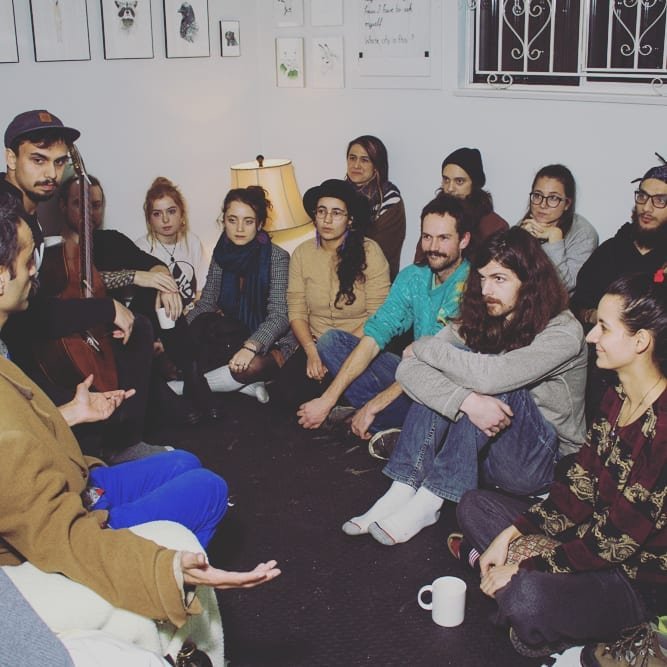
A group of people sitting in a close circle on the floor of a small room
Community — A gathering at the gallery. The domestic scale of the rooms created an unusual intimacy between audiences, artists, and the work.
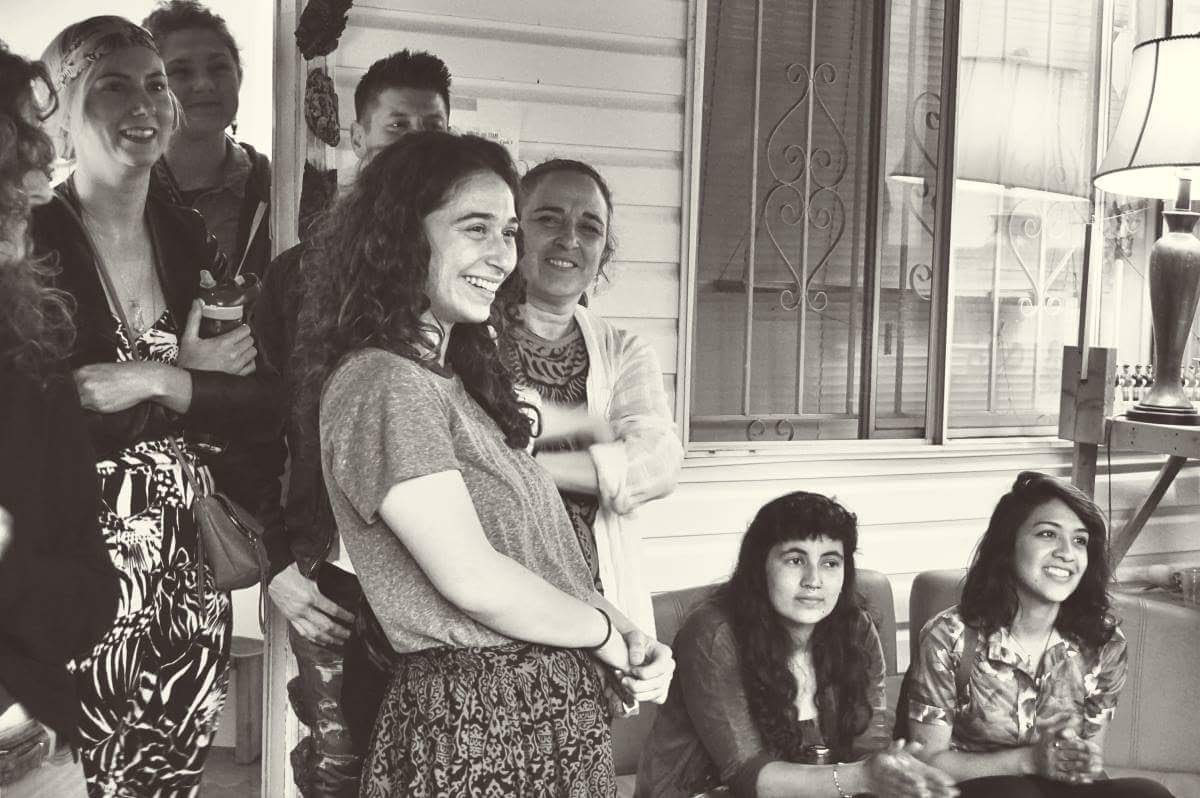
A group of people on the house's front porch during an event
Community — The porch at Kids Castle during a gallery event.
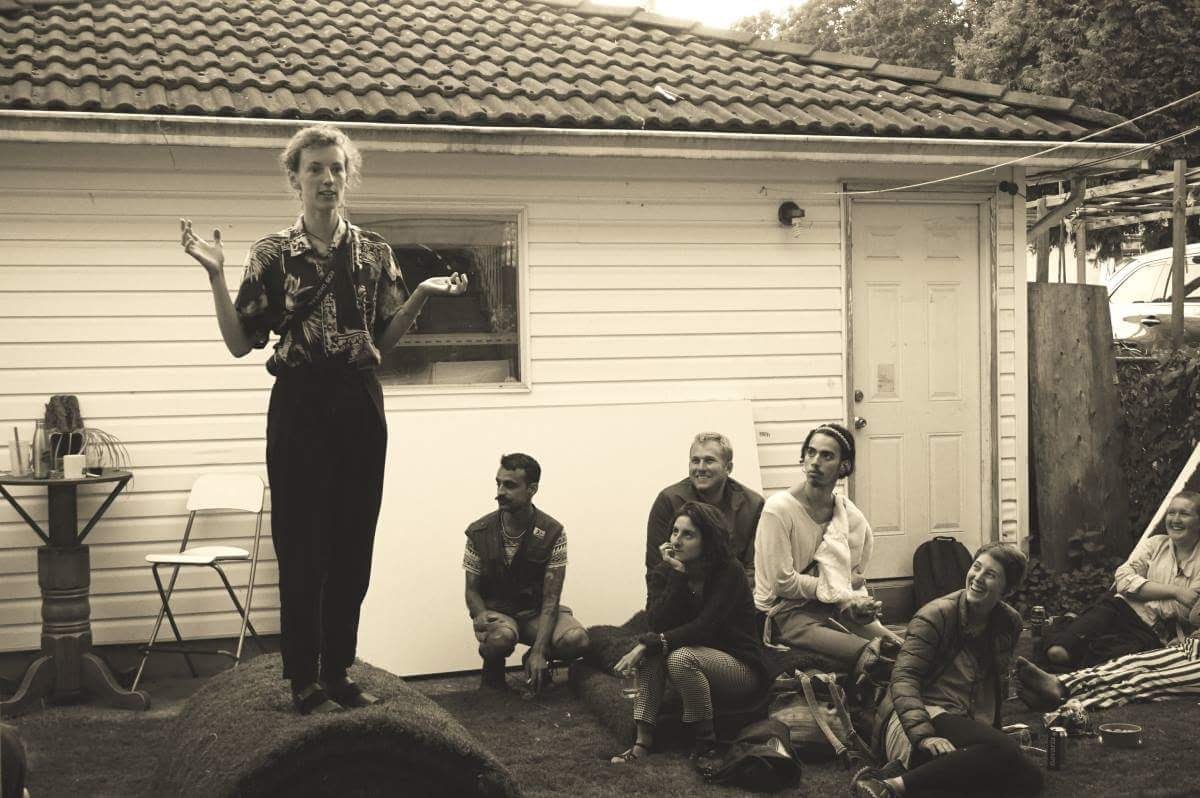
A person standing and speaking animatedly in the backyard beside the garage
Community — An artist talk in the backyard. The converted garage (CLOUD Studio) is visible behind the speaker.

Artists (all cycles)

  • Al Lafrance
  • Anastasia Qualia
  • Anwar Nasar
  • Brad Pearson
  • Cory Thibert
  • creamyskeleton
  • Denise Fort
  • DJ Bloomer
  • Dumbpop
  • Filiz Fuchs
  • Grace Fournier
  • Jessica Gabriel
  • Jimi James Fraser
  • Joss Sánchez
  • Joylyn Secunda
  • Katrina Kollmann
  • Kayla de Vos
  • Lee Gerlach
  • Linnea Gwiazda
  • Malou Uptmoor
  • Marcelo Vieira
  • Margo
  • Marie Whimbey
  • Matt Ariaratnam
  • Max Huberdeau
  • Michael Undem
  • Michelle Whimbey
  • Neo Oslund
  • Nico Woodward
  • Nicolás Segura
  • Raj Gill
  • Sumwun
  • Sydney Thorne
  • Taylor Ray
  • The Baker
  • Tito Ohep
  • Tyrell Warren
  • Valerie Comic
  • Zachary Schroeder

TF-007residency / program · ongoing

Temporary Frames Artist Residency

Record

Frame no.
TF-007
Status
active / ongoing
Timeline
2018–present
Format
Relational artist residency
Location
Vancouver, BC
Host / producer
Temporary Frames
Funding model
Currently operates without dedicated residency funding

Overview

The Temporary Frames Artist Residency is an ongoing grassroots program that shares available community and project spaces with multidisciplinary artists. Offered as suitable time and space become available, the residency gives artists a dedicated environment for self-directed research, rehearsal, making, reflection, or rest without requiring an exhibition, performance, or finished work.

Residency Model

Established in 2018 in response to the scarcity and cost of accessible workspace in Vancouver, the program treats available space as a resource to be shared. Residents have included practitioners in physical theatre, visual art, sculpture, spoken word, clown, and reclaimed-material practice.

The residency is deliberately flexible. Its duration, setting, and working conditions adapt to the spaces Temporary Frames has access to and to the needs of each artist. Rather than organizing the residency around a required public outcome, the program supports stages of practice that are often difficult to resource: thinking, researching, rehearsing, testing, experimenting, and allowing work to develop at its own pace.

Thematic Context: Relational Residency

The residency extends Temporary Frames’ broader practice of using temporary or underused spaces as cultural infrastructure. Its value lies in the relationship between artist, time, space, and community rather than in the production of a predetermined deliverable.

By maintaining room for process without a required endpoint, the residency supports forms of creative labour that are often invisible within presentation-focused arts models and asks a simple question: what becomes possible when an artist is given space and time without being asked to prove the experience through a finished product?

Artists in Residence

  • 2018Tyrell WarrenCortes IslandReclaimed material & situational artresident
  • 2019Nathaniel JustinianoUSATheatre & performanceresident
  • 2019Anwar NasrEgyptSculpture & expressive artsresident
  • 2020Michelle WhimbeyVancouver IslandVisual artresident
  • 2020Neo OslundVisual artresident
  • 2023Tom CryanPhysical theatreresident
  • 2024William SinghSpoken wordresident
  • 2025Tyrell WarrenClown studiesresident

PRACTICE AREAclown pedagogy / practice-research · 2024–

Clown Working Group

Record

Status
active / ongoing
Timeline
2024–present
Base
Vancouver, BC
Executive / Creative Director
Tyrell Warren
Format
Self-facilitated, artist-led practice-research ensemble
Working cycles
Five seasonal terms to date; each term contains multiple weekly sessions
Public record
Four process showings to date, beginning in the second term
Working model
A continuing core with invited clown practitioners joining selected terms
Pedagogical mentorship
David MacMurray Smith — periodic review and mentorship; group sessions remain self-facilitated

Overview

Clown Working Group is a self-facilitated research ensemble investigating clown as a practice of presence, improvisation, and relation. Since 2024, participants have worked in seasonal terms, each centred on a specific question and a set of repeatable scores.

The research asks how a performer can follow impulse without steering toward a result, make internal experience legible, hold contradictory states, and remain responsive to a room. Rigor comes through sustained duration, shared vocabulary, clear agreements, reflection, and return.

Beginning with the second term, each cycle has ended in a public process showing. These events share the group’s current place in the research and allow the presence of an audience to become part of the investigation.

Explore the archive

  • 01Seasonal Terms2024–2026A term-by-term record of five research cycles, their questions, structures, participants, and confirmed gaps.chronology / archive
  • 02Public Process ShowingsfourHow the group shares unfinished research, frames audience roles, and documents what becomes visible in public.performance record
  • 03Working Questions & ReflectionsongoingSelected research threads on communication, presence, permission, structure, and the relation between process and form.research notes

Ensemble structure: riverbed and tributaries

The continuing ensemble forms the riverbed: its shared pedagogy, agreements, and term-level intention. Invited practitioners enter as tributaries, bringing other histories and pressures into the research. This structure keeps the group’s practice legible while allowing it to change. Facilitation remains collective.

Lineage and mentorship

The group’s shared vocabulary is rooted in the clown pedagogy of David MacMurray Smith and Fantastic Space Enterprises, including clown nature, rivering, masks, and paths of permission. MacMurray Smith periodically mentors and reviews the work; the weekly sessions are self-facilitated. See “With Our Clown Nature in Mind,” Canadian Theatre Review 183 (2020).

Pochinko and Grotowski appear as earlier influences within this pedagogical lineage.

Related research

  • ARC-003CLOUD Studio2019–A grassroots movement studio and incubator for physical theatre, somatic research, and clown practice.studio / research
  • WRITINGMy Mental InstitutionarchiveWriting and visual documentation from a related participatory performance world.essay / project record
  • PRACTICEDeep ListeningongoingTemporary Frames’ parallel inquiry into sustained attention, sensory autonomy, sound, and collective space.practice area

CLOWN ARCHIVE · 01chronology / seasonal research

Seasonal Terms

Archive terminology

A term is a seasonal cycle of weekly sessions. The group confirms five terms and four public process showings. The Summer 2025 record remains incomplete.

Five seasonal terms

Term 1 · Fall 2024 — Formation

September–December 2024 · studio research · no public showing

Tyrell, Suna, Raj, and Joe compared four structures: a principles group, jam/support group, facilitators group, and ensemble. They formed a small principle-based group with collective facilitation, a seasonal commitment, and a future public share.

Term 2 · Spring 2025 — Dream Charevents

March–May 2025 · Temporary Frames Studio and Vines Art Studio · Showing 1 at What Lab

Participants made embodied slices of desired lives present in the room. The first public sharing positioned the audience as witnesses and, when invited by a score, participants. The group later remembered this as its most galvanized term.

Participants documented: Eddy, Ernesto, Joe, Tyrell, Raj.

Term 3 · Summer 2025 — Expanded iteration

Dates and venue under verification · Showing 2

An expanded configuration continued the experiment of inviting other clown practitioners into the group. The term and showing are confirmed; exact dates, venue, and full credits remain under verification.

Term 4 · Fall 2025 — Honesty of Communication

August–October 2025 · What Lab and Russian Hall · Showing 3 in October 2025

The largest documented configuration examined outside-in and inside-out expression: what a performer intends, what appears, and what the room receives. Check-ins, long rivers, and a North Star became the term’s main structures.

Participants documented: Raj, Tyrell, Joe, Ernesto, Jessica, Heather, Anna.

Term 5 · Winter 2026 — Presence and Turn-Making

January–March 2026 · Russian Hall · eleven weeks · Showing 4 in March 2026, documented on video

The group contracted around its continuing core to re-articulate its foundations. Across eleven self-facilitated weeks, the research focused on presence, turn-making, and how a defined practice can remain open to new participants without losing its current.

Working core documented: Raj, Tyrell, Joe, Ernesto. Later records also name Evelyn and Nayana Fielkov in relation to the term; final role credits remain under review.

Clown Working Group pages

  • Overview
  • Public Process Showings
  • Working Questions & Reflections

CLOWN ARCHIVE · 02performance record / audience relation

Public Process Showings

Why the work is shown

Beginning with the second term, each seasonal cycle has ended in a public sharing: four showings in total. The group presents its current place in the research, allowing uncertainty, vulnerability, miscommunication, recovery, and change to remain visible.

Showing record

Showing 1 · Spring 2025

Dream Charevents · What Lab

An intimate sharing of embodied future slices. The audience witnessed the work and entered individual events when invited by a performer’s score.

Showing 2 · Summer 2025

Expanded iteration · details under verification

The showing is confirmed; venue, date, program structure, and full credits remain under verification.

Showing 3 · Fall 2025

Honesty of Communication · October 2025

Check-in material and long-form improvisation brought the gap between inner state and external expression into public view.

Showing 4 · Winter 2026

Presence and Turn-Making · March 2026 · video documented

The showing centred the ensemble’s turn-making, core vocabulary, and present-tense attention.

Audience positions

Witness

The audience attends to work in process. Its attention changes the stakes and becomes part of the room’s information.

Relation

A look, silence, laugh, or shift of attention can alter the performer’s next choice, even when the audience remains outside the playing area.

Participant

Some scores invite an audience member to speak, move, imagine, or inhabit a role. The invitation states what is being asked and leaves room to decline.

Findings from public sharing

The working notes describe a “documentary shift”: audiences responded most strongly when performers stayed freshly present with changing material. The showings also revealed that an open process benefits from a precise audience invitation.

Clown Working Group pages

  • Overview
  • Seasonal Terms
  • Working Questions & Reflections

CLOWN ARCHIVE · 03selected notes / continuing inquiry

Working Questions & Reflections

About these notes

These threads recur across sessions and show how the group’s questions have changed through repetition, disagreement, bodily experience, and public testing.

Selected research threads

Check-in is already performance

A check-in always presents a version of the speaker. The group began repeating it as a shorter performed communication, asking: “What form of honesty is reaching the room?”

Inside-out / outside-in

An internal feeling does not guarantee a legible action, and an effective external form may not reveal the performer’s inner state. The work asks how these directions inform one another.

High-definition presence

“High definition” names moments when intention, sensation, action, and relation become unusually precise. An audience may feel this alignment before it can explain it.

North Star as felt orientation

A North Star must be memorable under pressure and available in action. As an orientation, it clarifies choices without deciding them in advance.

A mask appears because it cares

Naming what a mask protects or desires can release new play. The Ring Master gives the mask a place, a duration, and a relation to other possible acts.

Freedom needs an arena

The river depends on a held duration, shared space, attention to others, and a way to return. Without enough form, a performer may repeat habit while believing they are following impulse.

Open research questions

  • How can a performer follow an impulse without converting it into a demand for novelty?
  • What lets a long river deepen rather than simply continue?
  • When does naming a mask create freedom, and when does the name become another mask?
  • How can witnesses speak about what they received without defining another performer’s experience?
  • What must remain stable when new practitioners enter a term, and what should be allowed to change?
  • How does the group know when a public sharing is an appropriate next pressure on the research?

Clown Working Group pages

  • Overview
  • Seasonal Terms
  • Public Process Showings

PRACTICE AREAsound / listening / spatial practice · ongoing

Deep Listening

Overview

Temporary Frames develops environments, performances, and participatory formats that foreground sustained attention to sound. Across the Gong Library and related programming, deep listening is explored through acoustic instruments, electronic sound, spatial and headphone-based audio, contemplative practice, sensory autonomy, and collective gathering.

This page gathers projects, presentations, and earlier programs that contribute to that listening practice.

Programs & Presentations

  • PRES-004Michael Red — Deep Listening Sound Sessions2026 A four-session series combining live ambient sound, wireless headphones, room audio, and sensory-choice design.series / co-production
  • TF-006International Drone Day2025 A daytime gathering spanning Indian classical, gamelan, modular synth, acoustic, gongs, live electronics, and electroacoustic drone practices.episodic project
  • PRES-003Plant Listening Showinaugural presentation A listening event and plant-care exchange that inaugurated the Temporary Frames space at Hypha Arts.presentation

Archive / Lineage

  • ARC-002Quiet Night Series2017–2020 A multidisciplinary low-volume performance series emphasizing attention, intimacy, and accessible participation.archived series

ONGOING PROGRAMMINGpresentations / co-productions · ongoing

Presentations & Co-Productions

Overview

Temporary Frames hosts and co-produces one-off readings, launches, performances, concerts, and interdisciplinary gatherings with artists and community partners. These presentations extend the organization’s spaces and production infrastructure into platforms for artistic exchange, experimentation, and public presentation.

Individual events are recorded as completed presentations within this ongoing programming stream rather than treated as standalone active projects.

2026

  • PRES-004 Michael Red — Deep Listening Sound Sessions Feb–Mar 2026 A four-session co-production combining live ambient performance, wireless headphones, room audio, and individualized volume control. series / listening

2025

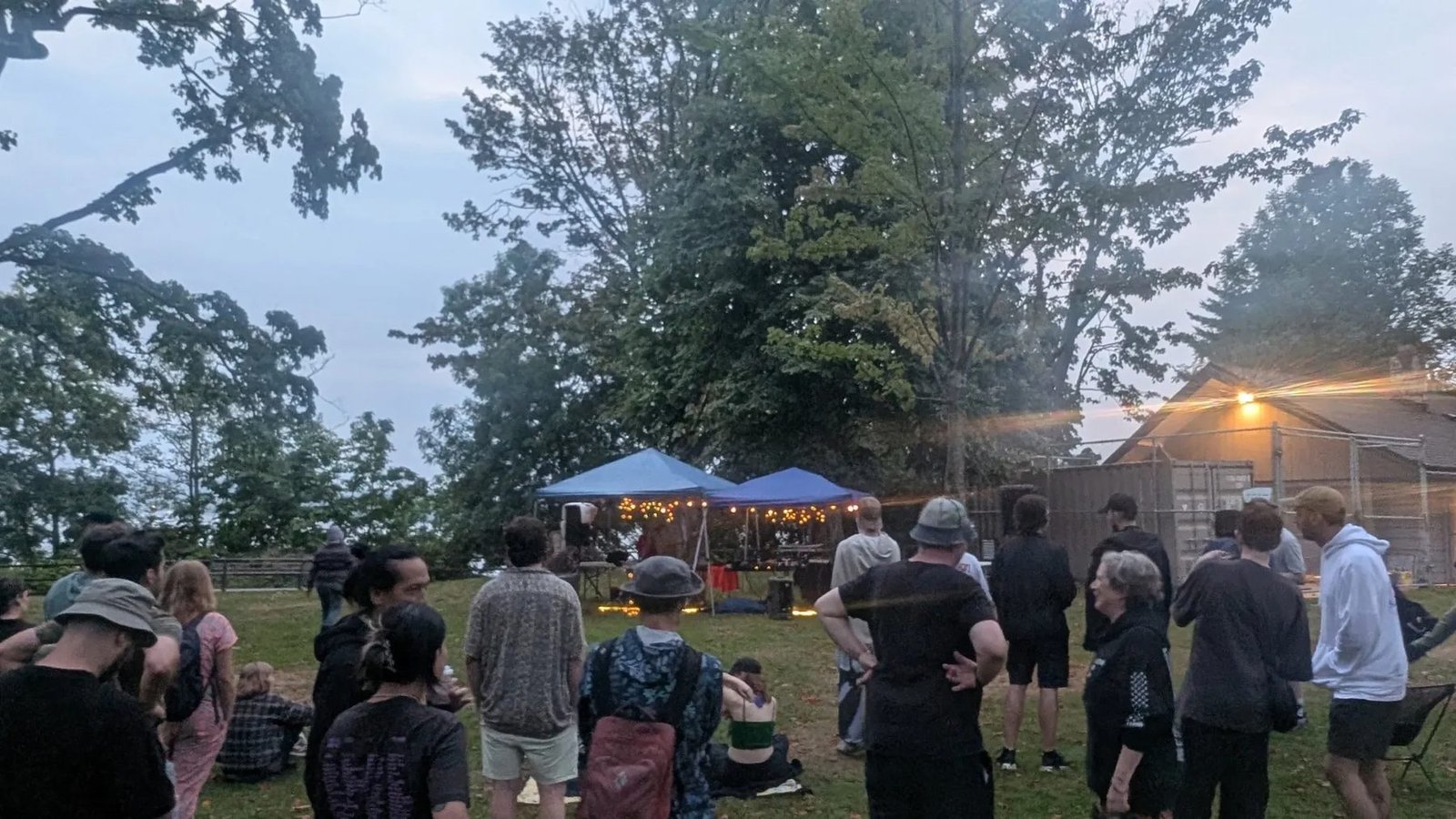
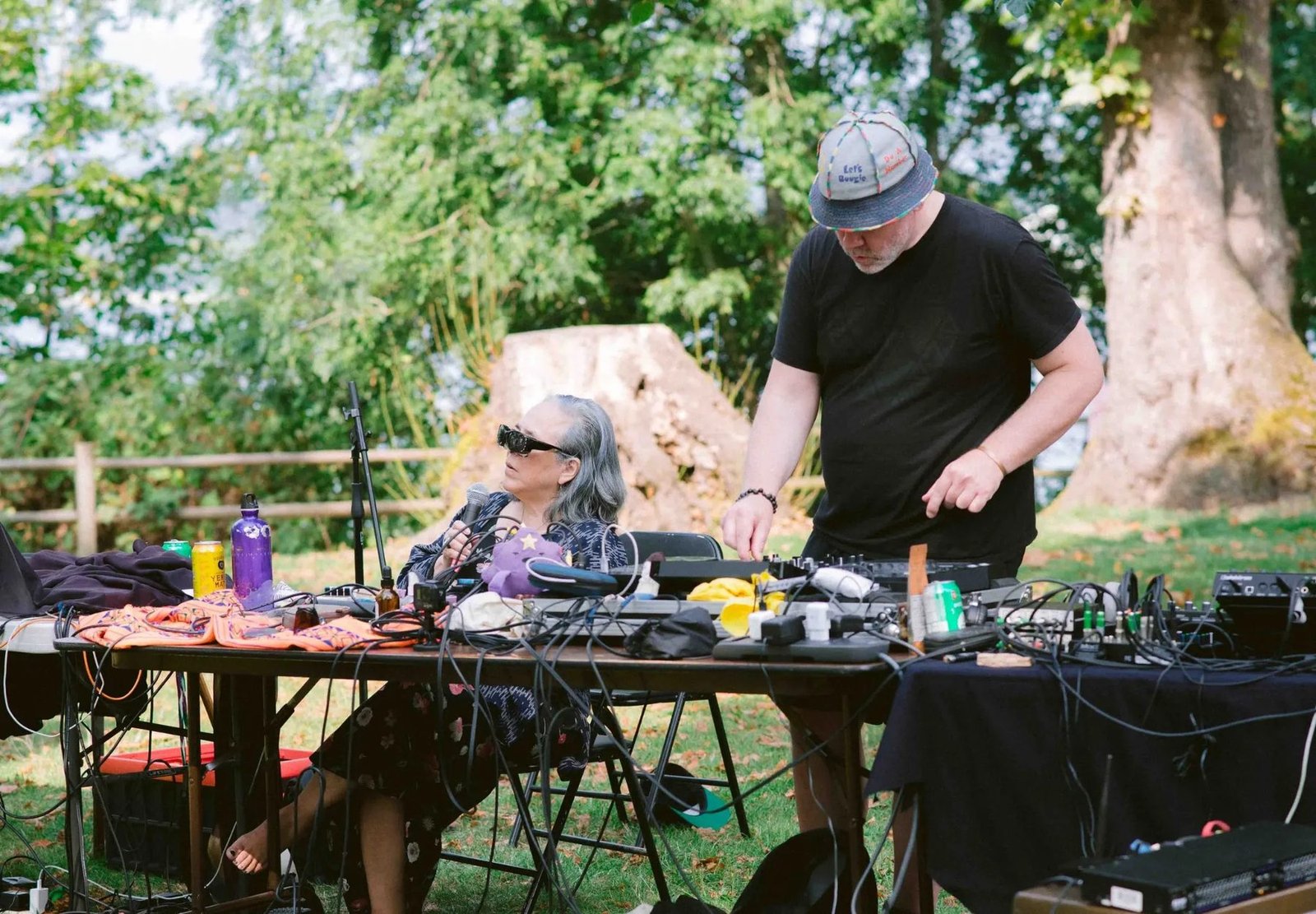
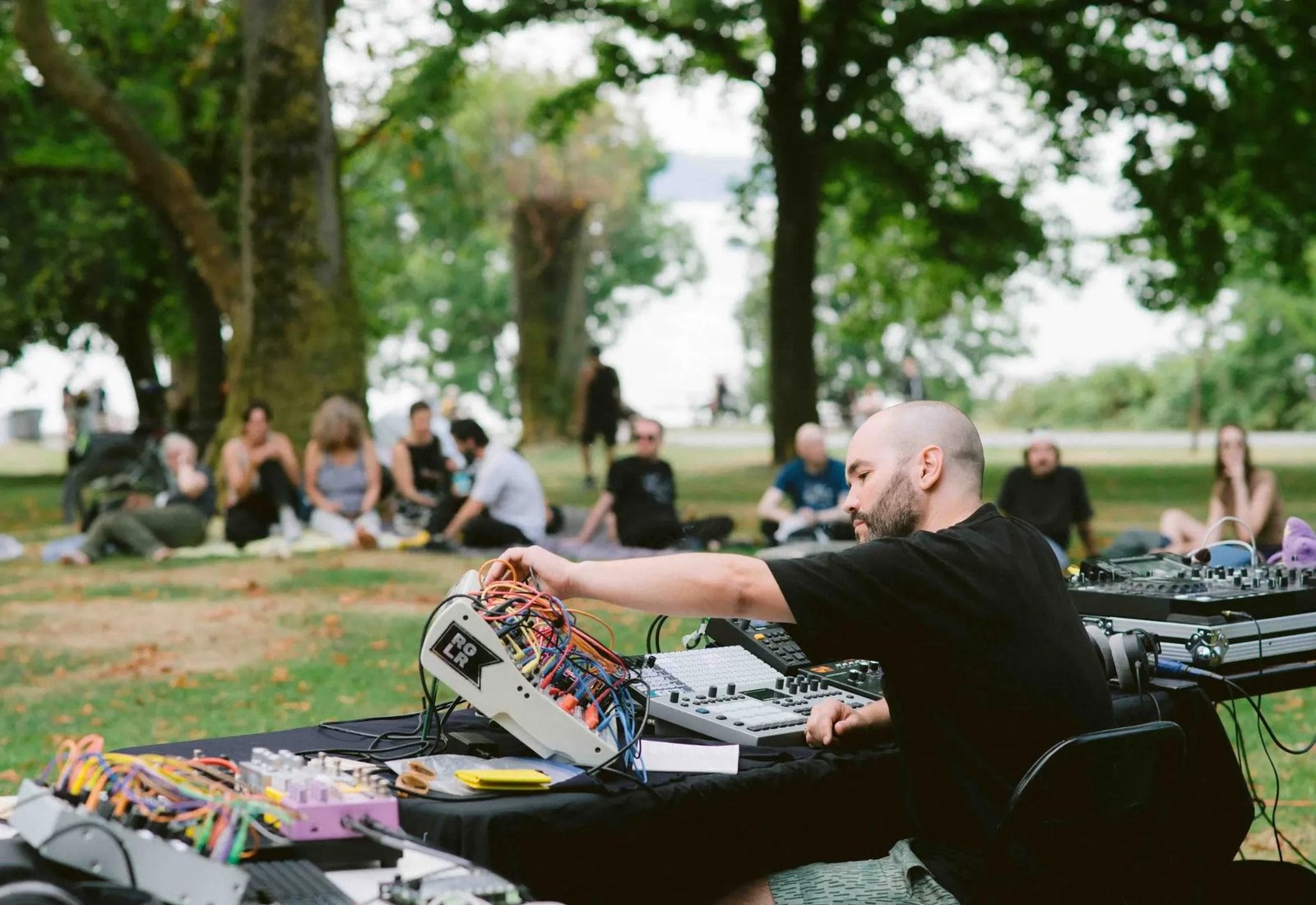
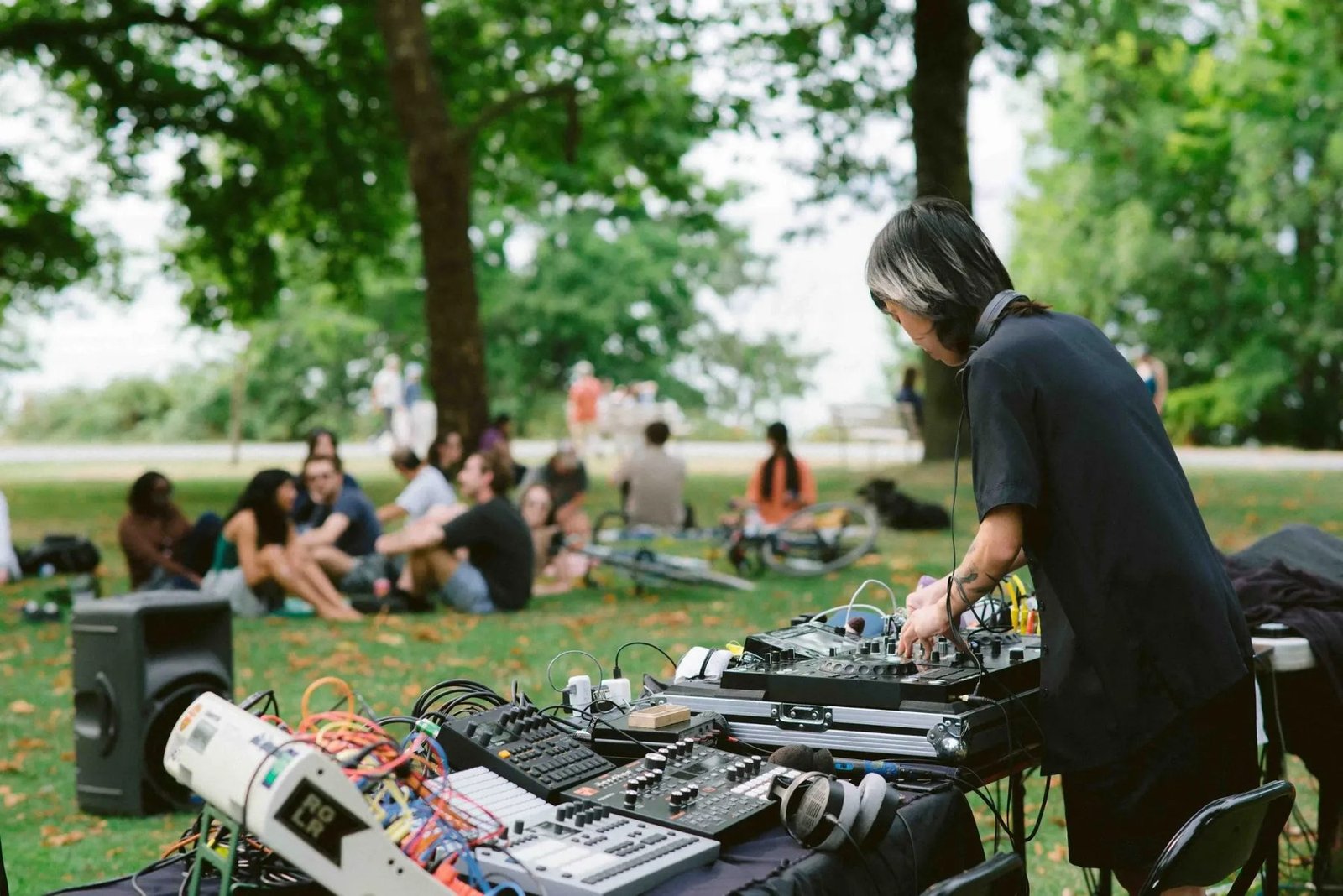
  • PRES-005 AMBIENT/ETC — OUTDOOR EDITION 001 6 Sep 2025 A donation-based outdoor ambient and experimental music gathering co-presented with Low Indigo at Hadden Park. music / co-presentation
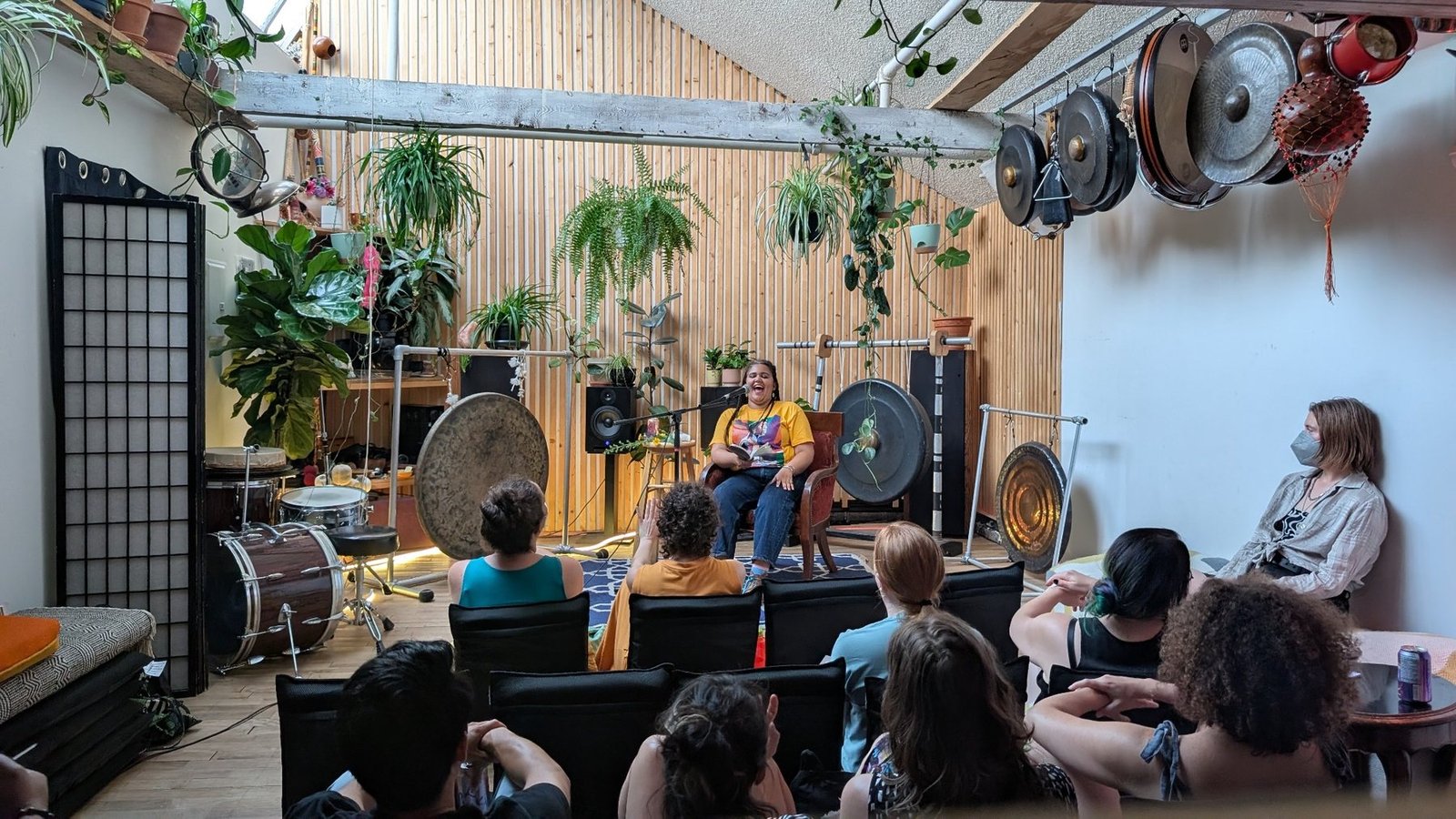
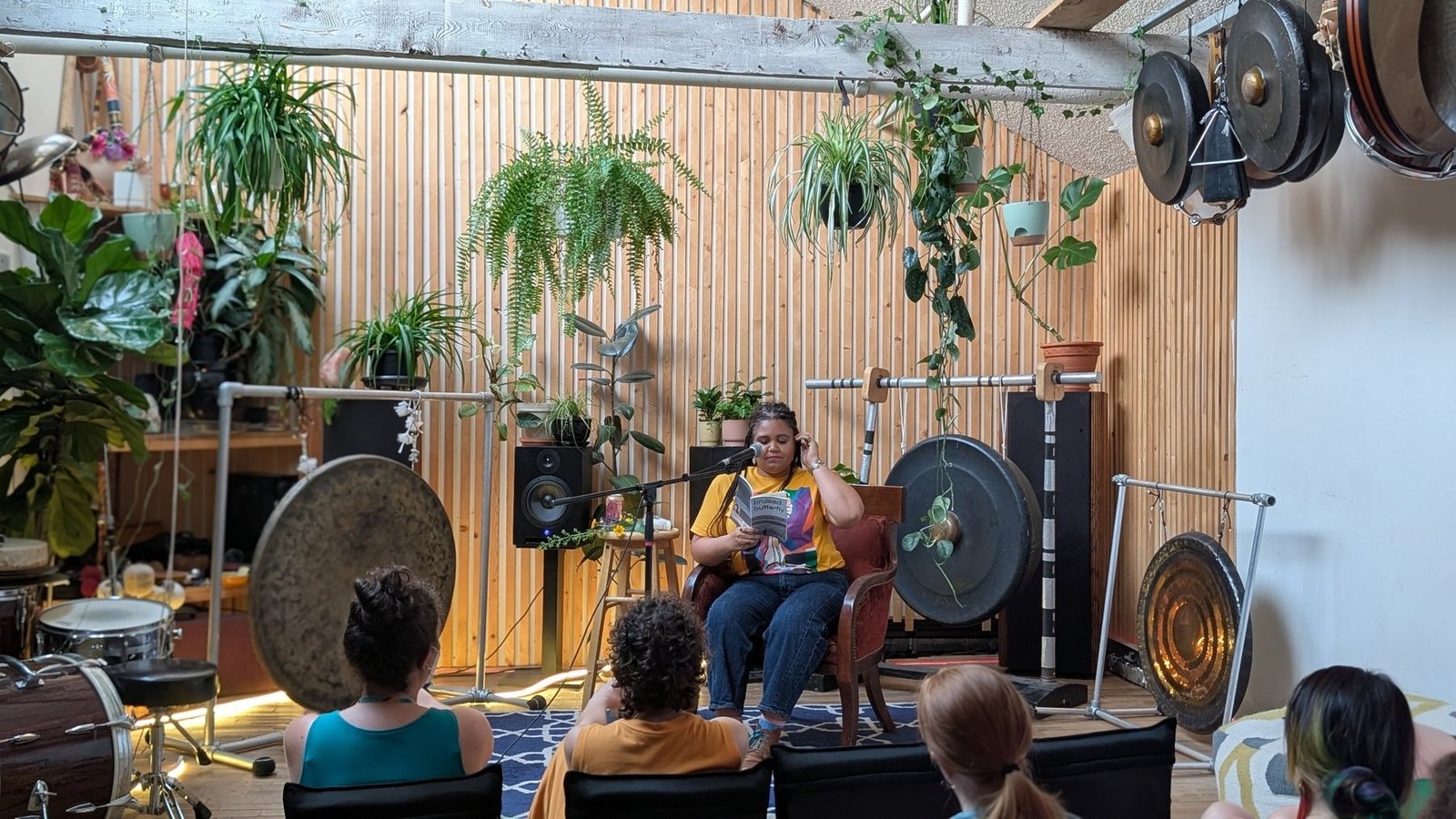
  • PRES-001 E.A. van Wyk — Bruised Butterfly Book Launch 11 Jul 2025 A poetry book launch and live reading hosted in the Gong Library. poetry / reading

2024

  • PRES-002 Aaron Friend Lettner — Book of Light Oct 2024 A photographic Tarot deck launch with live collaborative card readings hosted in the Gong Library. visual art / reading

Earlier presentation

  • PRES-003 Plant Listening Show inaugural event A listening event and plant-care exchange that inaugurated the Temporary Frames space at Hypha Arts. listening / community

PRES-001poetry / reading · 11 July 2025

Bruised Butterfly

Record

Record no.
PRES-001
Status
completed presentation
Artist / Author
E.A. van Wyk
Event
Bruised Butterfly book launch
Date
11 July 2025
Time
7:00–8:00 PM
Location
Gong Library, Vancouver, BC
Temporary Frames role
Host / venue
Format
Poetry book launch / live reading

Overview

On 11 July 2025, the Gong Library hosted the launch of E.A. van Wyk’s poetry collection Bruised Butterfly. The event centered on a live reading by the author, with an audience gathered in the library for an intimate literary presentation.

Van Wyk’s work explores immigrant identity, isolation, climate grief, memory, belonging, and transformation. The launch extended the Gong Library’s programming beyond sound-based performance into poetry and spoken word, using the space as a focused setting for author and audience to meet.

Hosting Context

For this presentation, Temporary Frames’ role was straightforward: the Gong Library provided the venue and hosted the reading. The event demonstrates the space’s capacity to support small-scale literary and interdisciplinary gatherings alongside its ongoing sound and listening programs.

Documentation

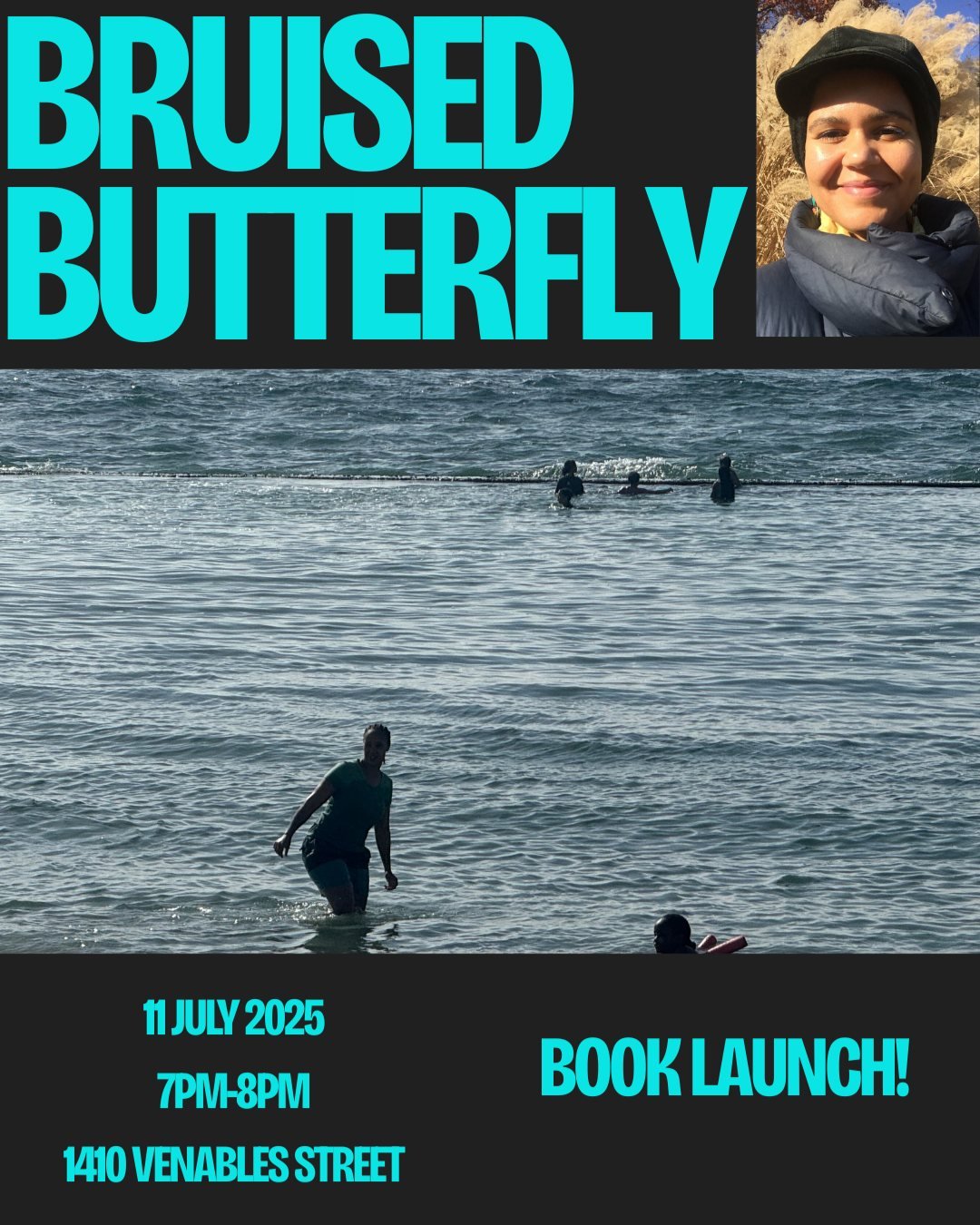
Poster and photographs from the 2025 book launch.

Promotional poster for the Bruised Butterfly book launch, with event date, time, and venue.
Promotional poster for Bruised Butterfly.
Audience seated in the Gong Library during the poetry book launch.
Audience gathered in the Gong Library for the reading.
The author seated with a book and microphone during the live reading in the Gong Library.
Live reading during the launch.
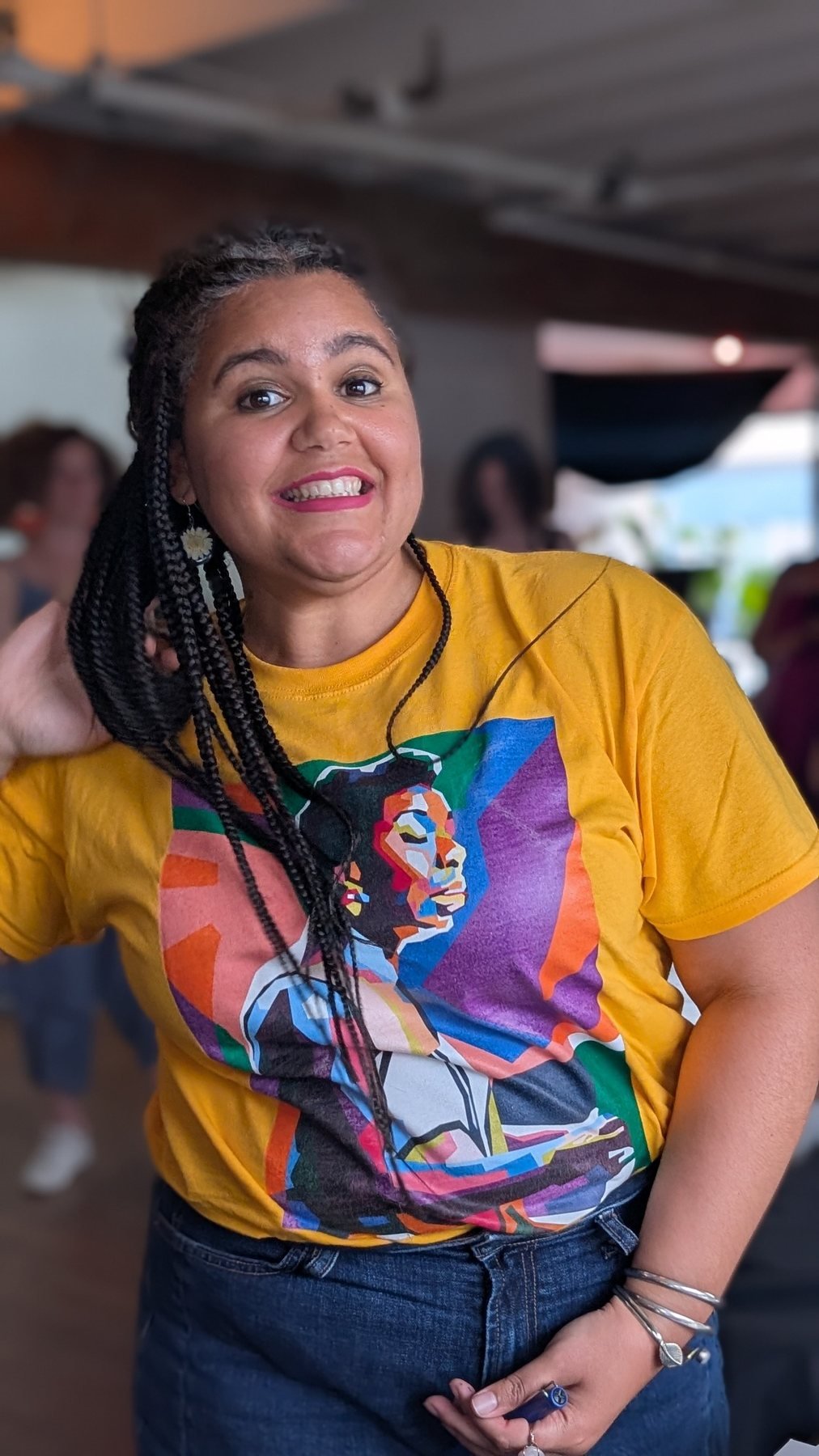
Portrait photograph taken during the Bruised Butterfly book launch.
Portrait from the book launch.

PRES-002visual art / card reading · October 2024

Book of Light

Record

Record no.
PRES-002
Status
completed presentation
Artist
Aaron Friend Lettner
Event
Book of Light launch
Date
October 2024
Location
Gong Library, Vancouver, BC
Host / Partner
Hypha Arts Social Club / Gong Library
Format
Photographic Tarot launch / participatory card readings

Overview

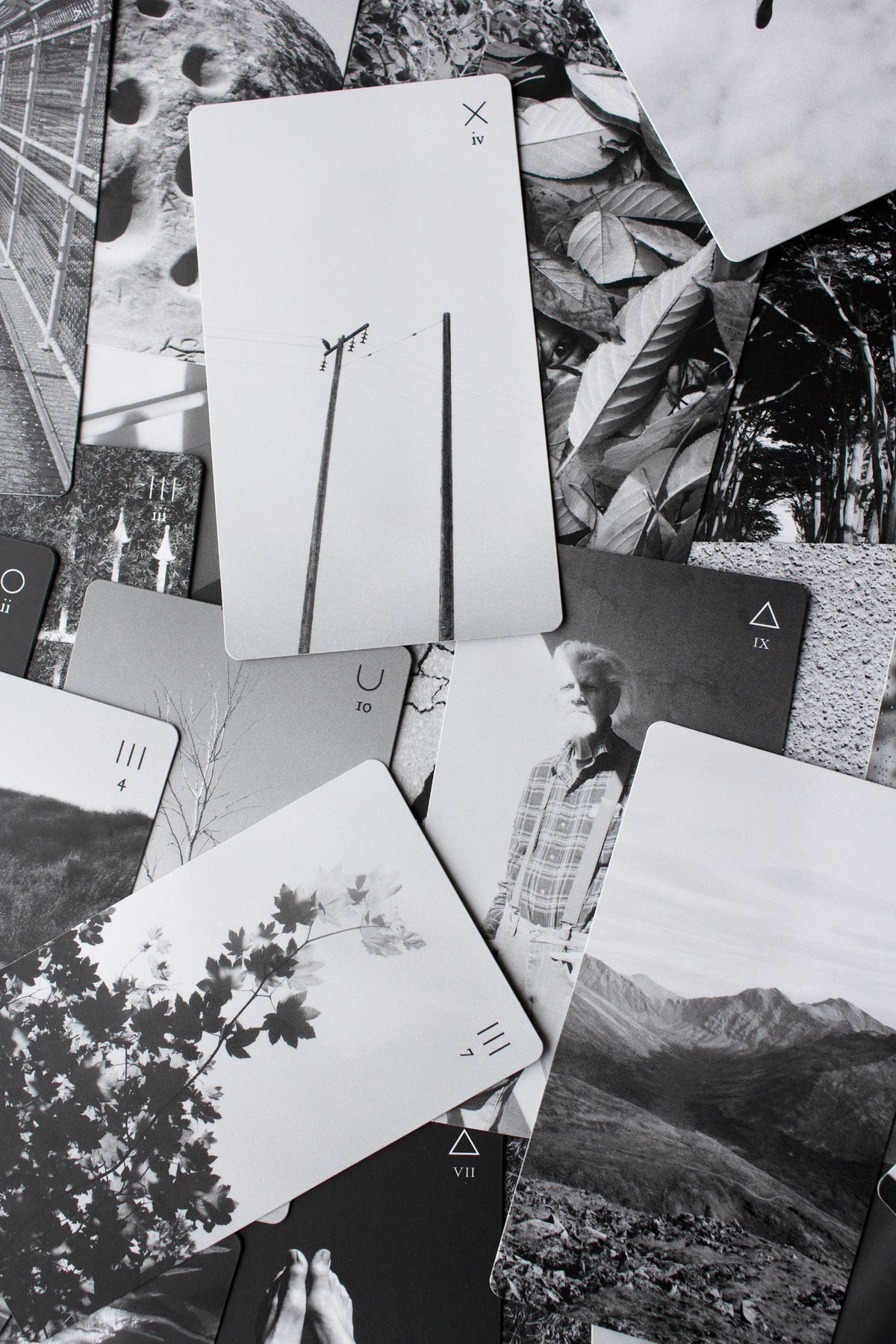
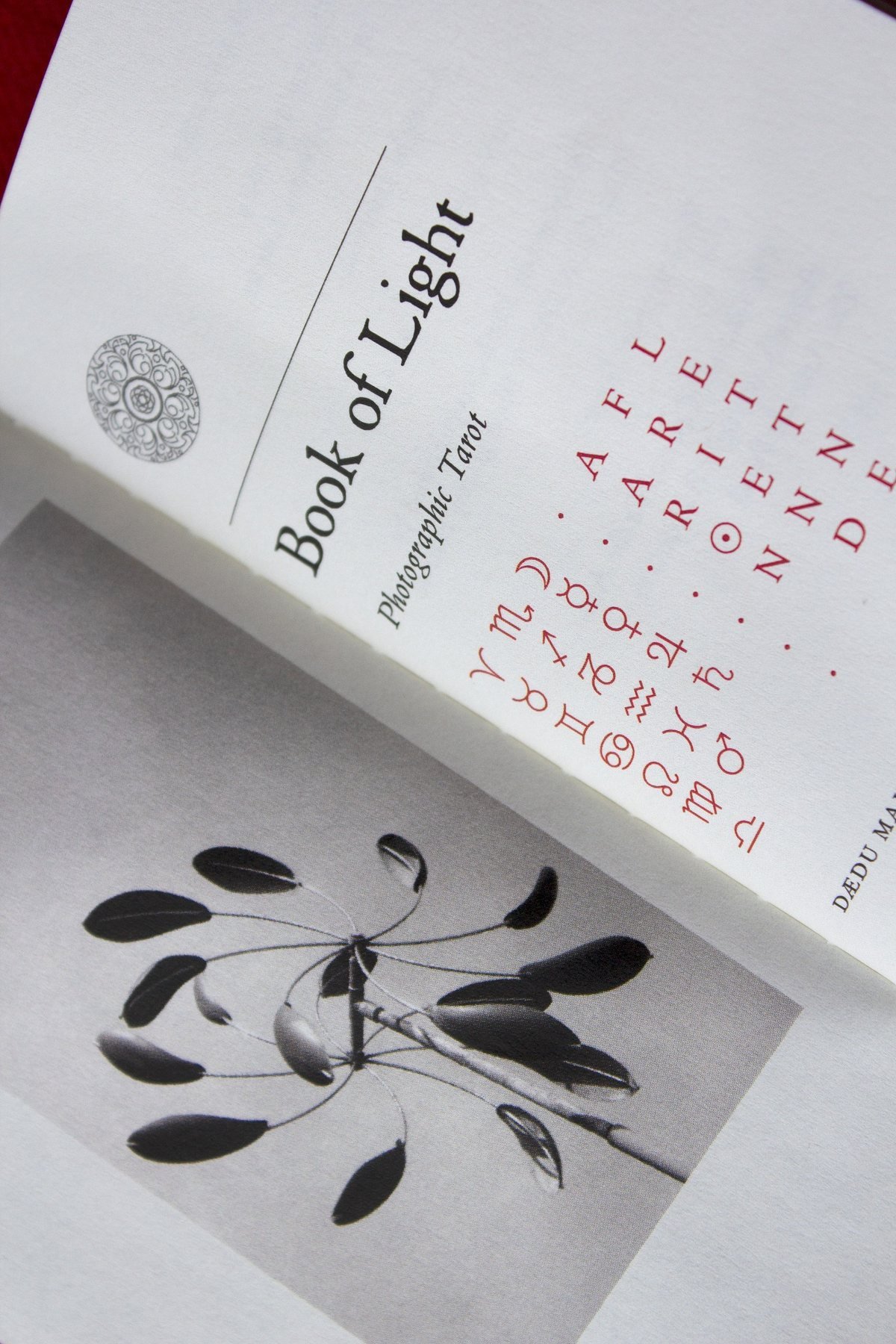
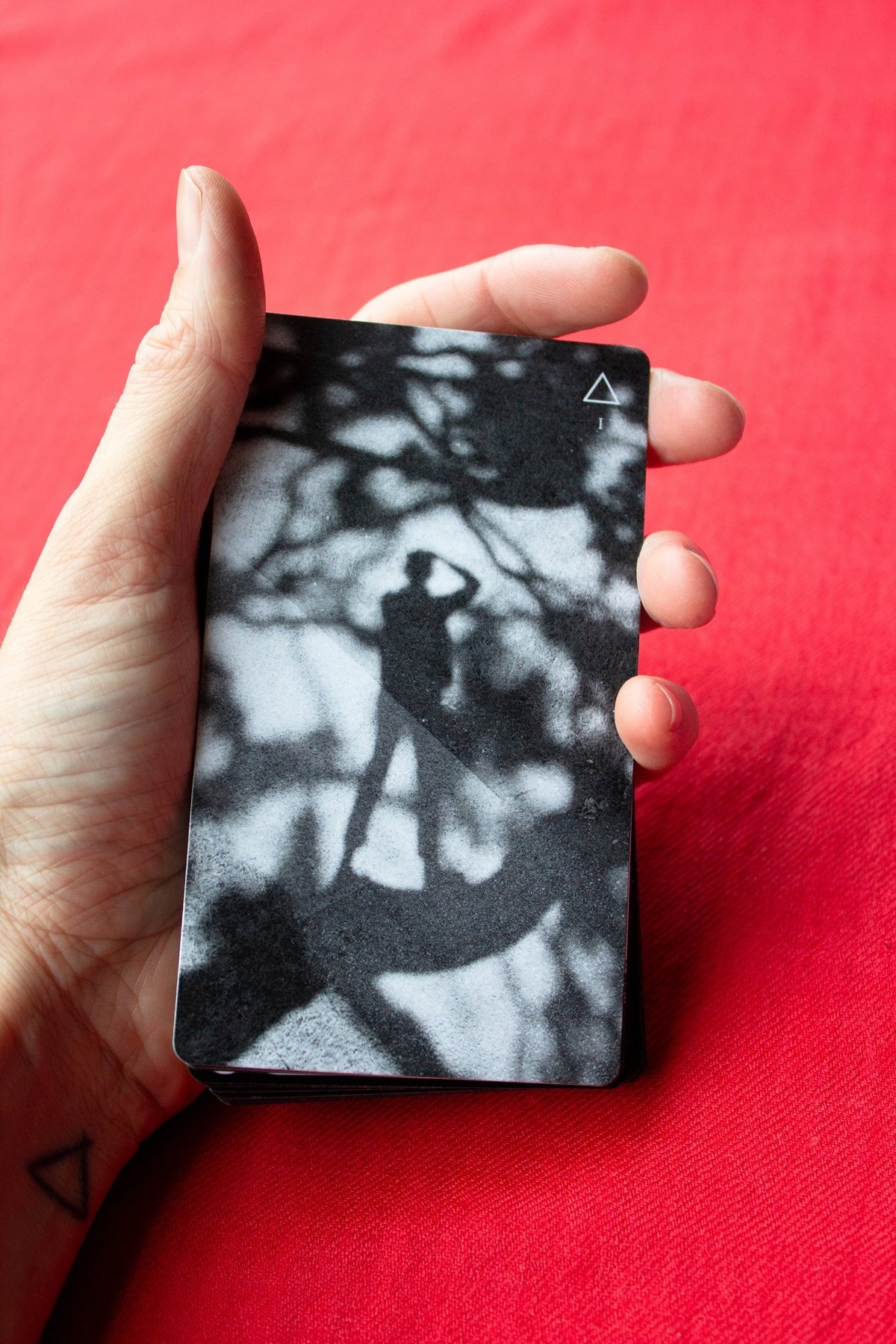
In October 2024, the Gong Library hosted the launch of Aaron Friend Lettner’s Book of Light for the Hypha Arts Social Club. Book of Light is a 78-card black-and-white photographic Tarot deck assembled from an archive of more than 4,000 negatives made over seven years, primarily along Canada’s West Coast.

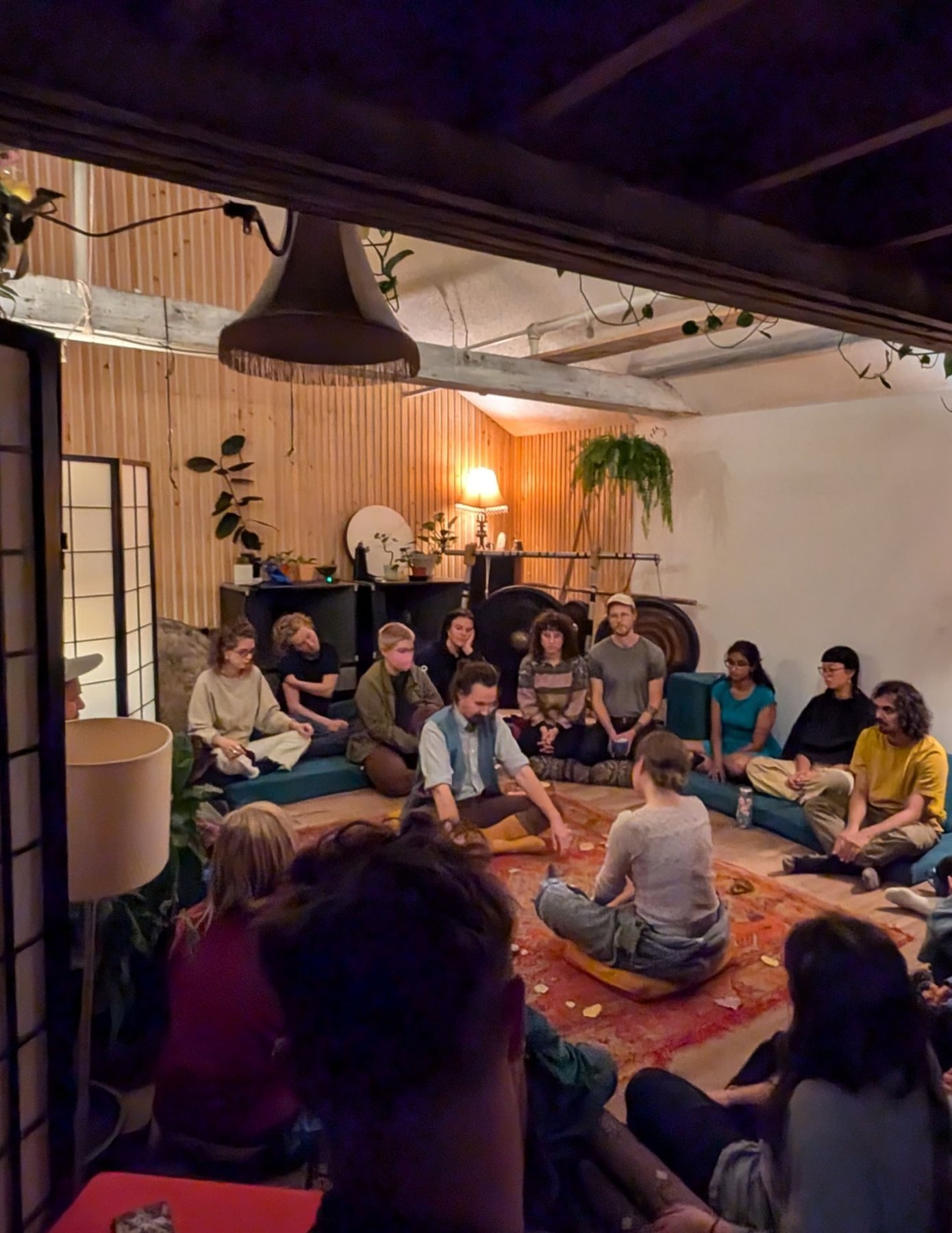
The launch included live card readings with attendees. As cards were drawn, Lettner and participants used the photographs as prompts for conversation, interpretation, and unexpected associations between images.

Presentation Context

The card-reading format gave attendees a direct way to encounter the photographic deck through conversation as well as through the images themselves. The event combined a publication launch with a participatory activity while retaining the informal scale of the Hypha Arts Social Club.

For Temporary Frames and the Gong Library, the presentation expanded the space’s programming into photography, publishing, and participatory visual art.

Documentation

Documentation of Book of Light and its October 2024 launch at the Gong Library.

A spread of black-and-white photographic Tarot cards from Aaron Friend Lettner’s Book of Light.
Book of Light photographic Tarot deck.
Close-up of the Book of Light Photographic Tarot publication showing its title page and black-and-white photograph.
Book of Light: Photographic Tarot publication detail.
A hand holds a black-and-white photographic Tarot card from Book of Light against a red background.
Card detail from Book of Light.
Attendees sit in a circle in the Gong Library during the Book of Light launch and participatory card readings.
Book of Light launch gathering at the Gong Library, October 2024.

About

Temporary Frames Arts Society is a registered non-profit arts organization founded in 2017, based in East Vancouver, working across live sound, immersive performance, and relational aesthetics. The work is about listening, presence, and what happens between people in a shared space.

Temporary Frames works on the unceded territories of the xʷməθkʷəy̓əm (Musqueam), Sḵwx̱wú7mesh (Squamish), and səlilwətaɬ (Tsleil-Waututh) Nations. We are based at Hypha Artist Association in East Vancouver.

Our Origin: The Architecture of Impermanence

Temporary Frames Arts Society was born directly out of the material realities of Vancouver’s housing and real estate landscape. The organization was founded inside a teardown home at 2655 Renfrew Street, Vancouver, BC; a house, along with its entire block, slated for demolition.

Living and creating within a condemned structure, the founders experienced firsthand the profound tension between the human desire to establish roots and the urban reality of being uprooted. Rather than resisting this transience, the house became a laboratory. We established Temporary Frames as a platform to actively explore themes of impermanence, community adaptation, and metamorphosis. We learned early on that while the physical structures we inhabit may be temporary, the relational connections and artistic lineages forged within them are continuous and enduring.

Mission

Temporary Frames facilitates spaces, residencies, and situational art projects that resource independent artists and the public. Through active programs such as the Gong Library and Imaginal Airlines, alongside curated music and sound events, we provide the physical and administrative containers necessary for interdisciplinary creators to experiment, rehearse, and present work. We put highly intentional, temporary structures around fragile ideas, giving them the exact space they need to incubate, materialize, and evolve.

Vision

We envision a cultural landscape that embraces the impermanence of existence while actively generating new legends, myths, art forms, and dances. We strive to fundamentally redefine how communities live, gather, and inhabit space; promoting radical flexibility, mobility, and experimental adaptation in the face of constant societal change. Through our spatial and artistic endeavors, we seek to rediscover and celebrate collective empowerment, building temporary containers that sustain a better, more connected future.

Core Values

Relational Empowerment: We believe in community-engaged practices. The success of our projects is measured by the quality of human connection and the depth of the relationships they foster. We are fiercely committed to empowering individuals and collectives to reimagine their environments, utilizing art as a vehicle for personal and communal agency.

Imaginative Rigor: We value imaginative expression not merely as an aesthetic pursuit, but as a critical methodology for providing creative solutions to complex societal challenges.

Continuity Through Transience: Embracing the inevitability of change, we promote experimental adaptation in our operational models and artistic output. Recognizing the fleeting nature of physical spaces, we value the profound, lasting continuity that shared art and community bring to our lives.

Milestones & Organizational Evolution

Since our inception, Temporary Frames has operated as an agile incubator, transforming overlooked spaces into vibrant cultural hubs. To date, we have collaborated with more than 150 independent artists, housed numerous multidisciplinary exhibitions and events, and facilitated workshops.

The Wheel of Time Gallery & Early Incubation

Operating out of the original Renfrew Street teardown, the Wheel of Time Gallery served as our foundational experimental art space. It was a site for serendipitous encounters, where artists and performers could showcase their work. Over three years, the gallery hosted seven cycles of shows across more than 40 artists, fostering intense community engagement while the property awaited demolition. Concurrently, we reclaimed the property's garage, converting it into a shared, grassroots movement studio named CLOUD STUDIO that provided essential daily workspace for physical theatre and clowning practitioners.

The Current Era: Hypha Arts, The Gong Library & Imaginal Airlines

Following the inevitable demolition of the Wheel of Time Gallery and a hiatus during the COVID-19 global shutdown, Temporary Frames relocated in 2023 to a new space at Hypha Arts, located at 1410 Venables Street. This new home catalyzed the launch of our current projects: the Gong Library, Imaginal Airlines, and curated music presentations.

The Gong Library

Operating as a dynamic intersection of sound, movement, and knowledge, the Gong Library is conceived as a rigorous "playroom" for adults and artists. At its core is an 18-voice just intonation sound installation. This quadraphonic sine-wave soundscape creates a highly responsive acoustic environment that visitors can experience as the playing gongs actively modulate one another. The space invites participants to engage in emergent sonic practices, acoustic wellness, and embodied experiences that challenge traditional ways of knowing. It serves as a highly active platform for interdisciplinary collaboration, seamlessly blending ambient music, contemporary dance, clowning, and the visual arts into singular, immersive situations.
Imaginal Airlines

Imaginal Airlines operates as a situational sonic experience navigating the participant's imaginal airspace. Framed as Flight A108, the project co-opts the familiar rituals of commercial air travel; from check-in and security to take-off and landing. The experience functions as part concert, part active meditation, and part return-journey to the Self. The flight features a live musical performance by Imaginal Cells, a sextet that generates expansive sonic landscapes utilizing gongs, resonant percussion, and strings.

In addition to these core projects, the space is actively utilized for a wide variety of multidisciplinary events, including live music shows, poetry readings, short residencies, workshops, and meditative practices.

People

  • Raj Gill — Executive & Artistic / Creative Director
  • Tyrell Warren — Program Director
  • Miel Nicholson — Managing Director
  • Board of Directors — Matthew Ariaratnam, Suna Galey, Raj Gill

History

  • 2017Temporary Frames Arts Society founded in East Vancouver.
  • 2023The Gong Library opens; ongoing development with 80+ collaborating artists.
  • 2025Imaginal Airlines: Flight A108 developed with the Imaginal Cells sextet; inaugural performance September 13, 2025 at the Hadden Park Field House.

Funders

  • Creative BC
  • European DigiScore Project
  • City of Vancouver

Partners

  • Hypha Artist Association Society
  • Low Indigo
  • Light Blues
  • Muro Studios
  • Caroline Ballhorn Studios
  • Indian Summer Festival
  • Modern Biology
  • Margins of Sound Society
  • Stretch Metal

Accessibility

This site is built to WCAG AA contrast throughout, works without images, respects reduced-motion preferences, and is fully navigable by keyboard.

Temporary Frames office and studio are located on the 2nd floor of Hypha Arts in East Vancouver. Unfortunately, we don't have an elevator at this site.

1410 Venables Street, Vancouver, BC, Canada

Contact

  • temporaryframes@gmail.com
  • 1410 Venables Street, Vancouver, BC, Canada

SPACE / PARTNERSHIPEast Vancouver · ongoing

Hypha Arts

Temporary Frames & Hypha Arts

Temporary Frames works closely with Hypha Artist Association. The Temporary Frames studio and offices are located within Hypha Arts, and the two organizations periodically co-produce concerts, listening events, performances, and community gatherings.

Hypha Artist Association Society provides essential, subsidized cultural work space to a diverse community of Vancouver-based artists and cultural organizations.

Visit hyphaarts.ca →

Record

Relationship
Studio, offices, and producing partnership
Location
1410 Venables Street, Vancouver, BC
Organizations
  • Hypha Artist Association Society
  • Temporary Frames Arts Society
Shared use
Private studios, events, gatherings, art shows, music, and community programming

Mission

Hypha Artist Association Society is a horizontally structured collective of artists and cultural organizations working across diverse disciplines. It maintains private studios and a shared common space for events, gatherings, art shows, music, and community programming—a modular, DIY environment that changes with the needs of its community.

Events Co-produced With Hypha Arts

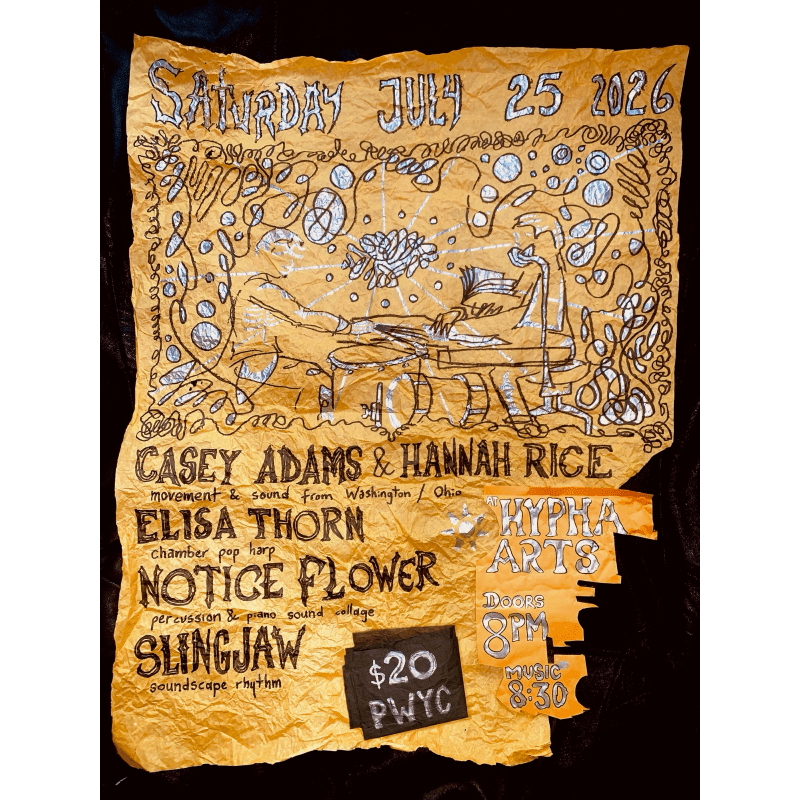
Event poster for Casey Adams and Hannah Rice, Elisa Thorn, Notice Flower, and Slingjaw at Hypha Arts
25 Jul 2026
Casey Adams & Hannah Rice · Elisa Thorn · Notice Flower · Slingjaw
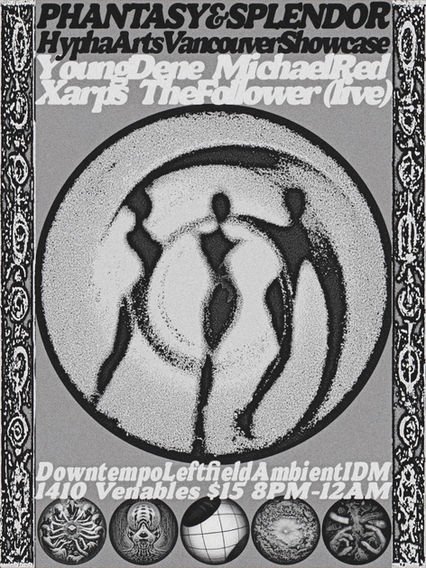
Event poster for Phantasy and Splendor, Young Dene, Michael Red, and Xarps TheFollower at Hypha Arts
4 Apr 2026
Phantasy & Splendor · Young Dene · Michael Red · Xarps TheFollower
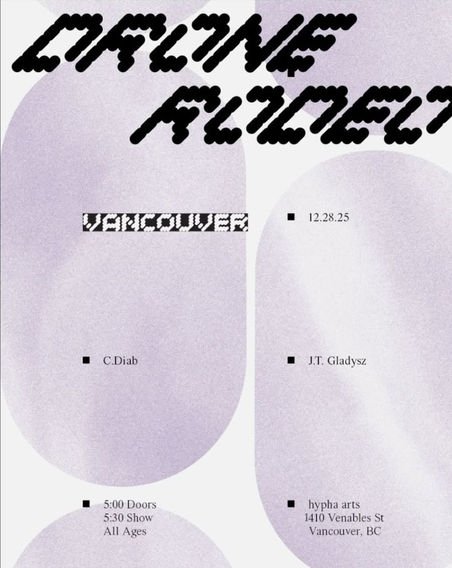
Drone Rodeo event poster featuring C. Diab and J.T. Gladysz at Hypha Arts
28 Dec 2025
Drone Rodeo — C. Diab & J.T. Gladysz
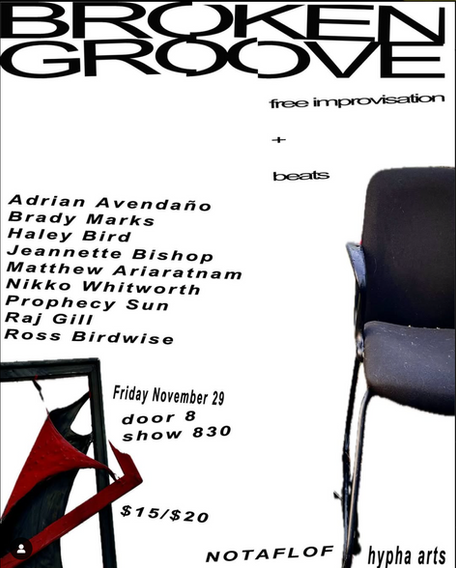
Broken Groove free improvisation event poster at Hypha Arts
28 Nov 2025
Broken Groove — Adrian Avendaño · Brady Marks · Haley Bird · Jeannette Bishop · Matthew Ariaratnam · Nikko Whitworth · Prophecy Sun · Raj Gill · Ross Birdwise
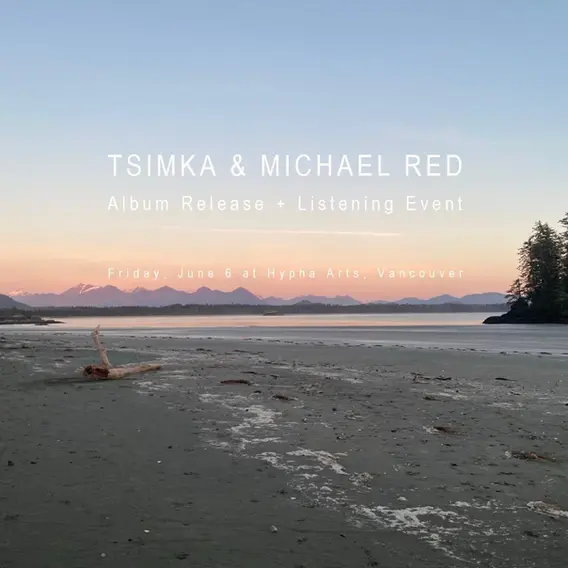
Tsimka and Michael Red album release and listening event poster at Hypha Arts
6 Jun 2025
Tsimka & Michael Red — Album Release + Listening Event
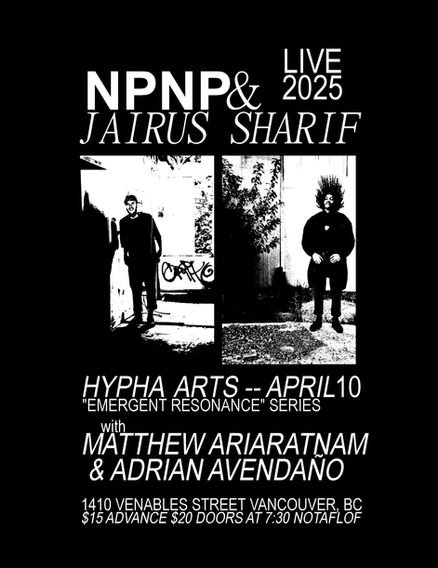
Emergence Resonance Series event poster featuring NPNP and Jairus Sharif at Hypha Arts
10 Apr 2025
Emergence Resonance Series — NPNP & Jairus Sharif, featuring Matthew Ariaratnam & Adrian Avendaño
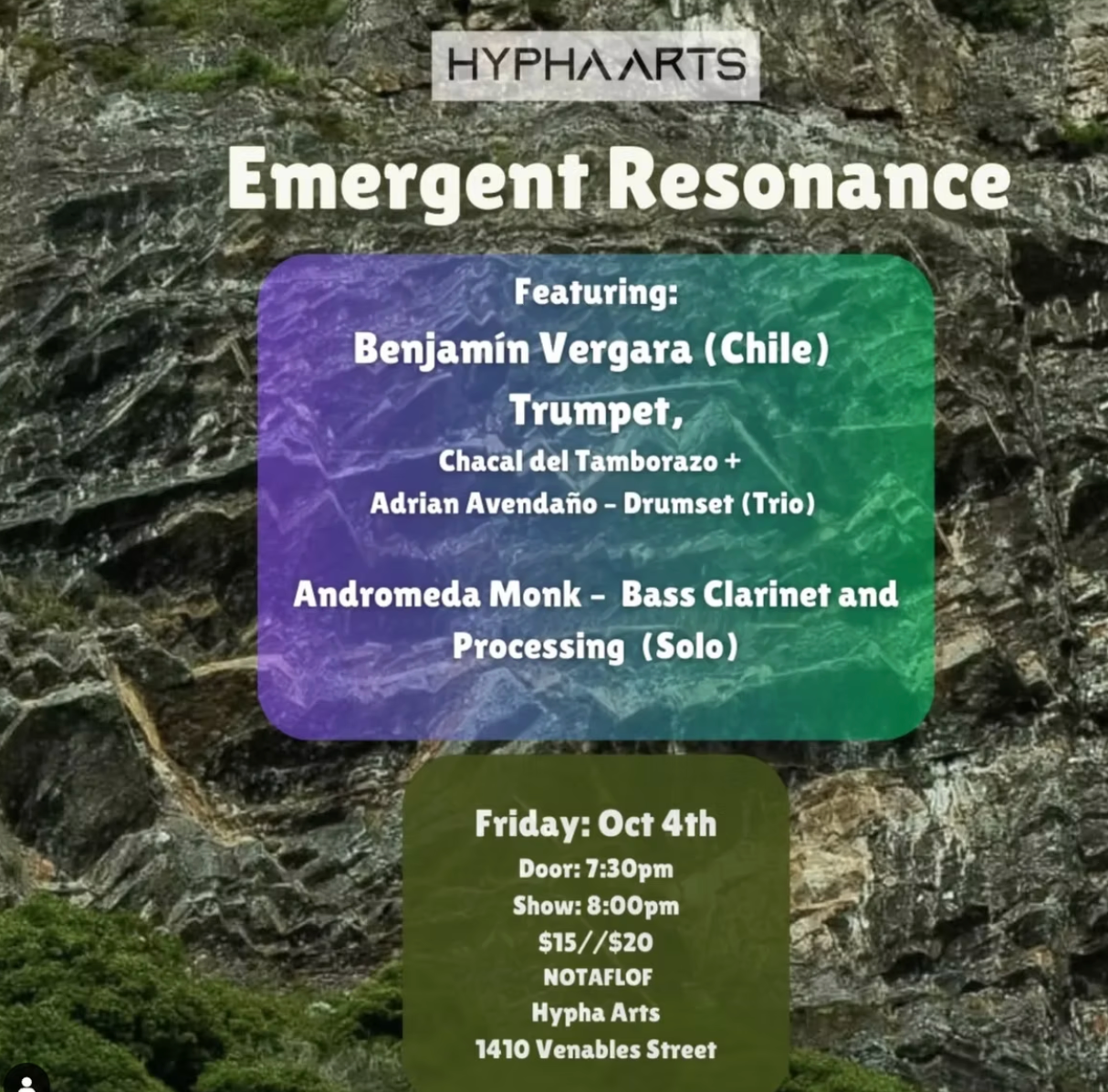
Emergent Resonance event poster featuring Benjamin Vergara, Chacal del Tamborazo with Adrian Avendaño, and Andromeda Monk at Hypha Arts on October 4, 2024
4 Oct 2024
Emergent Resonance — Benjamin Vergara (Chile), trumpet · Chacal del Tamborazo + Adrian Avendaño, drumset (trio) · Andromeda Monk, bass clarinet and processing (solo)

ARC-002series · 2017–2020

Quiet Night Series

Record

Location
Kids Castle / Wheel of Time (WOT) Gallery, Vancouver, BC
Project
A Temporary Frames Arts Society project
Created and produced by
Ben Wylie, Raj Gill, and Matthew Ariaratnam
Iterations
Four events
Timeline
2017–2020
Participation
45+ performers across the series
Format
Multidisciplinary quiet performance series

Project Overview

Spanning four distinct events, the Quiet Night Series was a decentralized, multidisciplinary performance initiative that prioritized radical accessibility and acoustic intimacy. Hosted within the temporary, community-driven frameworks of Kids Castle and the Wheel of Time Gallery, the series functioned as a free platform dedicated to cultivating deep, intentional engagement between performers, the space, and the audience.

The Process

To dismantle traditional curatorial gatekeeping, Quiet Night utilized a lottery-based selection model, welcoming artists and creators across all mediums to participate. The defining parameter for every performance was a low-volume constraint. This acoustic limitation acted as both a creative prompt and a leveling mechanism, challenging artists to experiment with short-form, quiet works. Stripped of loud amplification, the physical environment of the house shaped the acoustics, and attendees were naturally guided into a posture of active, focused listening.

Thematic Context

As an exercise in situational art, Quiet Night demonstrated that stripping away volume could actually amplify presence. By enforcing quietness within the inherently active, ephemeral environments of a tear-down house, the series carved out a highly accessible testing ground for vulnerability and experimentation. It cultivated a highly engaged, relational setting where silence, subtlety, and deep listening became the primary mediums for community connection.

Documentation

Archival photograph from the Quiet Night Series.

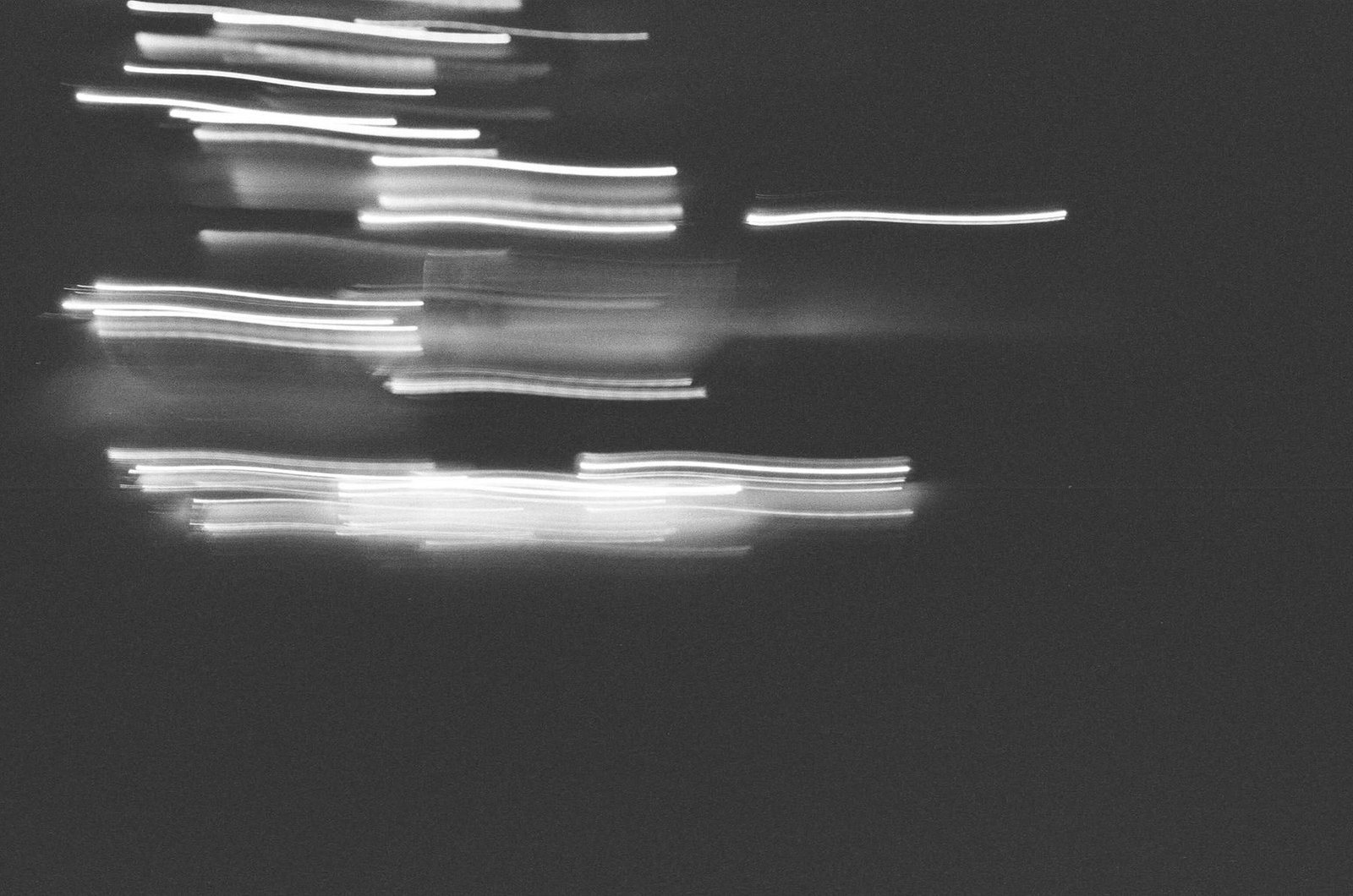
Black-and-white long-exposure archival image with streaks of light, associated with Quiet Night Series.
Long-exposure archival image from Quiet Night Series.

ARC-003studio / research platform · archived

CLOUD Studio

Record

Archive no.
ARC-003
Status
concluded following demolition
Timeline
2019– (concluded following demolition)
Location
Vancouver, BC
Founders & Producers
Raj Gill and Tyrell Warren
Format
Movement studio / physical theatre research platform

Short Description

CLOUD Studio was an independent movement and clowning workspace co-created by Raj Gill and Tyrell Warren inside a converted Vancouver garage. Built largely from salvaged and found materials, the studio provided an accessible and consistent space for physical training, improvisation, and ensemble practice. It became an important incubator for practitioners working with David MacMurray Smith’s clown methodology before the property was demolished for redevelopment and elements of the practice continued at Hypha Arts.

Project Statement

In 2019, responding to the scarcity and cost of accessible rehearsal space in Vancouver, Raj Gill and Tyrell Warren transformed an unused residential garage into CLOUD Studio.

Operating outside conventional institutional and commercial studio structures, CLOUD provided a dedicated environment for physical theatre practitioners investigating clown, kinetic release, relational awareness, and the pedagogical lineage of David MacMurray Smith. Its small scale and low overhead allowed artists to return regularly for sustained practice rather than working only within the time limits of rented rehearsal rooms.

The studio became a testing ground for somatic research, ensemble improvisation, rivering, mask work, and process-oriented rehearsal. Its value came less from formal production than from continuity: artists could repeatedly investigate impulse, presence, relationship, and physical responsiveness within a stable practice community.

Thematic Context: Temporary Space, Enduring Practice

CLOUD Studio embodied an approach that would become central to Temporary Frames: using overlooked or temporary architecture to create meaningful cultural infrastructure.

The garage was adapted largely through reclaimed materials, connecting the physical construction of the studio to broader questions of waste, value, reuse, and transformation. Rather than waiting for ideal facilities or significant resources, the project demonstrated how an existing space could be converted into a functional artistic container through collective labour and improvisation.

The property was eventually demolished for redevelopment. The loss of the building, however, did not end the artistic research it supported. The community, practices, and working methods developed at CLOUD continued elsewhere, including at Hypha Arts.

CLOUD Studio therefore represents an early expression of a recurring Temporary Frames principle: the physical container may be temporary, while the relationships, practices, and creative lineages developed inside it can endure.

The Practice & Utility

  • MATERIAL RECLAMATION: Salvaged and found materials were used to construct and equip the studio, embedding reuse and resourcefulness directly into the project.
  • SPACE CONVERSION: An underused residential garage was transformed into a functional movement and rehearsal environment.
  • SUSTAINED PRACTICE: Regular access allowed artists to maintain ongoing physical, somatic, and improvisational research outside formal classes or short-term rentals.
  • LINEAGE & RESEARCH: The studio supported investigation of David MacMurray Smith’s clown methodology, including mask work, kinetic release, rivering, and Ringmaster awareness.
  • CONTINUITY THROUGH CHANGE: When the building was demolished, the practices and community developed at CLOUD migrated into subsequent artistic contexts, including Hypha Arts.

Documentation

Archival photographs documenting the conversion of the garage into CLOUD Studio, from the original space through construction to completion.

Title card reading “BEFORE”.
Before.
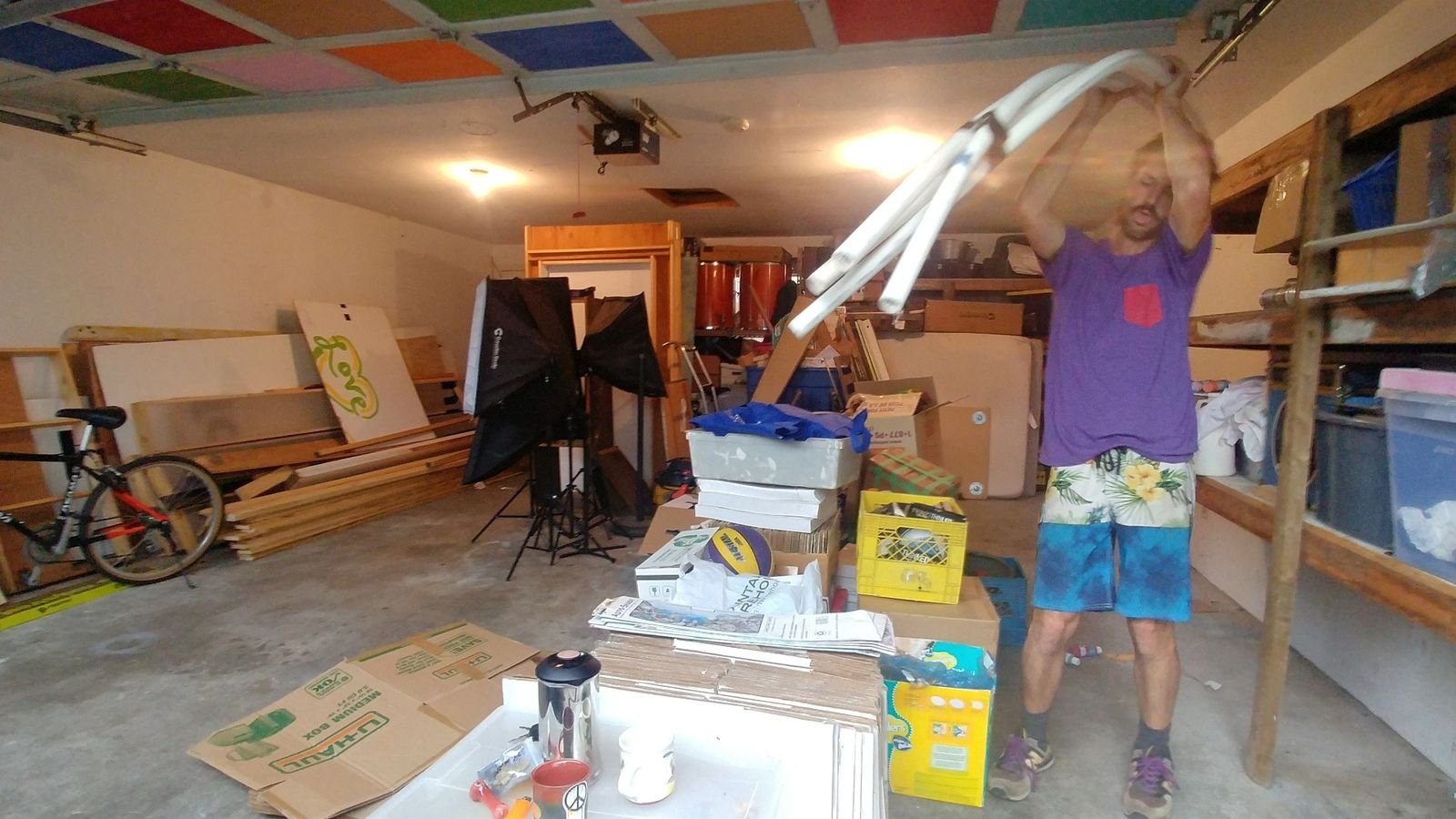
The original cluttered residential garage before it was converted into CLOUD Studio.
The garage before conversion.
Title card reading “BUILD”.
Build.
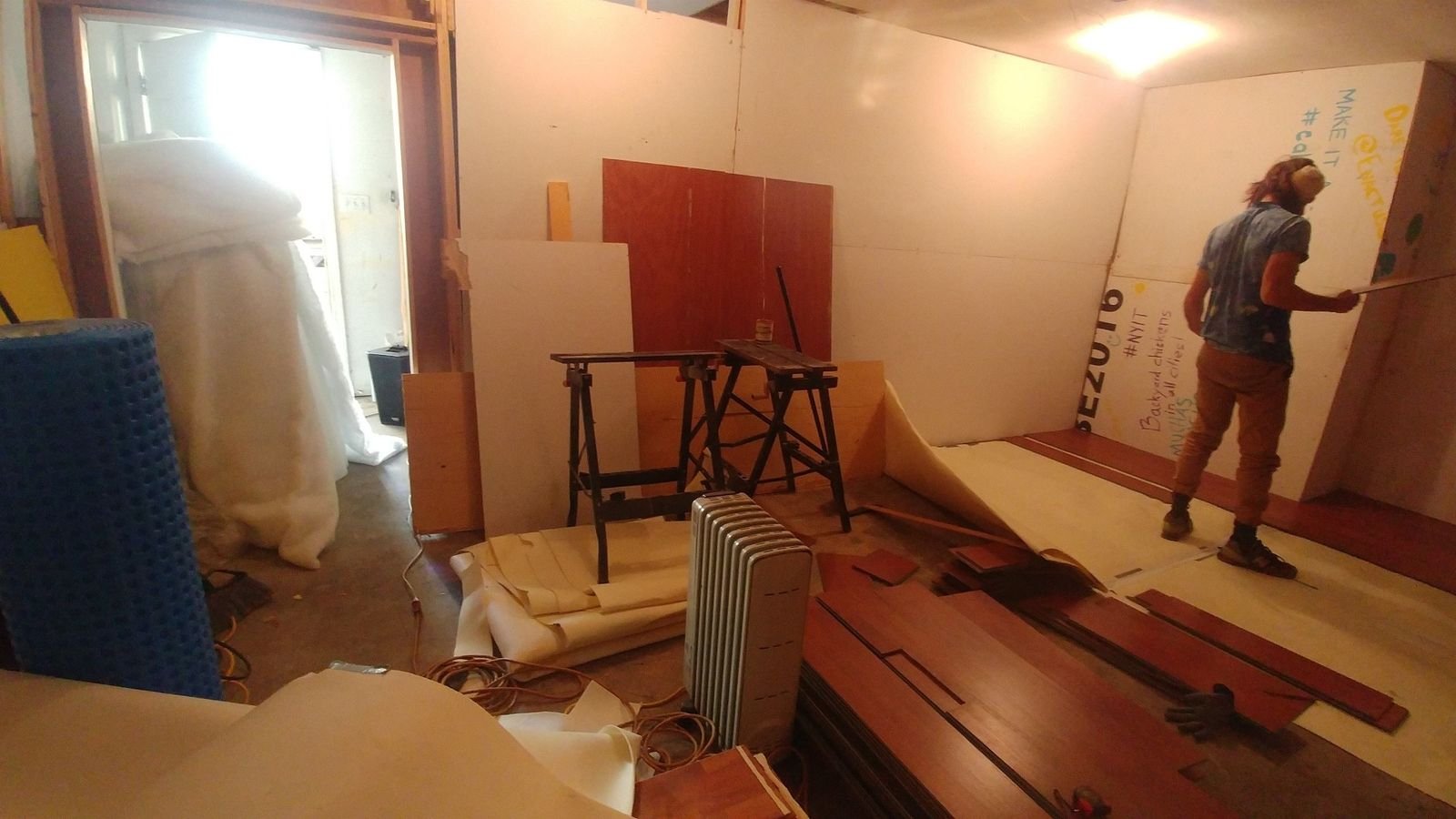
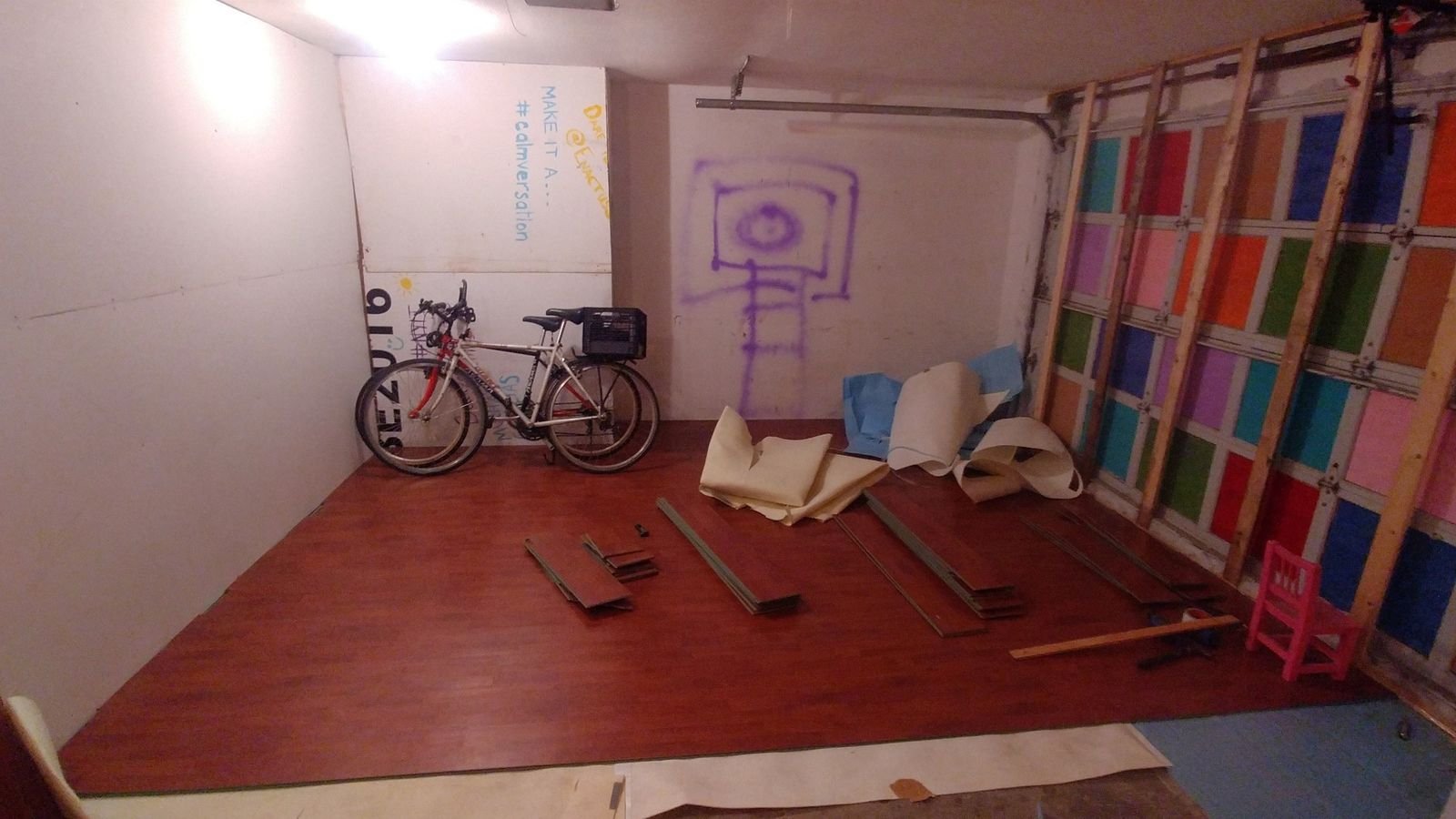
A person works inside the garage among reclaimed flooring, wall panels, insulation, tools, and building materials.
Reclaimed flooring and wall materials being prepared during the build.
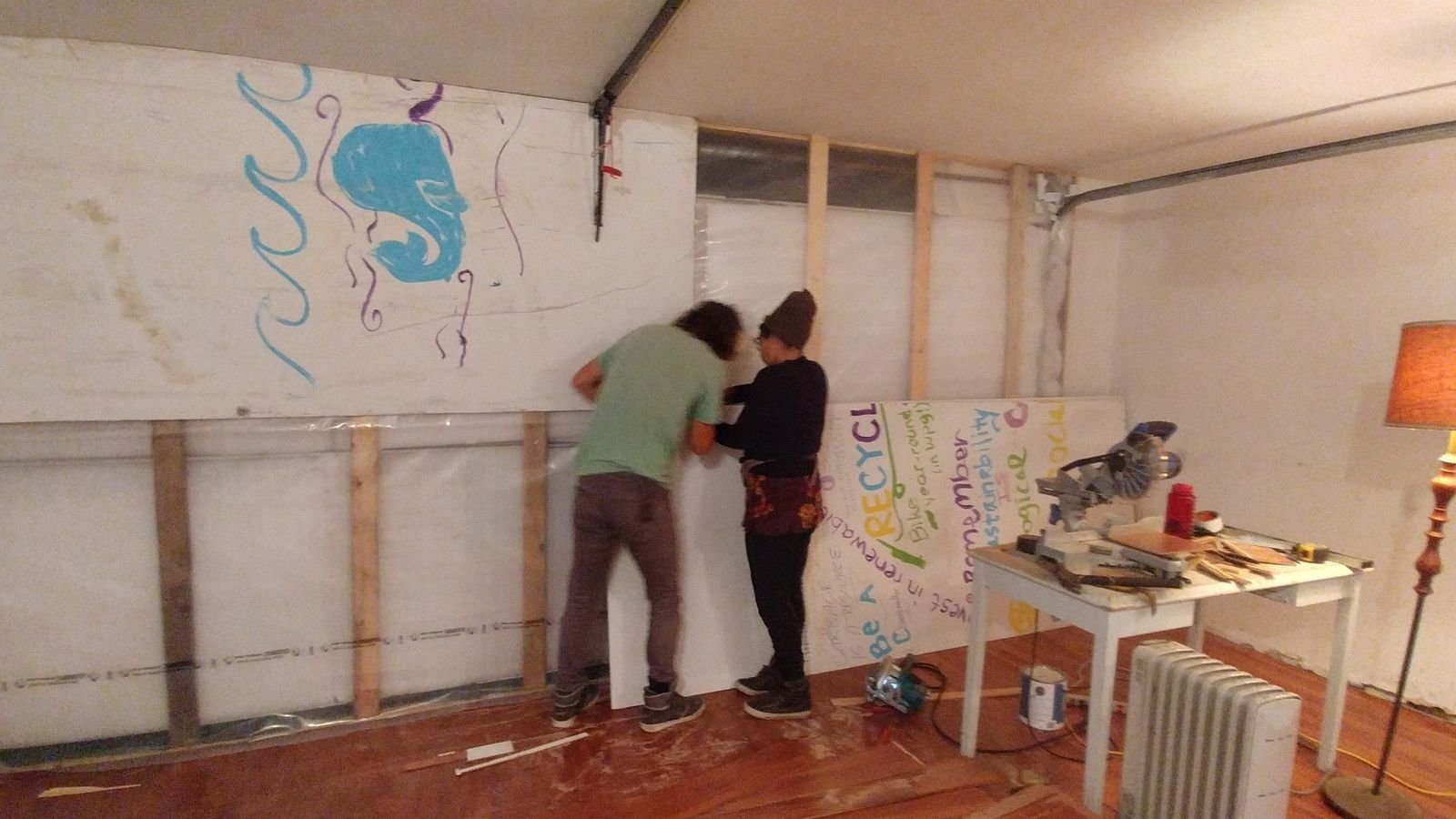
Two people install wall panels inside the garage during the CLOUD Studio conversion.
Wall construction using reclaimed and repurposed materials.
Reclaimed wood flooring is being installed across the garage floor while wall and insulation work continues.
Early flooring installation and spatial conversion.
Stacks of reclaimed flooring, insulation, tools, and a partially completed studio floor during construction.
The studio floor taking shape.
A nearly completed CLOUD Studio interior with finished wood floor and newly enclosed white walls.
Near-complete movement floor and enclosed rehearsal space.
Title card reading “COMPLETE”.
Complete.
The finished CLOUD Studio with wood movement floor, padded walls, heater, and studio equipment.
Completed CLOUD Studio movement space.
A second view of the completed CLOUD Studio showing the wood floor, padded walls, curtain, and open movement area.
Completed studio from the opposite corner.

ARC-001archive · interactive community arts

Interactive Community Arts

Record

Archive no.
ARC-001
Status
archived collection
Format
Participatory / Interactive Community Arts
Projects
5 project records

Collection

Interactive Community Arts gathers a group of participatory projects in which art is made through direct encounter: with symbols, geometry, materials, shadows, sound, play, and other people.

These works share an interest in temporary structures, accessible participation, relational play, material transformation, and collective imagination.

Projects

  • ICA-001GLYPH YO’ SELF2018–2021Personal symbols embedded into a house approaching demolition.participatory
  • ICA-002Sri YantraarchivedA communal mandala made from reclaimed paint at Kids Castle.participatory
  • ICA-003Cardboard DayarchivedA community cardboard build transformed into a public parade around Trout Lake.relational
  • ICA-004Shadowjam with Mind of a Snail2018A shared dream of shadow puppetry, music, craft, and improvisation.performance
  • ICA-005Sonic Ping-Pong2-year activationA musical ping-pong table that evolved into community seating for The Gong Library.installation

ICA-001participatory · 2018–2021

GLYPH YO’ SELF

Record

Location
Wheel of Time (WOT) Gallery, Vancouver, BC
Timeline
2018–2021
Format
Participatory community art
Context
Wheel of Time Gallery — a temporary, immersive gathering space inside a Vancouver residential property slated for demolition

Project Overview

GLYPH yo Self was a participatory community art project housed within the Wheel of Time (WOT) Gallery—a temporary, immersive gathering space situated inside a Vancouver residential property slated for demolition. The project served as a collective intervention, inviting individuals to leave a deliberate, personal mark on a structure nearing the end of its lifecycle.

The Process

Participants were invited into the space to design and create their own personal symbols, or "glyphs," using pieces of donated wood. These individual wooden totems were then integrated directly into the architecture of the house, slowly covering and transforming the space through community contribution.

Thematic Context

Rooted in themes of impermanence, cycles, and transition, the project embraced the impending demolition of the venue rather than resisting it. By embedding personal symbols into a doomed structure, GLYPH yo Self explored the tension between creation and destruction. It functioned as both an aesthetic transformation of a tear-down property and a situational art experience, allowing the community to collectively grieve, celebrate, and redefine a space in its final moments.

Documentation

Archival photographs from GLYPH yo Self.

Dozens of participant-made circular glyphs painted on reclaimed wooden panels and arranged together.
Participant-made glyph panels gathered during the project.
GLYPH yo Self project instructions displayed beside a cluster of small circular participant glyphs.
Project instructions and participant glyphs at the Wheel of Time Gallery.
Painted wooden strips bearing colorful circular glyphs displayed with the GLYPH yo Self project sign.
Completed wooden glyph panels and project signage.
Participants seated together making glyphs while a child holds up a completed painted wooden glyph panel.
Community participants making and sharing glyphs.

ICA-002participatory · Kids Castle

SRI YANTRA // KIDS CASTLE MANDALA

Record

Location
Kids Castle (KC), Vancouver, BC
Producer
Raj Gill
Artists / Collaborators
The Kids Castle collective, friends, and extended community; Craig Irvin, Anwar Nasar, Matthew Ariaratnam
Format
Participatory mandala / community art

Project Overview

Sri Yantra was a large-scale, participatory mandala art piece created as the symbolic and energetic anchor for Kids Castle; a temporary collective house and experimental community arts hub in Vancouver. Rather than a solitary artistic endeavor, the piece functioned as a situational gathering point, bringing people together through a shared act of creation.

The Process

The creation of the mandala was deeply rooted in communal effort and resourceful ingenuity. The physical painting of the piece was a collective action carried out by members of the house, visiting friends, and the broader KC community. True to the collective’s ethos of sustainability and working within temporary frameworks, the entire piece was brought to life using exclusively reclaimed paints salvaged from a local recycling center.

Thematic Context

Serving as an early precursor to the relational projects housed under Temporary Frames and the Wheel of Time Gallery, the Kids Castle Sri Yantra utilized sacred geometry to ground a chaotic, highly creative environment. The Sri Yantra represents cosmic cycles, the intersection of energies, and the journey toward the center. By relying on salvaged materials and the overlapping contributions of many different hands, the act of making the mandala mirrored its meaning; transforming a temporary, shared living situation into an intentional container for connection, impermanence, and collective art-making.

Documentation

Archival photographs from Sri Yantra.

A large Sri Yantra mural painted on an interior wall, featuring dark blue triangles inside a golden circle on a pink and black background.
Sri Yantra mural detail.
A group of participants pose indoors in front of the completed Sri Yantra mural.
Community portrait in front of the completed Sri Yantra mural.

PRES-004series / co-production · Feb–Mar 2026

Michael Red — Deep Listening Sound Sessions

Record

Record no.
PRES-004
Status
completed series
Featured artist
Michael Red
Sessions
Four
Timeline
February and March 2026
Location
Gong Library at Hypha Arts, 1410 Venables Street, Vancouver, BC
Co-producers
Light Blues and the Gong Library
In association with
Low Indigo and Hypha Arts
Format
Live ambient sound journey / headphone listening series
Listening system
Wireless stereo headphones with individual volume control + room sound system
Capacity
Approximately 30 participants per session

Overview

The Deep Listening Sound Sessions were a four-session series of intimate live sound journeys featuring Vancouver artist Michael Red and co-produced by Light Blues and the Gong Library. Presented at Hypha Arts, the sessions combined a room sound system with wireless stereo headphones equipped with individual volume controls, allowing each participant to adjust their own listening level while remaining part of a shared acoustic environment.

Michael Red performed responsive ambient soundscapes incorporating electronic synthesis, processed and dubbed-out nature recordings, and frequency-focused material. Attendance was intentionally limited to maintain a quiet, spacious setting.

Listening Format

Each session was structured around the full arc of arrival, listening, and re-entry. Guests arrived to quiet music, herbal tea, and homemade cookies before the performance began. Entry closed once the sound journey was underway in order to minimize interruption.

Participants could listen from cushions, blankets, and seating throughout the Gong Library. Wireless headphones offered individual volume control alongside the physical sound of the room. A secondary lounge with couches provided additional space for movement, rest, or temporary withdrawal from the main listening area.

Sensory Autonomy & Shared Listening

The series explored how spatial design and audio technology can support different modes of attention within a shared listening experience. Individual headphone volume, multiple seating options, limited capacity, and access to a secondary room gave participants greater control over how they engaged with the performance.

Within the broader Gong Library program, the sessions became one example of deep listening as both an artistic practice and a form of gathering: creating conditions for sustained attention, introspection, acoustic immersion, and shared quiet.

View within the Deep Listening practice area →

Documentation

Documentation from the 2026 Deep Listening Sound Sessions.

A seated audience wearing illuminated wireless headphones listens to Michael Red performing in the Gong Library under red and purple light.
Audience listening through wireless headphones during a Deep Listening Sound Session in the Gong Library.
Michael Red performs at a table in the Gong Library while audience members listen through wireless headphones.
Michael Red performing during the Deep Listening Sound Sessions.

PRES-005outdoor music / co-presentation · 6 September 2025

AMBIENT/ETC — OUTDOOR EDITION 001

Record

Record no.
PRES-005
Status
completed co-presentation
Date
6 September 2025
Time
2:00–9:00 PM
Location
Hadden Park Field House, Vancouver, BC
Co-Presenters
Low Indigo & Temporary Frames
Curator
Michael Red
Format
Outdoor ambient / experimental music gathering
Admission
By donation
Funding
Partially funded by the City of Vancouver CASC grant (Communities and Artists Shifting Culture)
Additional support
Hypha Arts, Ephemeral Objects, Roshni Riar, and Modern Biology

Overview

Co-presented by Low Indigo and Temporary Frames, the inaugural outdoor edition of AMBIENT/ETC transformed the grounds around Hadden Park Field House into a durational listening environment for ambient and experimental music. Curated by Michael Red, the event combined live electronic performance, modular synthesis, DJ sets, artist pop-ups, and optional wireless headphones supplied by Modern Biology.

Program & Production

AMBIENT/ETC — OUTDOOR EDITION 001 extended Low Indigo’s ambient and experimental music programming into a public outdoor setting. Attendees were invited to move freely through the site, sit or lie on the grass, and encounter the performances within the surrounding park and waterfront environment.

The program featured SEEKERS INTERNATIONAL with Juwan Stockton, alongside live sets from PESEWA, CEASE WYSS on modular synth, DANIEL MAJER, ELI MURO, PIU, and SOUNS. XIUMEI contributed custom DJ edits, while SLIME STUDIO and EZ.NAIVE hosted pop-ups alongside the music program.

Modern Biology supplied stereo wireless headphones as an optional listening format, allowing attendees to hear greater sonic detail while remaining mobile within the site.

The event received partial financial support from the City of Vancouver, with additional support from Hypha Arts, Ephemeral Objects, and Roshni Riar. Admission operated on a donation basis, with collected funds distributed among participating artists and organizers.

Public Sonic Ecology

By relocating experimental music from an indoor venue to Hadden Park, the event placed electronic and acoustic material in direct relationship with the surrounding environmental soundscape. Wind, water, public activity, amplified sound, and headphone listening became overlapping parts of the experience.

The outdoor format also allowed people to encounter experimental music without entering a conventional club or concert setting. In this context, AMBIENT/ETC functioned as both a music presentation and an experiment in how public space can support informal, sustained, and collective listening.

Documentation

Photographs from AMBIENT/ETC — OUTDOOR EDITION 001 at Hadden Park, September 2025.

A crowd gathers on the grass at Hadden Park facing an outdoor canopy performance area at dusk.
Outdoor audience at Hadden Park as the event moved into evening.
Two artists work with microphones, mixers, and electronic equipment on an outdoor table beneath trees.
Live electronic performance in the park.
A performer works with modular synthesizers outdoors while audience members sit on the grass behind.
Modular synthesis performance with listeners gathered on the grass.
An electronic music performer works at a table of mixers and devices while people gather in the park.
Electronic set within the Hadden Park listening environment.
A performer sits on the grass operating a compact electronic instrument setup with the public gathering behind.
Ground-level electronics performance in the public park setting.
A participant works with small electronic components beside potted plants under an event canopy.
Artist activity at an electronics table during the outdoor program.
A musician performs into a microphone while playing a long-necked string instrument under an outdoor canopy.
Live instrumental performance under the event canopy.
Three participants stand around electronic music equipment on tables beneath an outdoor canopy.
Shared electronics setup during the afternoon program.
An electronic performer works at a densely cabled equipment table under warm string lights at night.
Nighttime electronic set as the durational program continued.

ICA-003relational · Trout Lake

CARDBOARD DAY

Record

Location
Trout Lake, Vancouver, BC
Producers
Tyrell Warren and Raj Gill
Format
Relational art event / public activation

Project Overview

Cardboard Day was a highly interactive, relational art event that transformed discarded commercial materials into a large-scale community build and public celebration. The project functioned as a temporary creative container, inviting the public to engage in collective play, hands-on construction, and a spontaneous, mobile celebration of the everyday.

The Process

The foundation of the project began with active resource gathering: sourcing massive, free pieces of discarded cardboard from local furniture stores. These reclaimed materials were then brought to a designated site where participants were provided with supplies, space, and an open invitation to build whatever they could imagine out of the cardboard.

Once the communal build phase was complete, the static workshop transitioned into a public activation. Participants gathered their freshly made creations and embarked on a "Cardboard Day Parade" around Trout Lake. We also invited musicians to come join. This lively procession functioned as a celebration of the cardboard itself, drawing in local park-goers who spontaneously joined the parade along the route.

Thematic Context

As a highly successful piece of situational art, Cardboard Day highlighted the potential for joy and connection through accessible, low-stakes materials. By transforming commercial waste (furniture boxes) into the focal point of a public parade, the project blurred the lines between everyday life, workshop, and performance. It demonstrated that a simple invitation to build and celebrate could foster immediate, unpretentious community engagement, temporarily transforming a public park into an immersive, shared reality.

Documentation

Archival photographs from Cardboard Day.

Two participants inside a playful cardboard bath-tub sculpture with a large yellow duck, staged in a grassy Vancouver park with high-rise buildings behind them.
Cardboard bath-tub sculpture activation in an urban park setting.
A group of participants pose together with cardboard costumes, parade props, and musical instruments during Cardboard Day.
Cardboard Day group portrait with parade sculptures and instruments.

ICA-004participatory performance · 2018

SHADOWJAM WITH MIND OF A SNAIL

Record

Location
The Wheel of Time Gallery, Vancouver, BC
Timeline
2018
Facilitators
Mind of a Snail (Chloé Ziner and Jessica Gabriel)
Format
Improvised, participatory shadow puppetry and music

Project Overview

An improvised, participatory shadow puppetry and music event designed to dissolve the boundary between audience and performer through collaborative, real-time storytelling.

Short Description

In 2018, the Wheel of Time Gallery hosted Shadowjam, a highly interactive situational art event facilitated by East Vancouver experimental theatre duo Mind of a Snail. The gathering transformed the teardown house into a collective, lo-fi projection laboratory. By blending real-time shadow projection, live musical looping, and tactile puppet fabrication, the event invited the community to participate in a shared, unscripted dreamscape where everyone functioned simultaneously as creator, musician, and narrator.

Project Statement

Expanding the Wheel of Time Gallery's mandate as a Temporary Autonomous Zone for intentional play, Temporary Frames collaborated with Mind of a Snail (Chloé Ziner and Jessica Gabriel) to host a Shadowjam in 2018. Active since 2003, Mind of a Snail is a pioneering experimental shadow theatre duo renowned for their multilayered visual storytelling, utilizing vintage overhead projectors, colorful analog backgrounds, and lo-fi special effects.

For this installation, the traditional theatrical model was completely decentralized. Rather than presenting a rehearsed, static performance, the Shadowjam functioned as an inclusive, co-created environment. The architecture of the event was broken down into active phases of craft, play, and sonic improvisation.

Upon entering, participants were provided with raw materials to construct their own physical shadow puppets. A large screen was suspended in the gallery and illuminated by multiple overhead projectors. Operating with a fluid, non-hierarchical structure, attendees were encouraged to freely rotate through different artistic roles—stepping behind the sheet as puppeteers, joining the live musical looping as sonic improvisers, or providing spontaneous narration. The resulting performance operated as a highly relational "choose your own adventure," where the art existed solely in the ephemeral collaboration of the strangers in the room.

Thematic Context: The Shared Dream

Shadowjam perfectly encapsulated the Temporary Frames ethos of "relational empowerment." By providing the community with simple, highly accessible tools (overhead projectors, paper, scissors, and looping pedals) and a safe structural container, the event proved that profound theatrical magic does not require high budgets or polished scripts. It relies on the willingness of a community to engage in vulnerable, collective imagination.

The Practice & Utility

  • TACTILE FABRICATIONIntegrating a hands-on "Craft & Play" component, ensuring participants physically engaged with the material creation of the art before manipulating it in the shadow space.
  • ANALOG PROJECTIONUtilizing analog overhead projectors to create highly accessible, multilayered optical environments without the barrier of complex digital rendering.
  • FLUID HIERARCHIESDismantling traditional audience-performer dynamics by structuring the event as an inclusive "shared dream," where attendees actively rotated between the roles of puppeteer, musician, and observer.
  • SONIC IMPROVISATIONCoupling the visual storytelling with a live, improvised soundtrack and real-time looping, anchoring the visual transience of the shadows in a continuous, responsive acoustic environment.

Documentation

Archival photograph from Shadowjam.

Participants manipulate shadow imagery around an illuminated overhead projection surface during Shadowjam.
Participatory shadow projection and live image-making during Shadowjam.

ICA-005interactive installation · 2-year activation

SONIC PING-PONG: INTERACTIVE TABLE TENNIS

Record

Location
Vancouver, BC
Producer
Raj Gill
Visual Artist
Student contributor from Byrne Creek Secondary School
Event Partners
Byrne Creek Secondary
Funding Partner
Vancouver Small Neighbourhood Grants
Timeline
2-Year Public Activation (Successfully Upcycled)
Format
Participatory art installation / interactive game / sound installation

Project Overview

A community-funded, participatory art installation transforming a custom-painted ping-pong table into a live musical instrument, a 50-player interactive game, and eventually, repurposed community seating.

Short Description

Supported by a Vancouver Small Neighbourhood Grant and produced by Temporary Frames, this project reimagined table tennis as a dynamic, relational sound installation. Featuring custom artwork by a student from Byrne Creek Secondary, the table was equipped with contact microphones that translated the percussive strikes of the game into live musical improvisation. After touring various community events—including Publik Secrets' Musical Playground and hosting mass-participation, knockout-style tournaments for up to 50 players, the table completed its lifecycle. After two years of use the piece was upcycled and transformed into dedicated seating for the Gong Library.
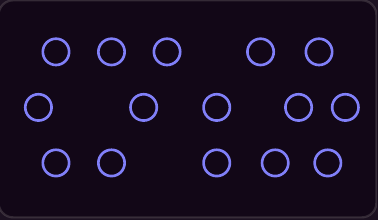
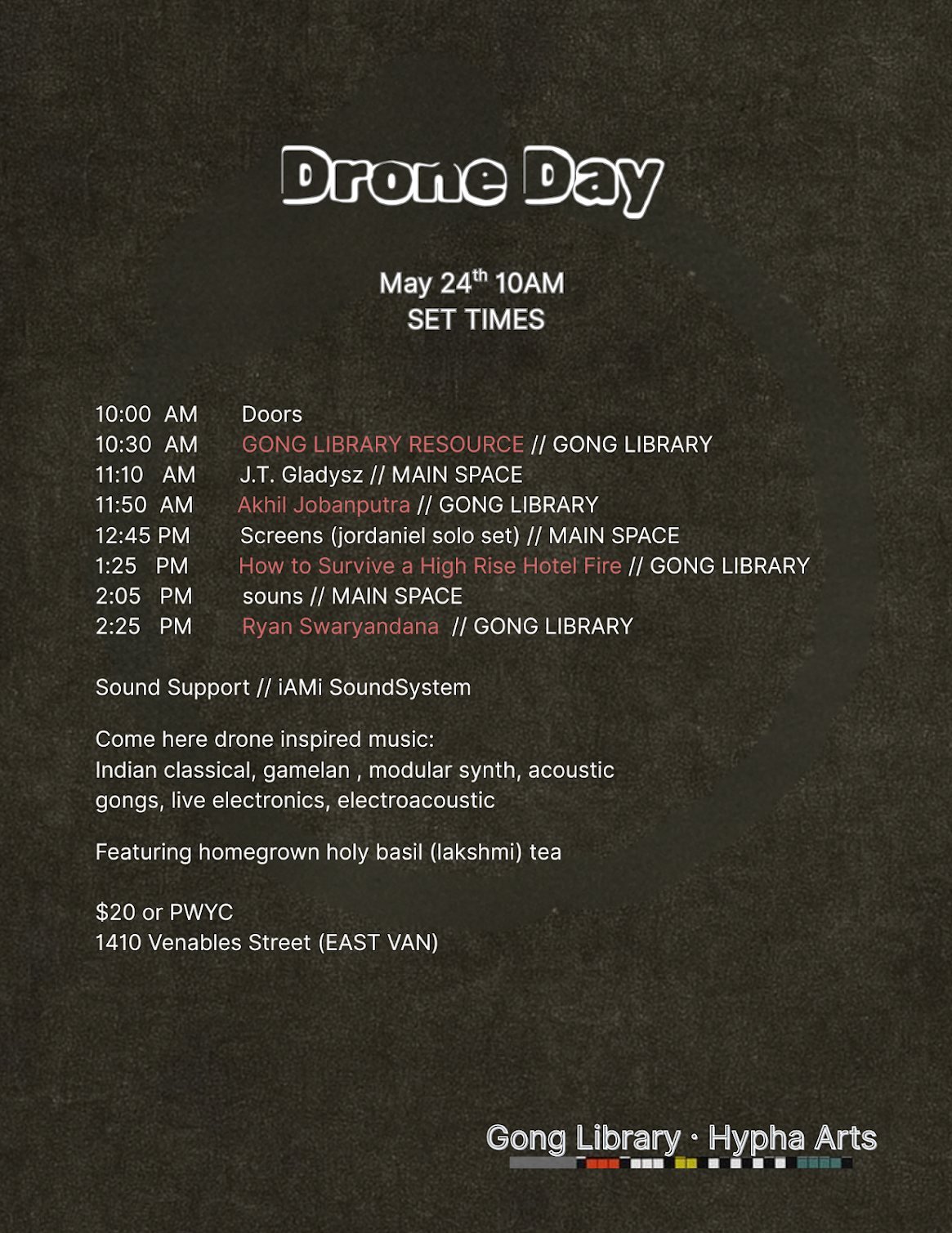
Project Statement

Designed to inject innovative interactivity into a traditional recreational sport, this project centered around the creation of a uniquely customized, art-stylized ping-pong table. The table’s visual identity was anchored by an original painting completed by a student from Byrne Creek Secondary, embedding local youth collaboration directly into the physical architecture of the piece.

To elevate the table from a visual set piece into a dynamic musical instrument, contact microphones were affixed to its underside. These sensors captured the distinctive acoustic impacts produced when balls struck the surface, processing the kinetic energy of the game into a diverse range of auditory outputs. With every strike and volley, the players actively contributed to an ever-evolving symphony of sound, transforming a standard rally into a live, rhythmic improvisation.
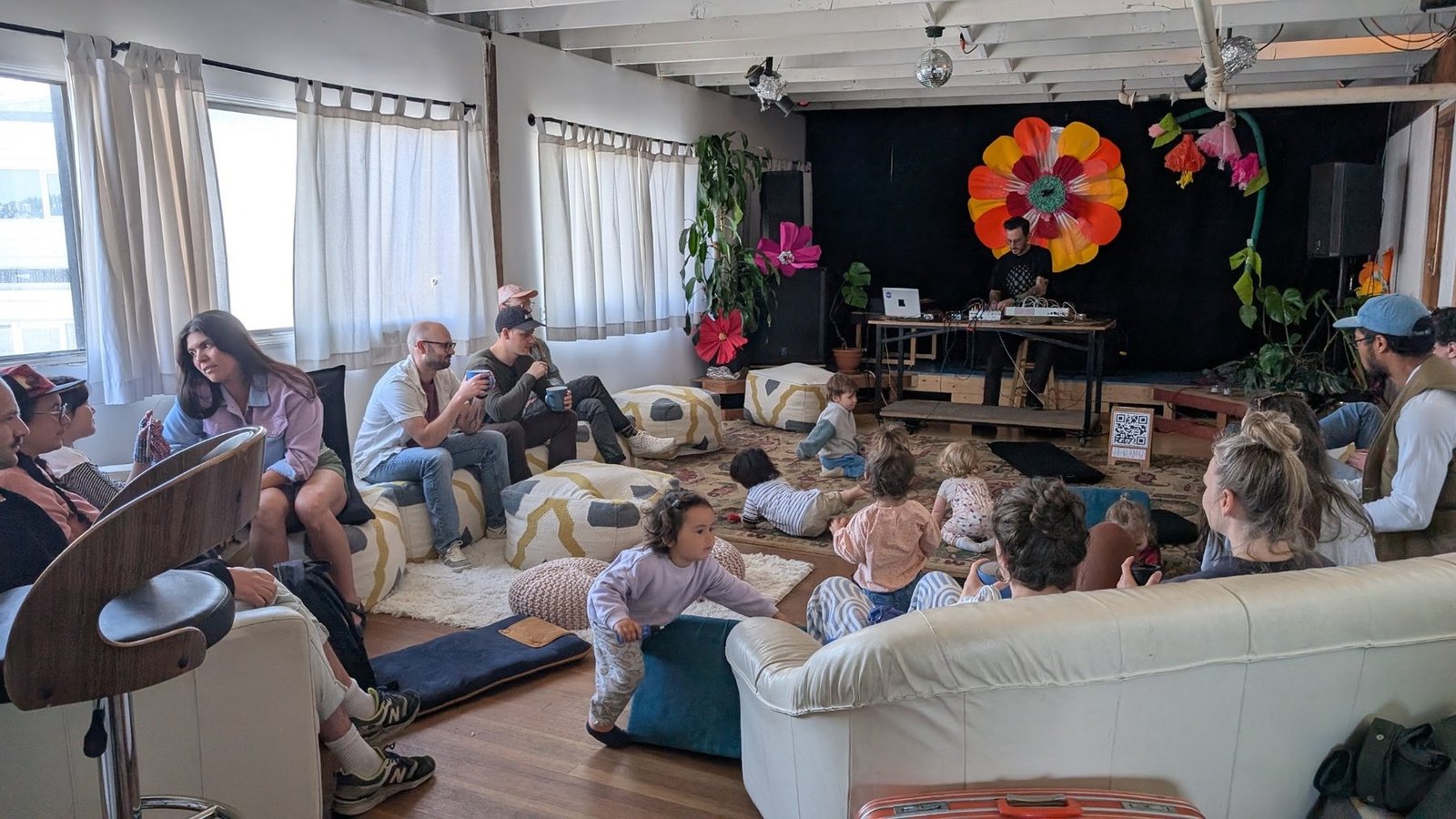
Thematic Context: Mass Participation and Relational Play

Moving beyond the auditory innovations, the project radically altered the standard rules of engagement by introducing a novel, high-capacity gameplay model. Rather than a traditional two-player format, the system was designed to accommodate mass participation, allowing up to 50 players to surround the table simultaneously.

Armed with paddles, participants engaged in a frantic, knockout-style format: successfully return a ball to the opposite side to stay in the game, or miss and be eliminated. This high-density model generated immediate unpredictability and thrill. The sheer volume of bodies crowding the table created suspense and altered the strategic dimensions of the game, as the large initial group gradually whittled down to a final pair. By merging sound, physical movement, and high-stakes communal play, the project successfully transformed a neighborhood sport into a deeply engaging piece of situational art.

Activation and Lifecycle: From Table to Gong Library

The Sonic Ping-Pong table was designed not as a static gallery object, but as a mobile community activator. Over a two-year period, it was deployed across multiple Vancouver environments. It saw recurring use at Byrne Creek Secondary, engaging the very student body that helped design it, and was used in the installation at Musical Playground, an interactive event operated by Publik Secrets.

Aligning with the Temporary Frames ethos of material reclamation and impermanence, the installation was never meant to last forever. After two years of use, the table was decommissioned. Rather than entering the waste stream, the materials were upcycled and re-fabricated into custom wooden benches. These benches now reside permanently in the Gong Library, continuing to provide grounding and support for the community in an entirely new form.

Documentation

Archival photographs from Sonic Ping-Pong, including fabrication, activation, and material afterlife.

Two upright painted panels for the Sonic Ping-Pong project stand in a workshop during fabrication.
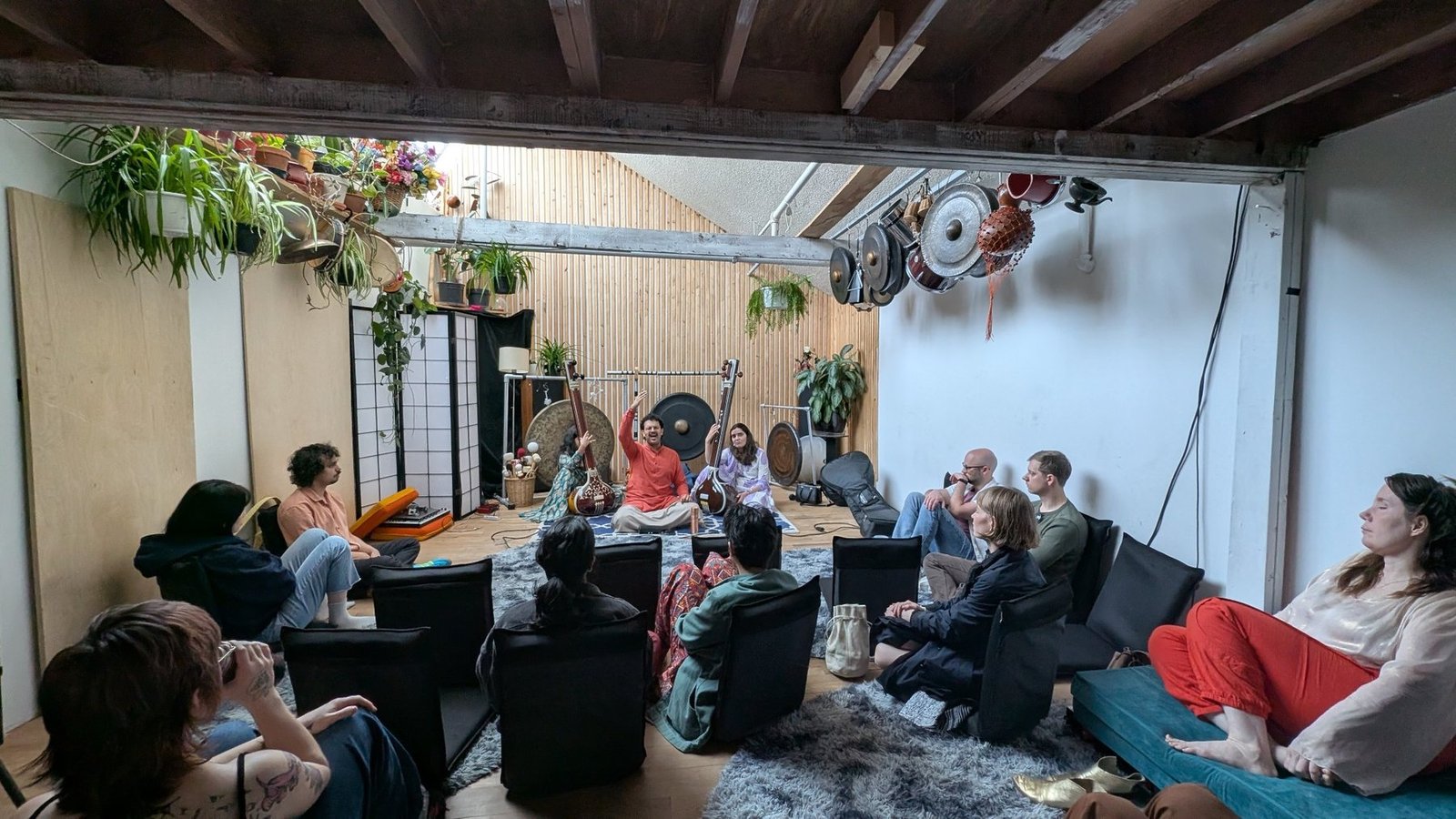
Painted table panels during fabrication.
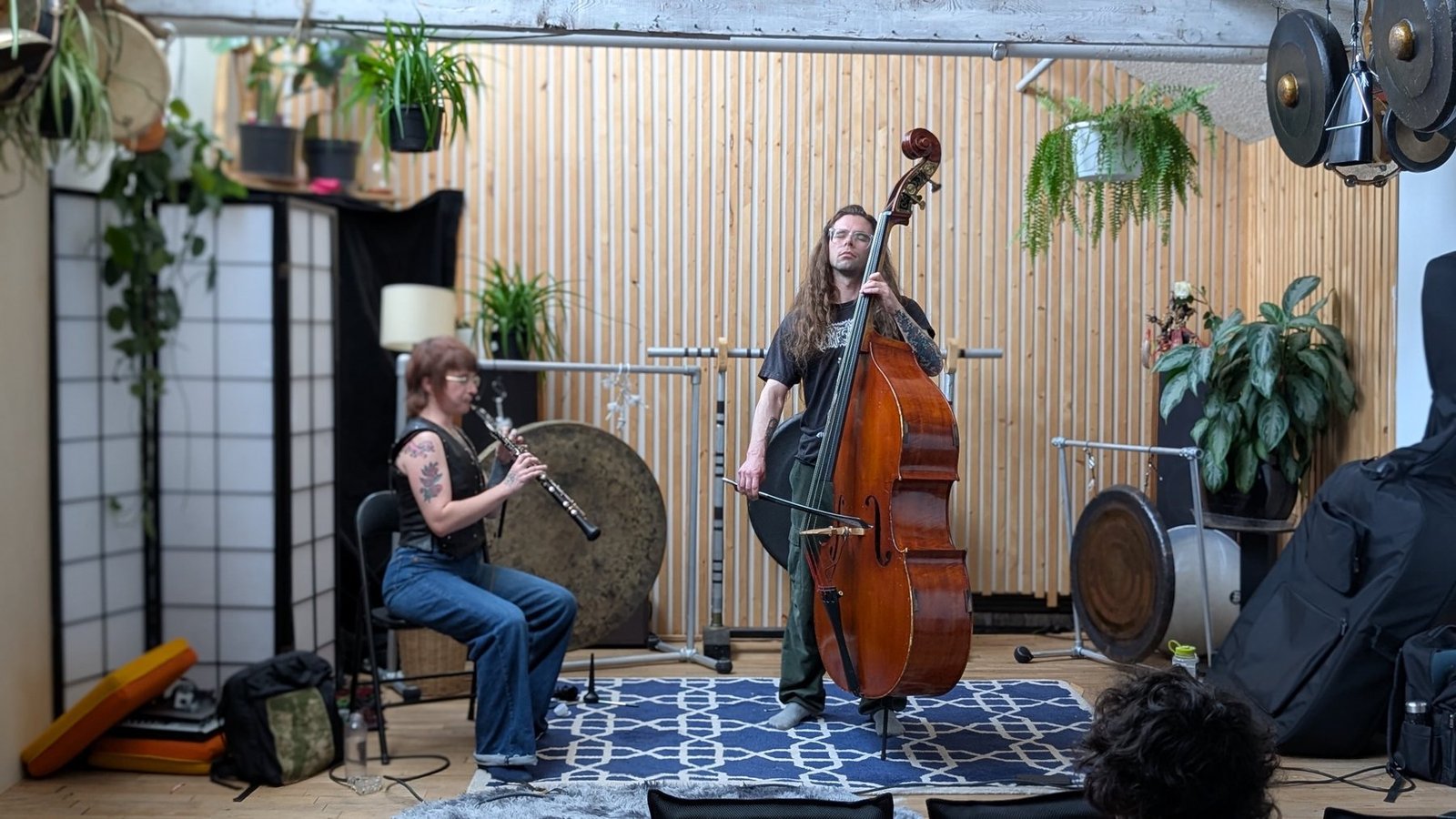
Students gather around the Sonic Ping-Pong table during a live activation in a school common area.
Sonic Ping-Pong activated at Byrne Creek Secondary.
Custom benches built from the decommissioned Sonic Ping-Pong table materials inside the Gong Library.
Upcycled benches made from the project materials.
Participants play Sonic Ping-Pong together during an indoor community activation.
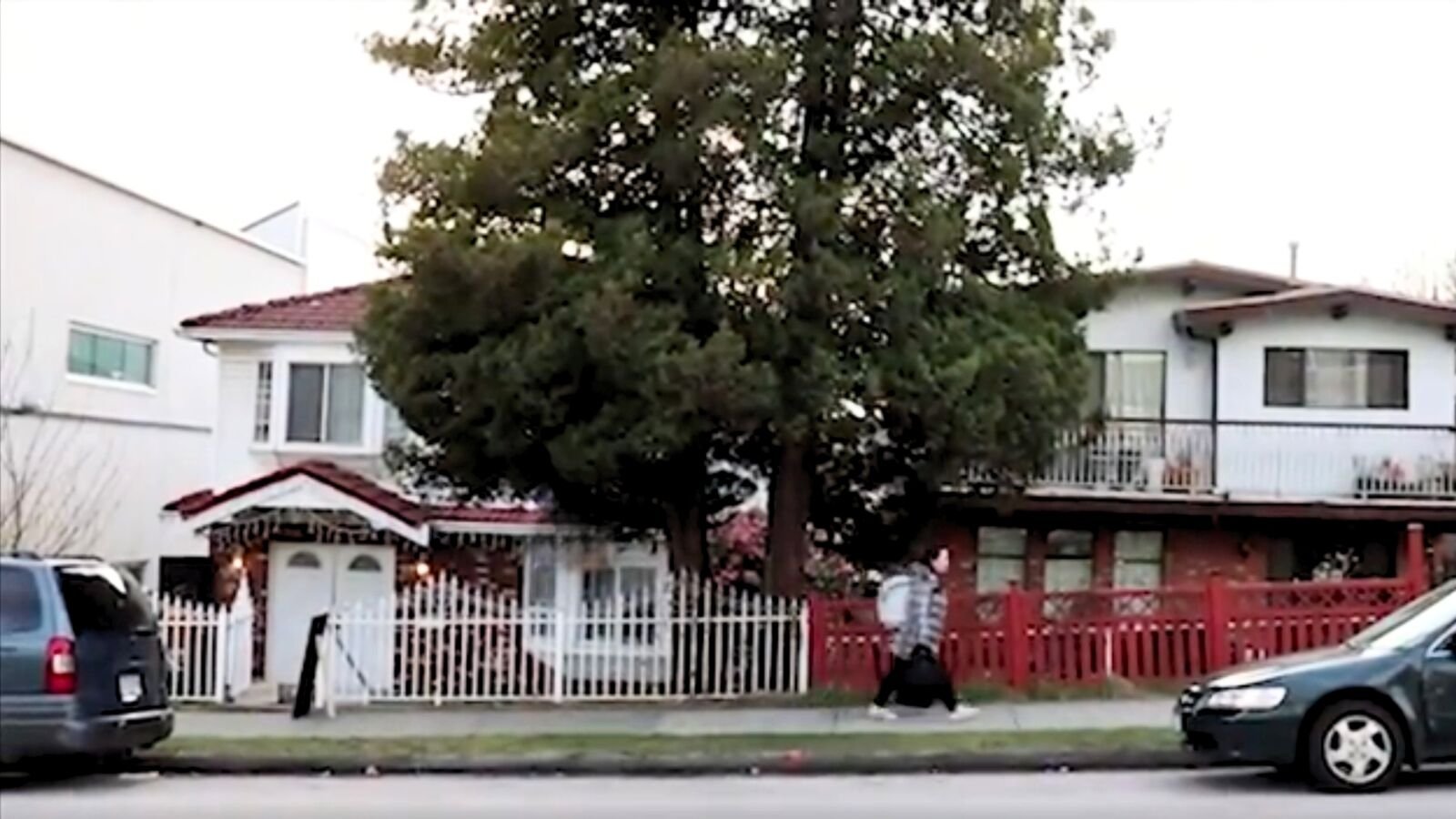
Community gameplay during an indoor activation.
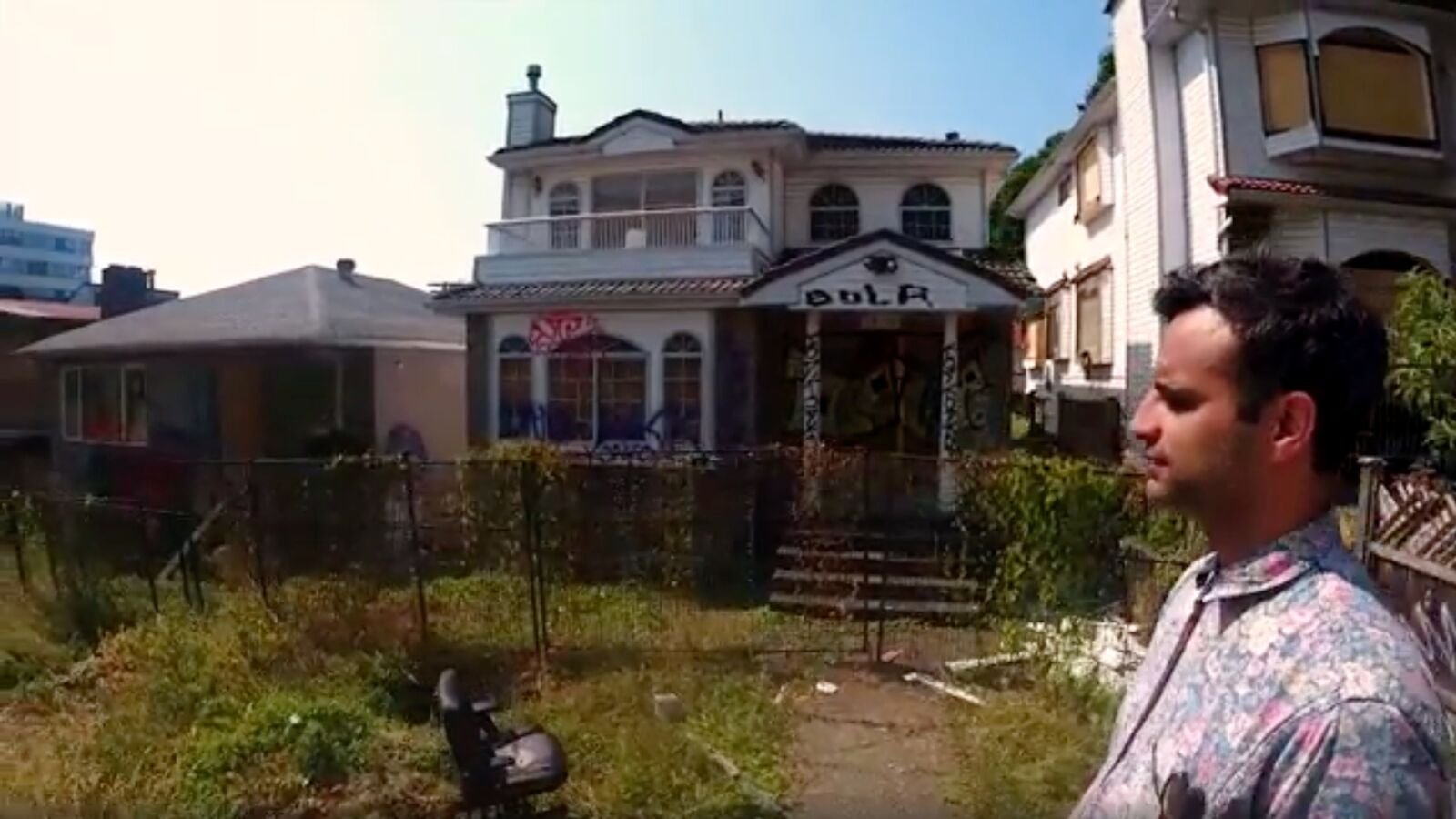
The Sonic Ping-Pong table is activated outdoors on a public sidewalk with passersby nearby.
Public sidewalk activation of Sonic Ping-Pong.

PRES-003listening / community · completed

Plant Listening Show

Record

Record no.
PRES-003
Status
completed presentation
Presentation
A Temporary Frames Arts Society presentation
Produced by
Kate Kennedy and Raj Gill
Hosted at
The Gong Library, Hypha Arts, Vancouver, BC
Music
Raj Gill, featuring sounds from Jessica Gabriel
Timeline
Inaugural event for the Temporary Frames space at Hypha Arts
Format
Listening event / plant-care exchange

Overview

The Plant Listening Show, co-produced by Kate Kennedy and Raj Gill in partnership with Hypha Arts, was the inaugural event for the Temporary Frames space at Hypha Arts. The gathering combined a dedicated listening environment with an informal plant-care and exchange space, inviting participants to attend with their houseplants.

Music by Raj Gill, incorporating sounds contributed by Jessica Gabriel, was presented in the listening room. Tulsi (Holy Basil) plants grown in advance of the event served as a recurring botanical element: fresh Tulsi tea was shared with attendees, while participants were also invited to bring plants for repotting, propagation, care, or exchange.

Spatial Curation

Hypha Arts Main Space — Social Hub & Plant Care

The main Hypha Arts space functioned as the active social area. Participants could talk, exchange clippings, propagate, and repot plants while sharing practical plant-care knowledge.

Temporary Frames Listening Room

The Temporary Frames room was maintained as a quiet listening area with cushions, mats, and sofas. Attendees and their plants could settle into the room for the music without the conversational activity of the main space.

Presentation Context

As the first activation of the Temporary Frames space at Hypha Arts, the event established a two-room model that paired social participation with focused listening. Its plant-centered format brought music, informal ecological care, and community exchange into the same event without requiring them to function as a conventional concert or workshop.

The presentation also extended the invitation to listen beyond the human audience by explicitly welcoming plants into the room, using a playful multispecies frame to encourage attention to care, environment, and shared space.

Writing

Essays and artist texts that extend the conceptual, philosophical, and somatic inquiries held within Temporary Frames projects.

Essays & artist texts

  • WR-001 The Genesis of the Wheel of Time Gallery and My Mental Institution Raj Gill A first-person reflection on impermanence, art as lived experience, perceptual habits, clowning, and the final exhibition at the Wheel of Time Gallery. essay / artist statement

WR-001essay / artist statement · Raj Gill

The Genesis of the Wheel of Time Gallery and My Mental Institution

Record

Text no.
WR-001
Author
Raj Gill
Form
Essay / artist statement
Related project
Wheel of Time Gallery — My Mental Institution
Themes
Art as lived experience; impermanence; intuition; clowning; perception; duration; eternal return

The final exhibition

The last show, before the teardown.

My Mental Institution was a solo exhibition staged during the final two months before the house was demolished. COVID-19 gathering restrictions transformed a planned group show into a solitary, site-specific work. Drawing on my training in physical theatre and clowning, and on a formative encounter at a mental health facility, the exhibition explored “editions of reality”: the loops we inhabit, the patterns that become automatic, and the self as both prisoner and director of its own institution.

The work was later preserved as a virtual tour. What follows traces the longer experiential and philosophical path that led to the Wheel of Time Gallery and its final exhibition.

Art as Experience

In 2018, our artist collective was searching for a place to live and work. We found a Vancouver Special scheduled to be demolished for a new apartment development. We were told that we might have one or two years in it.

My first encounter with the house revealed more than a structure. It held latent imaginative possibilities—the sort of shift in perception through which Cervantes’s Don Quixote could impose a romantic vision upon the ordinary world. The dreamer’s disease. These are the high-energy games fantasy-prone artists play. Walking through those soon-to-be temporary frames, I felt the familiar Vancouver narrative of the teardown house open into something else. A housing form that had defined an era was taking its turn in the dance of impermanence.

The house’s approaching destruction became the condition I annealed to. It offered a chance to follow the life and death of a place: to celebrate it, to let it work on me, and to work on it in return. It became a resonating chamber through which mythos, eros, and the muses could move. The developer gave us permission to do what we wished with the property, and the house began to resemble Hakim Bey’s “Temporary Autonomous Zone”—a provisional space in which creative freedom can arise outside ordinary restrictions.

Displacement is a recurring condition for Vancouver artists and renters. This was my third experience of being uprooted. The house came to embody that collective struggle, but it also posed another question: could a building awaiting demolition become an instrument of social, personal, and artistic engagement? Could it hold moments of play within the habituated structures of everyday reality?

Henri Bergson understands life as continuous movement, composed of moments that are genuinely new and unforeseen. That possibility matters: each moment may carry an opening toward something different. Art gave us permission to treat the house as a living canvas and a mandala—to rework, rewrite, and reimagine a familiar narrative.

The project made little conventional sense. There was no funding source or clear monetary value, only an investment of time, labour, and attention that disrupted ordinary domestic life. Its value lay in the experience itself. John Dewey’s Art as Experience argues that an artwork cannot be separated from what it does within lived experience. That distinction became central to the gallery. Art did not need to sit apart from life on a pedestal; it could emerge through the ways people inhabited, altered, and encountered a place together.

Why could a bedroom not become a gallery? Why could installations not take over its halls? Opening the house as a place for art and art-making softened the separation between the artwork, the artist, and the experiencer. The building was not merely a container for finished objects. It became an active participant in a collective process.

The House and the Inspiration

There are moments of intuition when an essence seems to reveal itself—when a resonance with a subject or material exceeds familiar techniques and concepts. Artists sharpen their tools, but they also attune themselves to the sources from which creation arrives. We cannot predict where that contact will happen. When it does, there is a rhythm that allows the work to unfold, at least until the mind interrupts it.

Bergson’s concept of duration, or durée, offered language for this process. Lived time is not a row of static segments; it is fluid, qualitative, and indivisible. Intuition enters an experience without first breaking it into analytical pieces. With the house, I found myself following that kind of unfolding—listening for the meaning that might guide the work before I could fully explain it.

A chance encounter with the Kalachakra, the “Wheel of Time” Tantra, at the Dorje-Ling Dharma Centre opened a cyclical path. The Kalachakra mandala became a powerful symbolic representation of time, while the construction and dissolution of a sand mandala revealed the impermanence of all material forms. The house could be approached in the same way: as a temporary, collective form whose eventual destruction was not a failure of the work but part of its meaning.

Ron Fricke’s film Samsara, a visceral meditation on the movement and transience of existence, deepened this connection. Its image of Buddhist monks constructing and then dissolving a sand mandala crystallized what had already begun to move through the project. The house became a living mandala. Each brushstroke, performance, conversation, and gathering participated in its changing form.

My Mental Institution: Editions of Reality

During the final two months before demolition, COVID-19 restrictions made the planned group exhibition impossible. The show shifted into a solo work, and the isolation of the period entered the exhibition as both circumstance and subject.

In 2005, while taking an experiential course in human development, I volunteered at a mental health facility as part of an exercise. We were asked to dress as clowns, spend time with residents, and “bring joy.” I was uneasy. I worried that the gesture could be demeaning, and I carried my own biases about clowning as lowbrow, frightening, or absurd. I nevertheless participated.

The day was joyful and complicated. We listened, sang, shared jokes, and met people who responded to our presence in very different ways. I perceived repetition in some interactions—small scenes or gestures that seemed to return again and again. Looking back, I recognize that this perception was mine: partial, situated, and incapable of explaining another person’s interior reality. The ethical turn of the later exhibition was therefore not to diagnose the residents I had met, but to direct the question toward myself. What repetitions structure my own life? Which of my realities have become so practiced that I no longer notice them?

Clowning offered a way to hold that inquiry. Clown is a slippery term with theatrical, folk, social, and ceremonial lineages across many cultures. It can entertain, reveal, subvert, and reorganize the relationship between a performer and the world. My physical-theatre and clown training became a method for meeting the present event before it settled into a familiar explanation.
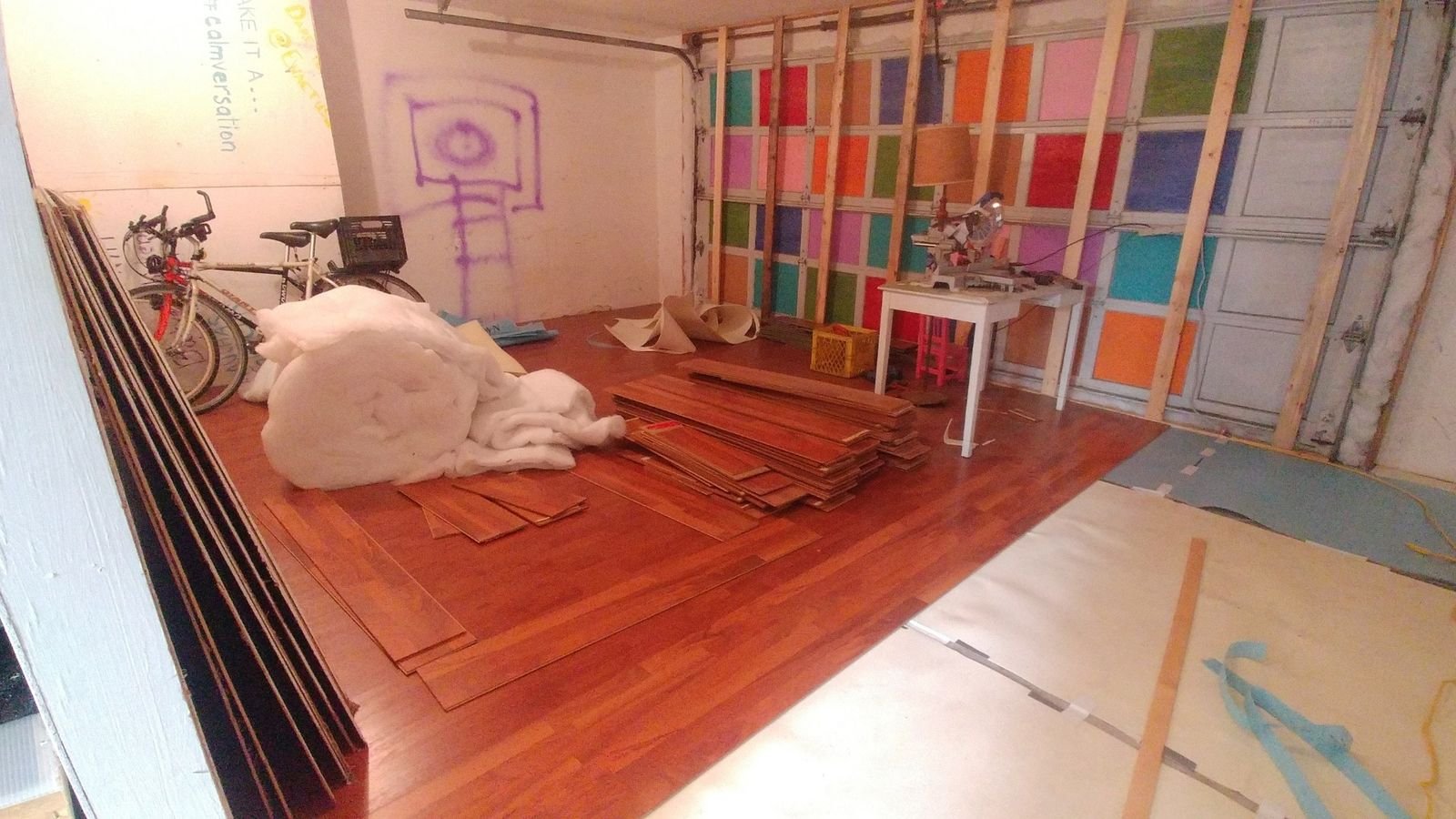
David MacMurray Smith’s Considerations for Clownology describes degrees of perceptual “edits”: ways experience is organized into intelligible reality.

  • The Present Event — apparent chaos: phenomena before they have been categorized through memory and association.
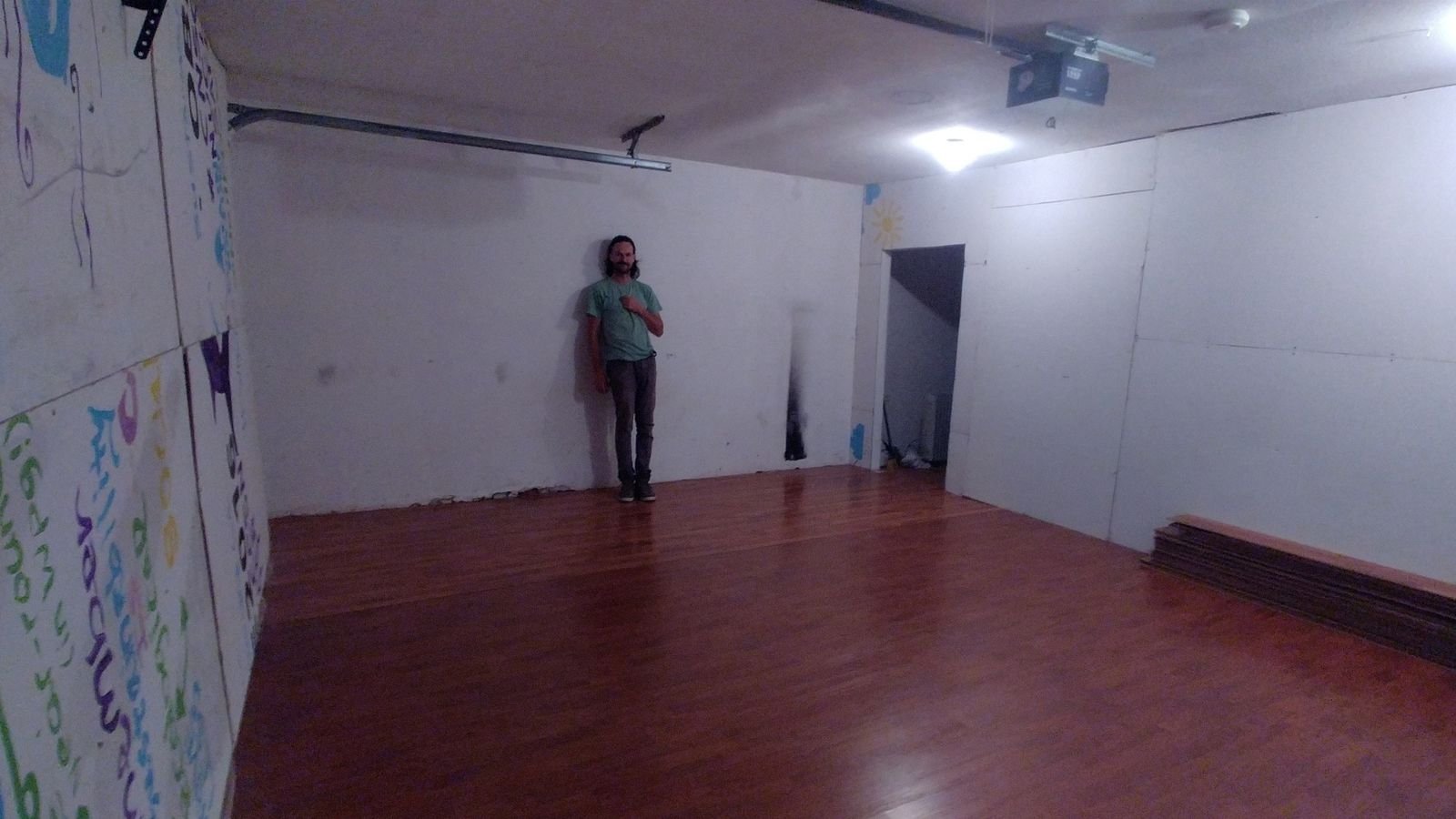
  • Edit 1 — perception: sensory experience organized through sight, sound, taste, touch, and smell.
  • Edit 2 — meaning / cognition: perception associated with memory, category, and relative value.
  • Edit 3 — predictability / repeatability: patterns recognized as recurring and potentially governed.
  • Edit 4 — institutionalization / ritualization: a repeated pattern practiced until it becomes pre-conscious—an automatic routine.
  • Edit 5 — reordering through predictability bypass: an encounter that does not fit the existing pattern and can open a new awareness.

The framework gave me a language for asking how perception becomes habit and how habit begins to masquerade as reality. Clowning can introduce the predictability bypass: surprise, failure, or an impossible event that interrupts an automatic edit and briefly returns the performer to the unknown.

When I converted my bedroom into a gallery, I felt a strong impulse to paint everything white—the ceiling, walls, and floor. Sitting alone in the completed room, I encountered a cosmic joke: a trained clown inside a self-constructed asylum. The room echoed a familiar cultural image of the padded cell, but its institution was not somewhere outside me. It was a theatrical frame for observing the loops I had built within myself.

I may experience myself as agentic and independent, yet I also live through innumerable recurring edits: the route I take, how I drink water, how I brush my hair, and the larger emotional or relational patterns that can repeat across years. Which habits support life, and which ones narrow it? When does conditioning speak through what I call choice? Where might a different choice become possible?

Questions of potential—what am I, how am I, who am I—followed me from younger years marked by strife and contradiction. I learned to notice cultural, social, familial, and biological conditioning, along with the limits it seemed to place upon me. I longed for change while watching certain feelings and situations recur in spirals. My Mental Institution gave those spirals a room, a body, and a frame in which they could be witnessed.
The self within the exhibition was therefore double: the figure caught inside recurring patterns and the observer capable of noticing, editing, or redirecting them. The institution was both spatial and internal. It held the possibility that awareness itself might become a doorway.

The Eternal Return: The Wheel of Time

Friedrich Nietzsche’s eternal recurrence asks us to imagine that every event in our lives will return, in every detail, without end. Whether read as cosmology or as an existential thought experiment, it places an immense weight upon the present: if this life were to repeat eternally, how would I choose to live it?

Harold Ramis’s film Groundhog Day gives the question a comic form. Phil Connors wakes into the same day over and over. He moves through cynicism, hedonism, manipulation, despair, and eventually care. The loop becomes a laboratory in which he tries out editions of reality until a more meaningful relationship to life can emerge.

The Wheel of Time Gallery existed inside its own visible cycle. We entered a house already marked for disappearance, transformed it through seven exhibition cycles, and watched it move toward demolition. My Mental Institution became the final turn of that wheel: a room about repetition inside a house whose ending had always been present.
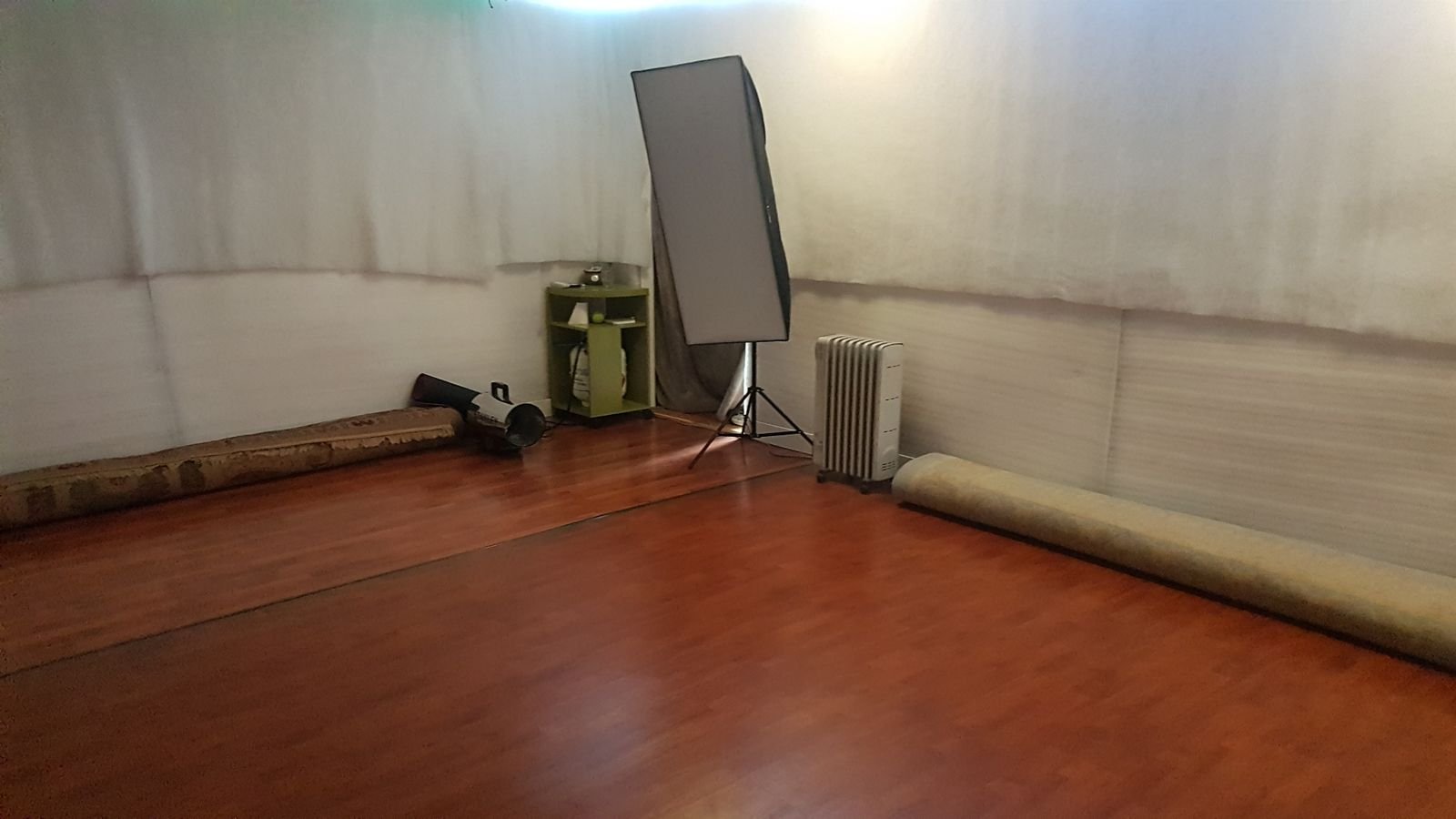
The destruction of the building did not sit outside the artwork. It completed it. What remained was not the permanent object but the experience carried by the people who passed through, the practices that continued into Temporary Frames, and the digital trace of a final room before it vanished.

References & Notes

  • Bey, Hakim. T.A.Z.: The Temporary Autonomous Zone, Ontological Anarchy, Poetic Terrorism. 1991.
  • Bergson, Henri. Writings on duration and intuition.
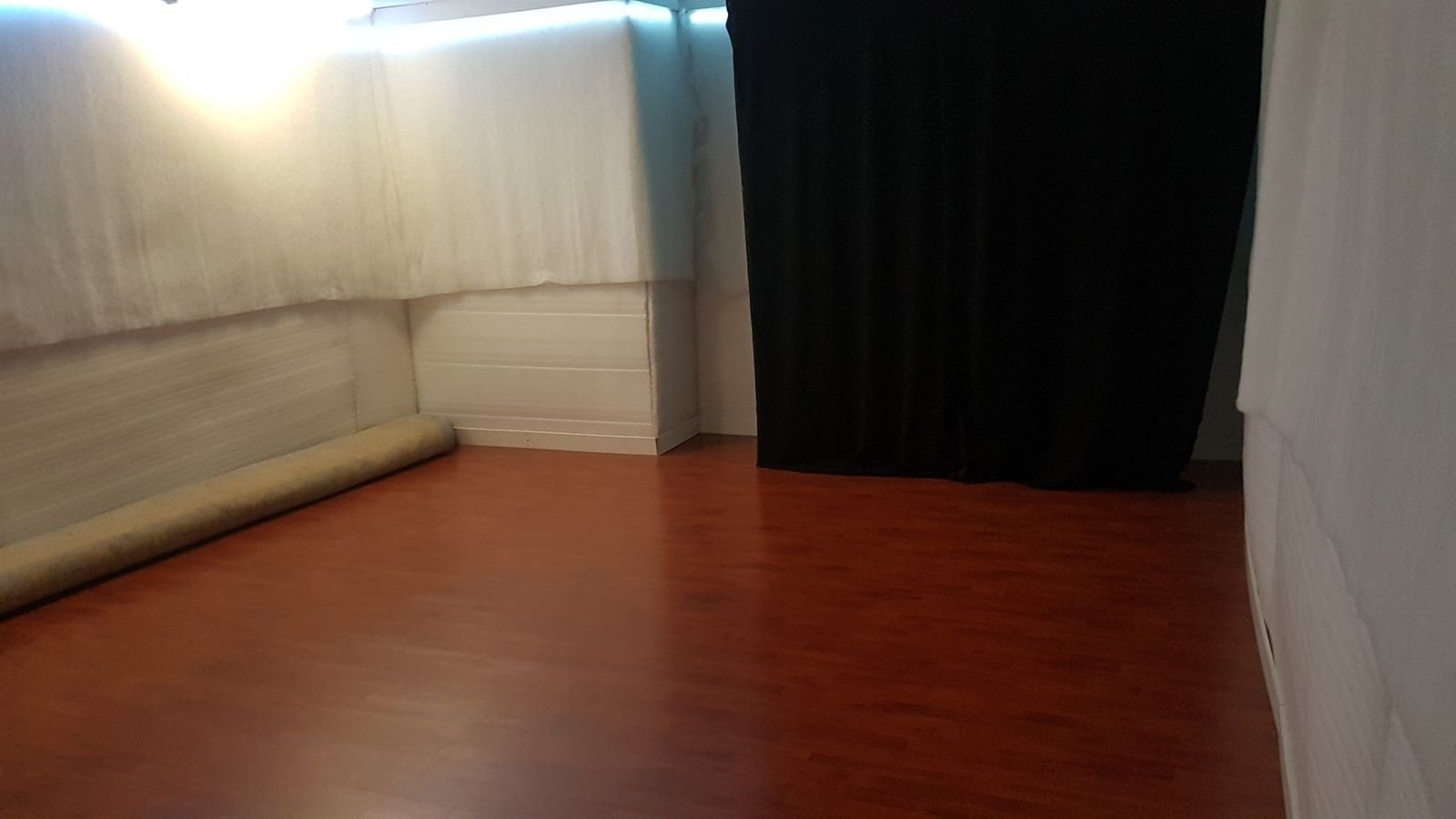
  • Dewey, John. Art as Experience. 1934.
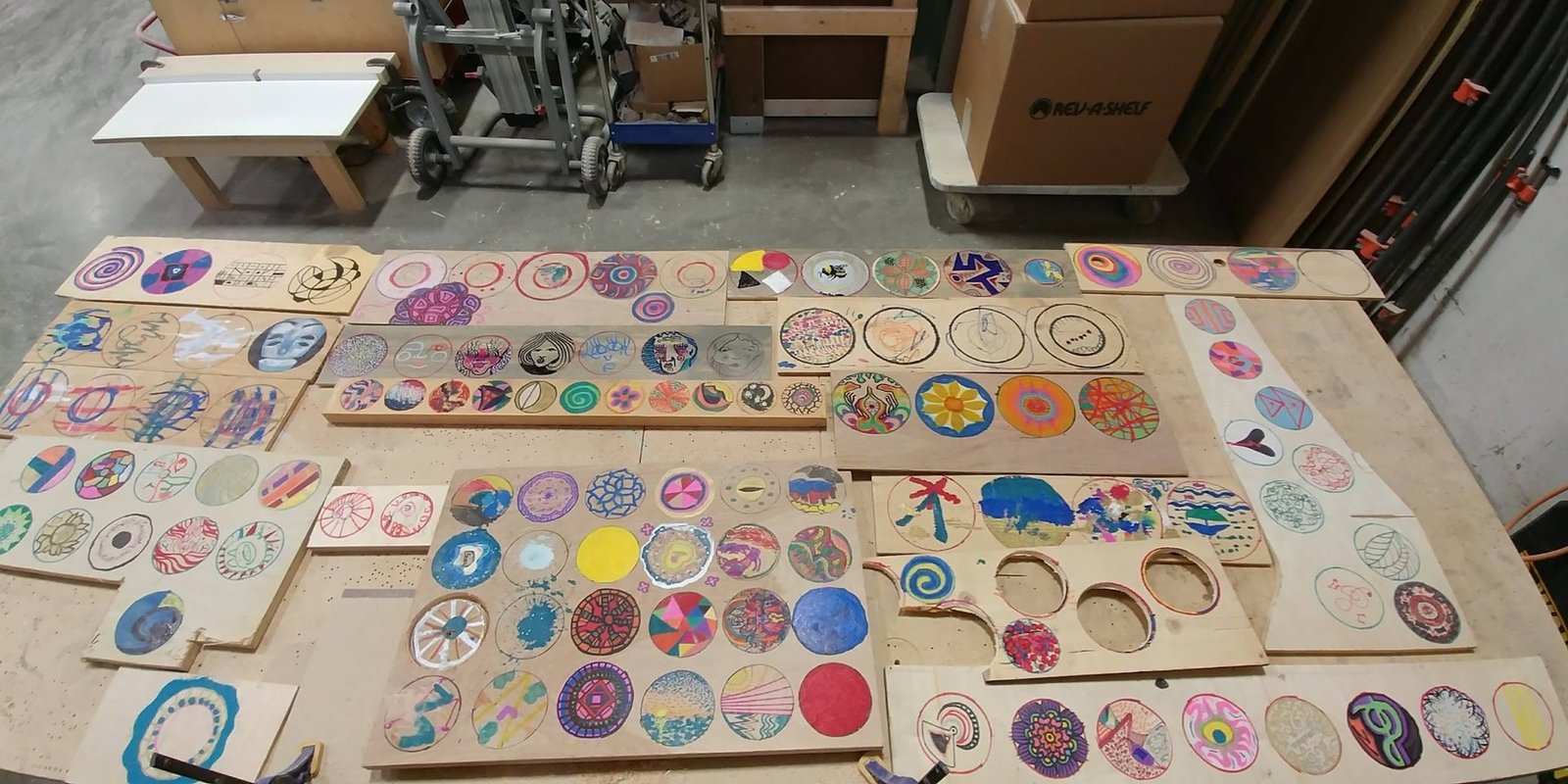
  • Fricke, Ron, director. Samsara. 2011.
  • MacMurray Smith, David. Considerations for Clownology. Pedagogical framework on perceptual editions of reality.
  • Nietzsche, Friedrich. The Gay Science, aphorism 341, “The Greatest Weight.” 1882.
  • Nietzsche, Friedrich. Thus Spoke Zarathustra. 1883–1891.
  • Ramis, Harold, director. Groundhog Day. Columbia Pictures, 1993.
  • Towsen, John H. Clowns. Hawthorn Books, 1976.

Related project

Return to the Wheel of Time Gallery and My Mental Institution project record →

Support Material and TEAM

A concise organizational, team, and project record for grant assessors, curators, programmers, and potential partners. The linked pages contain full descriptions, collaborators, histories, and documentation.

Organisational record

Organisation
Temporary Frames Arts Society
Status
Registered non-profit arts organization
Founded
2017
Based
East Vancouver, BC, Canada
Fields
Live sound; immersive performance; sound installation; clown and performance; meditative states; participatory and relational art
Project record status
4 active or episodic projects; 4 archived or concluded collections and projects
Practice areas
Deep Listening; Sound; Clown; Performance
Collaborative network
See the Artists & Collaborators directory below.
Presentations & co-productions
5 documented presentation records
Project-specific support
Creative BC; European Union DigiScore grant; ArtStarts; City of Vancouver CASC grant

TEAM & governance

Executive & Artistic / Creative Director
Raj Gill
Program Director
Tyrell Warren
Managing Director
Miel Nicholson
Current Board of Directors
  • Matthew Ariaratnam
  • Suna Galey
  • Raj Gill

Artists & Collaborators

Named artists, musicians, curators, producers, designers, mentors, and artist collectives documented across Temporary Frames projects and presentations. Some early records credit additional participants collectively or by first name only.

  • Aaron Friend Lettner
  • Adrian Avendaño
  • Aiden Ayers
  • Akhil Jobanputra
  • Al Lafrance
  • Anastasia Qualia
  • Anwar Nasar
  • Ben Wylie
  • Brad Pearson
  • Caroline Ballhorn
  • CEASE WYSS
  • Chloé Ziner
  • Cory Thibert
  • Craig Irvin
  • creamyskeleton
  • Daniel Majer
  • David MacMurray Smith
  • Denise Fort
  • DJ Bloomer
  • Dr. Ken Fields
  • Dumbpop
  • E.A. van Wyk
  • Eli Muro
  • Emily Lisa
  • EZ.NAIVE
  • Filiz Fuchs
  • Grace Fournier
  • Haley Bird
  • Harley Small
  • Irene Senent
  • Jaanum Jaswani
  • Jacob Oudshoorn
  • Jen Yakamovich
  • Jessica Gabriel
  • Jimi James Fraser
  • Jordaniel Bennett
  • Joss Sánchez
  • Joylyn Secunda
  • J.T. Gladysz
  • Juwan Stockton
  • Kate Kennedy
  • Katrina Kollmann
  • Kayla de Vos
  • Kiefer McQuillan
  • Laine Butler
  • Lee Gerlach
  • Linnea Gwiazda
  • Malou Uptmoor
  • Marcelo Vieira
  • Margo
  • Marie Whimbey
  • Matthew Ariaratnam
  • Max Huberdeau
  • Michael Red / SOUNS
  • Michael Undem
  • Michelle Whimbey
  • Miel Nicholson
  • Mind of a Snail
  • Nayanna Fielkov
  • Nathaniel Justiniano
  • Neo Oslund
  • Nico Woodward
  • Nicolás Segura
  • Nikko Whitworth
  • PESEWA
  • PIU
  • Putu Swaryandana / Ichi Oka
  • Raj Gill
  • SEEKERS INTERNATIONAL
  • Slime Studio
  • Sumwun
  • Suna Galey
  • Sydney Thorne
  • Tarun Nayar
  • Taylor Ray
  • The Baker
  • The Kids Castle collective
  • Tito Ohep
  • Tom Cryan
  • Tyrell Warren
  • Valerie Comic
  • William Singh
  • XIUMEI
  • Zachary Schroeder

Active project records

  • TF-001 — The Gong Library · active · 2023–
  • TF-002 — Imaginal Airlines · active · 2025–
  • TF-006 — International Drone Day · active / episodic · documented iteration 2025
  • TF-007 — Temporary Frames Artist Residency · active / ongoing · 2018–present

Practice area records

  • Deep Listening · ongoing sound / listening / spatial practice
  • Clown Working Group · active / ongoing · 2024–present

Archive & concluded records

  • TF-000 — Wheel of Time Gallery · concluded · 2018–2021
  • ARC-001 — Interactive Community Arts · archived collection · 5 project records
  • ARC-001.1 — GLYPH YO’ SELF · 2018–2021
  • ARC-001.2 — SRI YANTRA // KIDS CASTLE MANDALA · archived
  • ARC-001.3 — CARDBOARD DAY · archived
  • ARC-001.4 — SHADOWJAM WITH MIND OF A SNAIL · 2018
  • ARC-001.5 — SONIC PING-PONG: INTERACTIVE TABLE TENNIS · two-year public activation
  • ARC-002 — Quiet Night Series · 2017–2020
  • ARC-003 — CLOUD Studio · concluded following demolition

Presentation records

  • Presentations & Co-Productions · ongoing programming
  • PRES-001 — E.A. van Wyk, Bruised Butterfly Book Launch · completed · 11 Jul 2025
  • PRES-002 — Aaron Friend Lettner, Book of Light · completed · Oct 2024
  • PRES-003 — Plant Listening Show · completed · inaugural presentation at the Gong Library, Hypha Arts
  • PRES-004 — Michael Red, Deep Listening Sound Sessions · completed series · Feb–Mar 2026
  • PRES-005 — AMBIENT/ETC — OUTDOOR EDITION 001 · completed co-presentation · 6 Sep 2025